Department of Biology, Montclair State University, Montclair, NJ, 07043, USA.
Department of Biology and Werth Center for Coastal and Marine Studies, Southern Connecticut State University, New Haven, CT, 06515, USA.
Sci Rep. 2019 May 8;9(1):7078. doi: 10.1038/s41598-019-43536-5.
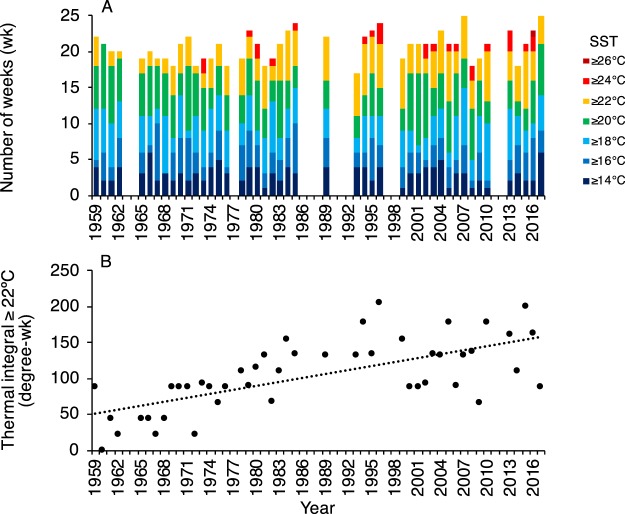
Temperate marine ecosystems globally are undergoing regime shifts from dominance by habitat-forming kelps to dominance by opportunistic algal turfs. While the environmental drivers of shifts to turf are generally well-documented, the feedback mechanisms that stabilize novel turf-dominated ecosystems remain poorly resolved. Here, we document a decline of kelp Saccharina latissima between 1980 and 2018 at sites at the southernmost extent of kelp forests in the Northwest Atlantic and their replacement by algal turf. We examined the drivers of a shift to turf and feedback mechanisms that stabilize turf reefs. Kelp replacement by turf was linked to a significant multi-decadal increase in sea temperature above an upper thermal threshold for kelp survival. In the turf-dominated ecosystem, 45% of S. latissima were attached to algal turf rather than rocky substrate due to preemption of space. Turf-attached kelp required significantly (2 to 4 times) less force to detach from the substrate, with an attendant pattern of lower survival following 2 major wave events as compared to rock-attached kelp. Turf-attached kelp allocated a significantly greater percentage of their biomass to the anchoring structure (holdfast), with a consequent energetic trade-off of slower growth. The results indicate a shift in community dominance from kelp to turf driven by thermal stress and stabilized by ecological feedbacks of lower survival and slower growth of kelp recruited to turf.
全球温带海洋生态系统正经历着从以生境形成性巨藻为主导到以机会性藻类草皮为主导的状态转变。虽然向草皮转变的环境驱动因素通常记录得很好,但稳定新的草皮主导生态系统的反馈机制仍未得到很好的解决。在这里,我们记录了北大西洋西北端巨藻林最南端的地点在 1980 年至 2018 年间巨藻的减少以及藻类草皮的取代。我们研究了草皮转变的驱动因素以及稳定草皮礁的反馈机制。草皮对海藻的取代与海温在巨藻生存的上限热阈值之上的多十年显著增加有关。在草皮主导的生态系统中,由于空间被抢占,45%的巨藻附着在藻类草皮上,而不是岩石基质上。与附着在岩石上的巨藻相比,附着在草皮上的巨藻需要明显(2 到 4 倍)更少的力才能从基质上脱落,在 2 次主要的海浪事件后,其存活率明显较低。附着在草皮上的巨藻将其生物量的很大一部分分配给锚固结构(固着器),因此生长速度较慢,从而产生能量上的权衡。结果表明,由于热应激的驱动,社区优势从巨藻向草皮转变,并通过草皮上生存能力较低和生长速度较慢的巨藻的生态反馈机制得到稳定。