Xiao Zhiguang, Sperl Bianca, Gärtner Silvia, Nedelko Tatiana, Stacher-Priehse Elvira, Ullrich Axel, Knyazev Pjotr G
Department of Molecular Biology, Max-Planck Institute of Biochemistry, Martinsried, Munich, 82152, Germany.
Department of Medicine, University of Rochester School of Medicine and Dentistry, Rochester, NY 14642, USA.
Oncotarget. 2019 Apr 2;10(26):2546-2560. doi: 10.18632/oncotarget.26817.
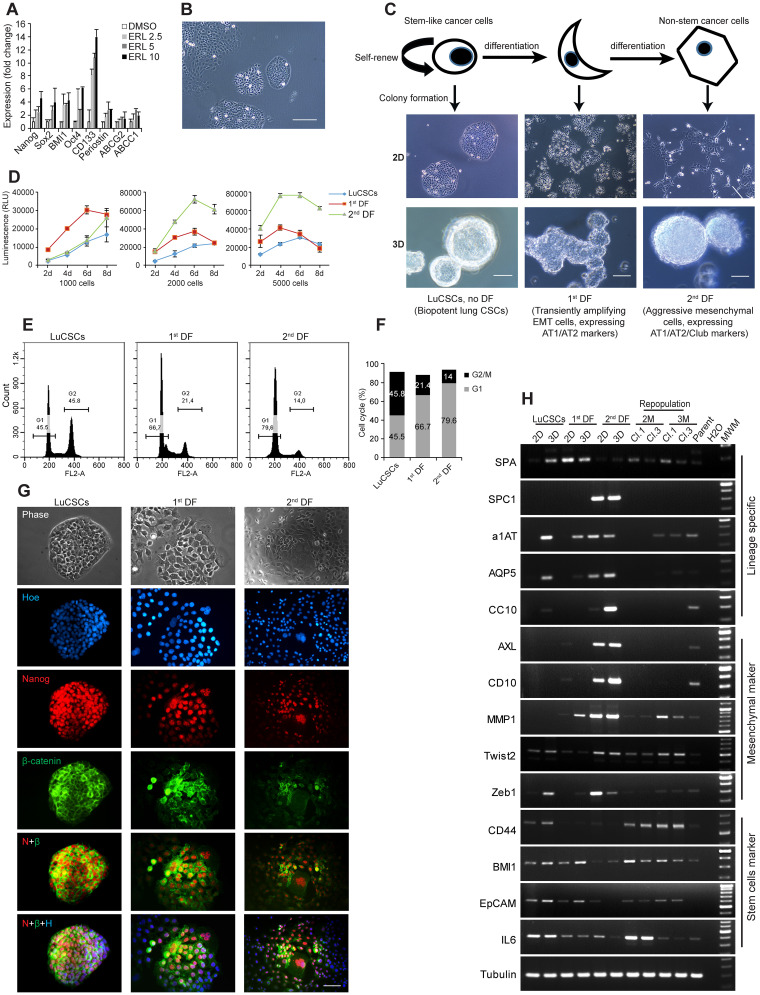
The lung cancer stem cell (LuCSC) model comprises an attractive framework to explore acquired drug resistance in non-small cell lung cancer (NSCLC) treatment. Here, we used NSCLC cell line model to translate cellular heterogeneity into tractable populations to understand the origin of lung cancers and drug resistance. The epithelial LuCSCs, presumably arising from alveolar bipotent stem/progenitor cells, were lineage naïve, noninvasive, and prone to creating aggressive progeny expressing AT2/AT1 markers. LuCSC-holoclones were able to initiate rimmed niches, where their specialization created pseudo-alveoli structures. Mechanistically, LuCSC transitioning from self-renewal (β-catenin and Nanog signaling) to malignant lineage differentiation is regulated by EGFR activation and the inverse inhibition of tumor suppressor MIG6. We further identified the functional roles of endogenous EGFR signaling in mediating progeny invasiveness and their ligands in LuCSC differentiation. Importantly, drug screening demonstrated that EGFR driving progeny were strongly responsive to TKIs; however, the LuCSCs were exclusively resistant but sensitive to AMPK agonist Metformin, antibiotic Salinomycin and to a lesser degree Carboplatin. Our data reveals previously an unknown mechanism of NSCLC resistance to EGFR-TKIs, which is associated with LuCSCs bearing a silenced EGFR and inversely expressed MIG6 suppressor gene. Taken altogether, successful NSCLC treatment requires development of a novel combination of drugs, efficiently targeting both LuCSCs and heterogeneous progeny.
肺癌干细胞(LuCSC)模型为探索非小细胞肺癌(NSCLC)治疗中获得性耐药性提供了一个有吸引力的框架。在此,我们使用NSCLC细胞系模型将细胞异质性转化为易于处理的群体,以了解肺癌的起源和耐药性。上皮性LuCSCs可能起源于肺泡双能干细胞/祖细胞,它们谱系幼稚、无侵袭性,并且易于产生表达AT2/AT1标志物的侵袭性后代。LuCSC全克隆能够启动边缘小生境,在那里它们的特化产生了假肺泡结构。从机制上讲,LuCSC从自我更新(β-连环蛋白和Nanog信号)向恶性谱系分化的转变受EGFR激活和肿瘤抑制因子MIG6的反向抑制调节。我们进一步确定了内源性EGFR信号在介导后代侵袭性中的功能作用及其配体在LuCSC分化中的作用。重要的是,药物筛选表明,EGFR驱动的后代对酪氨酸激酶抑制剂(TKIs)有强烈反应;然而,LuCSCs仅对AMPK激动剂二甲双胍、抗生素沙利霉素以及程度较轻的卡铂耐药但敏感。我们的数据揭示了NSCLC对EGFR-TKIs耐药的一种先前未知的机制,这与携带沉默EGFR和反向表达MIG6抑制基因的LuCSCs有关。综上所述,成功的NSCLC治疗需要开发一种新型的联合药物,有效地靶向LuCSCs和异质性后代。