Hsueh Brian Y, Waters Christopher M
Microbiology and Molecular Genetics, Michigan State University, East Lansing, MI, 48824, USA.
F1000Res. 2019 Apr 30;8. doi: 10.12688/f1000research.18093.1. eCollection 2019.
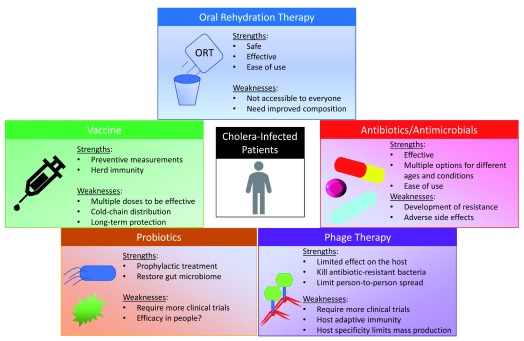
Cholera infections caused by the gamma-proteobacterium have ravaged human populations for centuries, and cholera pandemics have afflicted every corner of the globe. Fortunately, interventions such as oral rehydration therapy, antibiotics/antimicrobials, and vaccines have saved countless people afflicted with cholera, and new interventions such as probiotics and phage therapy are being developed as promising approaches to treat even more cholera infections. Although current therapies are mostly effective and can reduce disease transmission, cholera outbreaks remain deadly, as was seen during recent outbreaks in Haiti, Ethiopia, and Yemen. This is due to significant underlying political and socioeconomic complications, including shortages of vaccines and clean food and water and a lack of health surveillance. In this review, we highlight the strengths and weaknesses of current cholera therapies, discuss emerging technologies, and argue that a multi-pronged, flexible approach is needed to continue to reduce the worldwide burden of cholera.
由γ-变形菌引起的霍乱感染已经肆虐人类几个世纪了,霍乱大流行曾使全球各个角落都深受其害。幸运的是,诸如口服补液疗法、抗生素/抗菌药物以及疫苗等干预措施挽救了无数霍乱患者,而且益生菌和噬菌体疗法等新的干预措施也正在被开发,有望成为治疗更多霍乱感染的有效方法。尽管目前的疗法大多有效且能减少疾病传播,但霍乱疫情仍然致命,就像在海地、埃塞俄比亚和也门最近的疫情中所看到的那样。这是由于存在重大的潜在政治和社会经济问题,包括疫苗、清洁食品和水短缺以及缺乏卫生监测。在本综述中,我们强调了当前霍乱疗法的优缺点,讨论了新兴技术,并认为需要采取多管齐下、灵活的方法来继续减轻全球霍乱负担。