IEEE Trans Biomed Eng. 2020 Feb;67(2):471-481. doi: 10.1109/TBME.2019.2915526. Epub 2019 May 8.
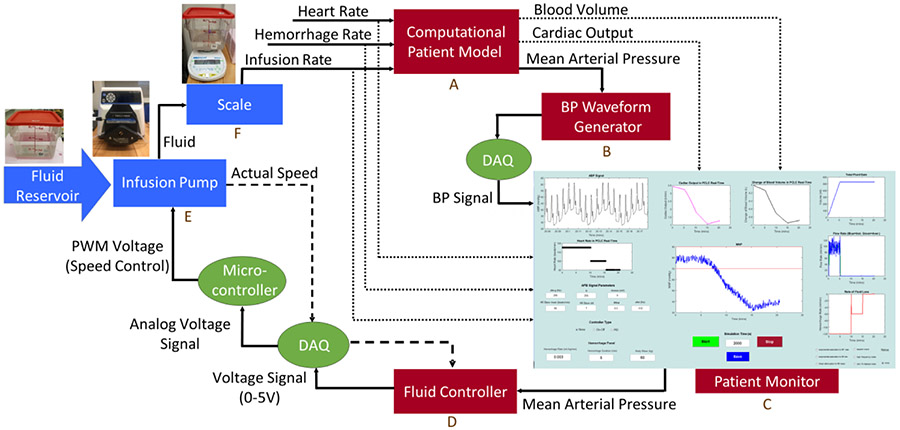
This paper presents a hardware-in-the-loop (HIL) testing platform for evaluating the performance of fluid resuscitation control algorithms. The proposed platform is a cyber-physical system that integrates physical devices with computational models and computer-based algorithms.
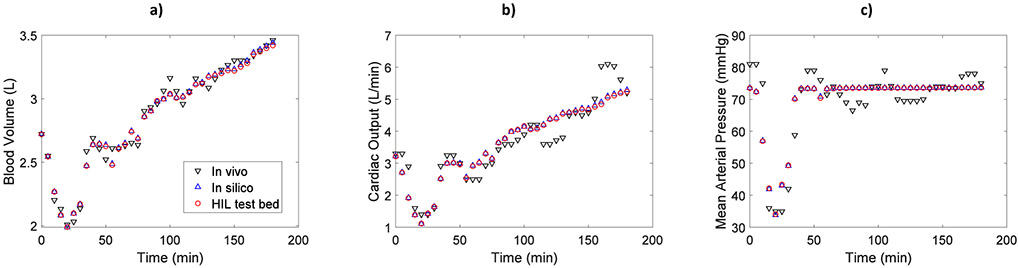
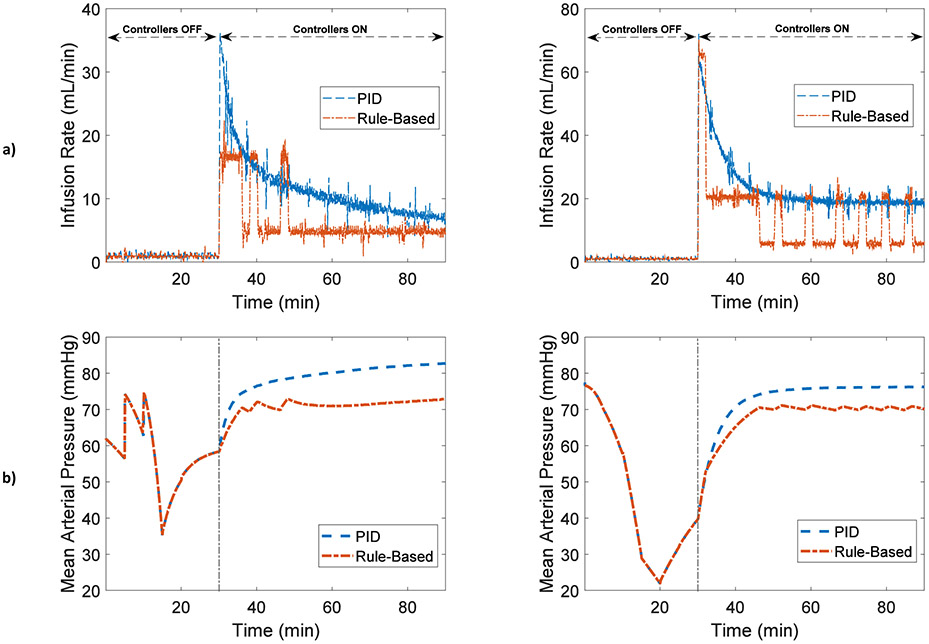
The HIL test bed is evaluated against in silico and in vivo data to ensure the hemodynamic variables are appropriately predicted in the proposed platform. The test bed is then used to investigate the performance of two fluid resuscitation control algorithms: a decision table (rule-based) and a proportional-integral-derivative (PID) controller.
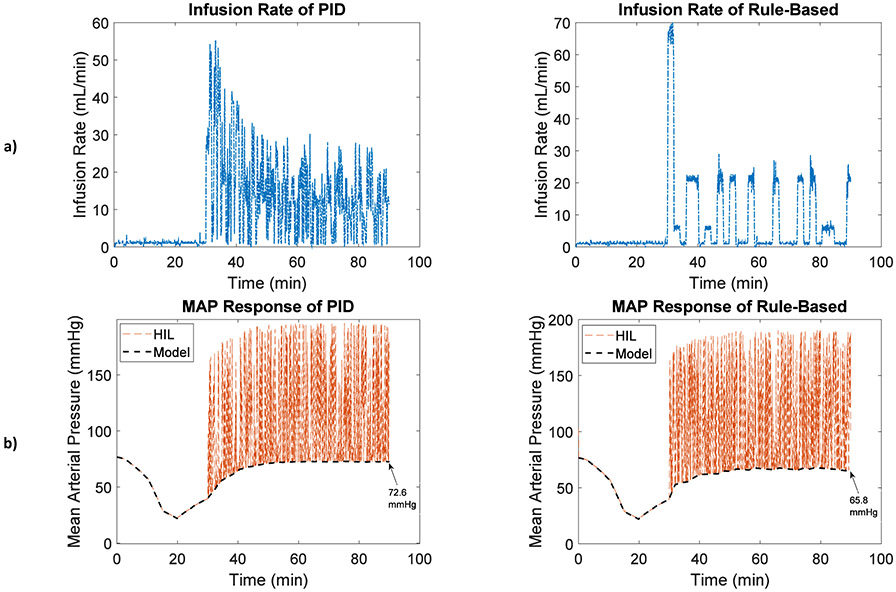
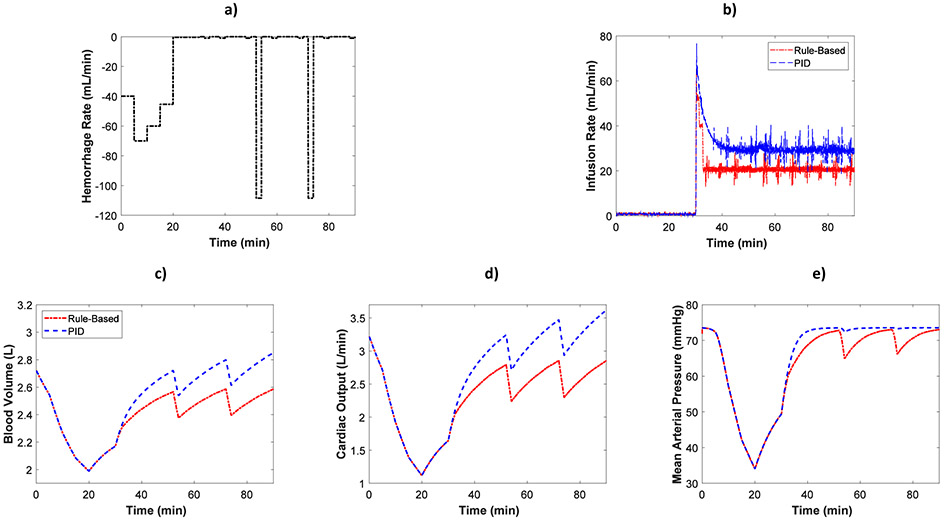
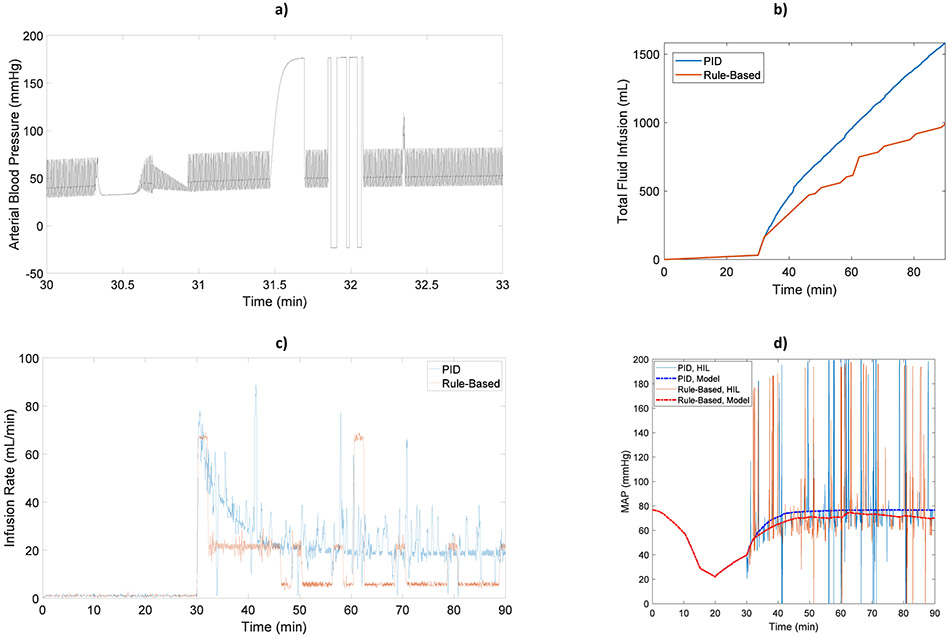
The statistical evaluation of test bed indicates that similar results are observed in the HIL test bed, in silico implementation, and the in vivo data, verifying that the HIL test bed can adequately predict the hemodynamic responses. Comparison of the two fluid resuscitation controllers reveals that both controllers stabilized hemodynamic variables over time and had similar speed to efficiently achieve the target level of the hemodynamic endpoint. However, the accuracy of the PID controller was higher than the rule-based for the scenarios tested in the HIL platform.
The results demonstrate the potential of the HIL test bed for realistic testing of physiologic controllers by incorporating physical devices with computational models of physiology and disturbances.
This type of testing enables relatively fast evaluation of physiologic closed-loop control systems to aid in iterative design processes and offers complementary means to existing techniques (e.g., in silico, in vivo, and clinical studies) for testing of such systems against a wide range of disturbances and scenarios.
本文提出了一种硬件在环 (HIL) 测试平台,用于评估液体复苏控制算法的性能。该平台是一个集成了物理设备、计算模型和基于计算机的算法的信息物理系统。
通过与计算机仿真和体内数据进行评估,确保在提出的平台中适当预测血流动力学变量。然后,使用该测试平台研究了两种液体复苏控制算法的性能:决策表(基于规则)和比例积分微分 (PID) 控制器。
测试平台的统计评估表明,在 HIL 测试平台、计算机仿真实现和体内数据中观察到相似的结果,验证了 HIL 测试平台能够充分预测血流动力学反应。两种液体复苏控制器的比较表明,两种控制器都能随着时间的推移稳定血流动力学变量,并以相似的速度有效地实现血流动力学终点的目标水平。然而,在 HIL 平台测试的场景中,PID 控制器的准确性高于基于规则的控制器。
结果表明,通过将生理计算模型与物理设备相结合,该 HIL 测试平台具有对生理控制器进行真实测试的潜力。
这种测试为生理闭环控制系统的相对快速评估提供了可能性,有助于迭代设计过程,并为测试此类系统提供了与现有技术(例如计算机仿真、体内和临床研究)互补的手段,以应对广泛的干扰和场景。