Li Ka Shing Knowledge Institute, St. Michael's Hospital, Toronto, ON, Canada.
Division of Cancer Control and Population Sciences, National Cancer Institute, National Institutes of Health, Bethesda, MD, USA.
Implement Sci. 2019 May 9;14(1):50. doi: 10.1186/s13012-019-0895-1.
Inadequate sustainability of implementation of evidence-based interventions has led to calls for research on how sustainability can be optimized. To advance our understanding of intervention sustainability, we explored how implementation researchers conceptualized and planned for the sustainability of their implemented interventions with studies funded by the United States (US) National Institutes of Health (NIH).
We used sequential, mixed methods to explore how researchers conceptualized and planned for the sustainability of the health interventions using (1) a document review of all active and completed US NIH R01 Grants and Equivalents reviewed within the Dissemination and Implementation Research in Health (DIRH) Study Section between 2004 and 2016 and (2) a qualitative content analysis of semi-structured interviews with NIH R01 DIRH grant recipients.
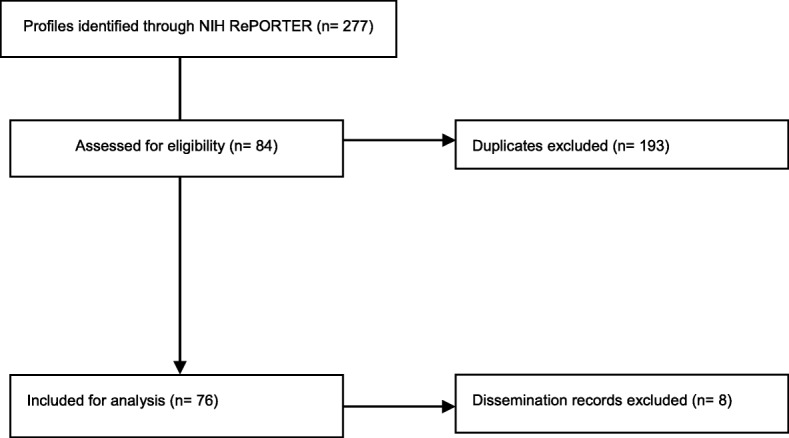
We found 277 R01 profiles within the DIRH study section listed on the US NIH RePORTER website including 84 that were eligible for screening. Of the 84 unique projects, 76 (90.5%) had primary implementation outcomes. Of the 76 implementation project profiles, 51 (67.1%) made references to sustainability and none referred to sustainability planning. In both profiles and interviews, researchers conceptualized sustainability primarily as the continued delivery of interventions, programs, or implementation strategies. Few researchers referenced frameworks with sustainability constructs and offered limited information on how they operationalized frameworks. Researchers described broad categories of approaches and strategies to promote sustainability and key factors that may influence researchers to plan for sustainability, such as personal beliefs, self-efficacy, perception of their role, and the challenges of the grant funding system.
We explored how US NIH R01 DIRH grant recipients conceptualized and planned for the sustainability of their interventions. Our results identified the need to test, consolidate, and provide guidance on how to operationalize sustainability frameworks, and to develop strategies on how funders and researchers can advance sustainability research.
基于证据的干预措施实施的可持续性不足,这促使人们呼吁研究如何优化可持续性。为了深入了解干预措施的可持续性,我们探讨了美国国立卫生研究院(NIH)资助的实施研究人员如何概念化和规划实施干预措施的可持续性。
我们使用顺序、混合方法,通过(1)对 2004 年至 2016 年期间在传播和实施研究健康(DIRH)研究组内审查的所有美国 NIH R01 赠款和同等赠款的所有活跃和已完成的美国 NIH R01 赠款和同等赠款进行文件审查,以及(2)对 NIH R01 DIRH 赠款接受者进行半结构化访谈的定性内容分析,来探索研究人员如何概念化和规划健康干预措施的可持续性。
我们在 DIRH 研究组的美国 NIH RePORTER 网站上找到了 277 个 R01 档案,其中 84 个符合筛选条件。在 84 个独特项目中,有 76 个(90.5%)具有主要的实施结果。在 76 个实施项目简介中,有 51 个(67.1%)提到了可持续性,但没有一个提到可持续性规划。在档案和访谈中,研究人员主要将可持续性概念化为干预措施、计划或实施策略的持续交付。很少有研究人员参考具有可持续性结构的框架,并提供有关如何实施框架的有限信息。研究人员描述了促进可持续性的广泛类别方法和策略,以及可能影响研究人员计划可持续性的关键因素,例如个人信仰、自我效能感、对自己角色的看法以及赠款资助系统的挑战。
我们探讨了美国 NIH R01 DIRH 赠款接受者如何概念化和规划他们的干预措施的可持续性。我们的研究结果表明需要测试、整合和提供有关如何实施可持续性框架的指导,并制定有关资助者和研究人员如何推进可持续性研究的策略。