Department of Physics, Massachusetts Institute of Technology, Cambridge, 02139, MA, USA.
Department of Plant Pathology and Microbiology, The Hebrew University of Jerusalem, Rehovot, 7610001, Israel.
Nat Commun. 2019 May 9;10(1):2120. doi: 10.1038/s41467-019-09925-0.
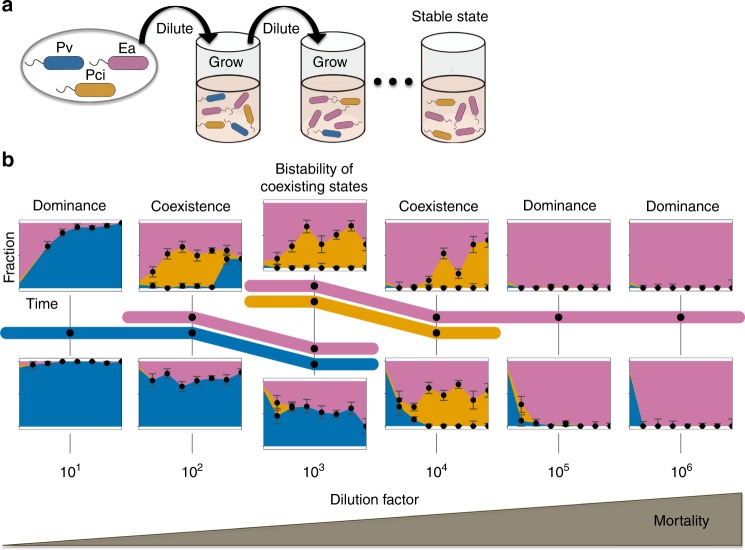
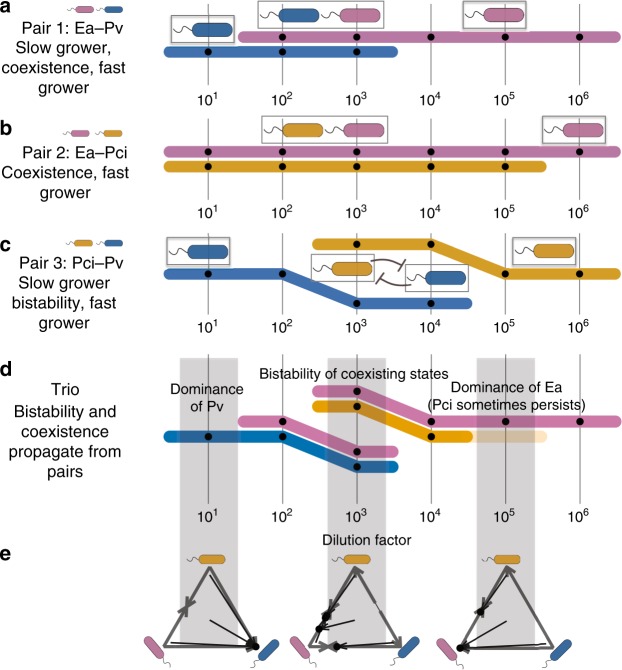
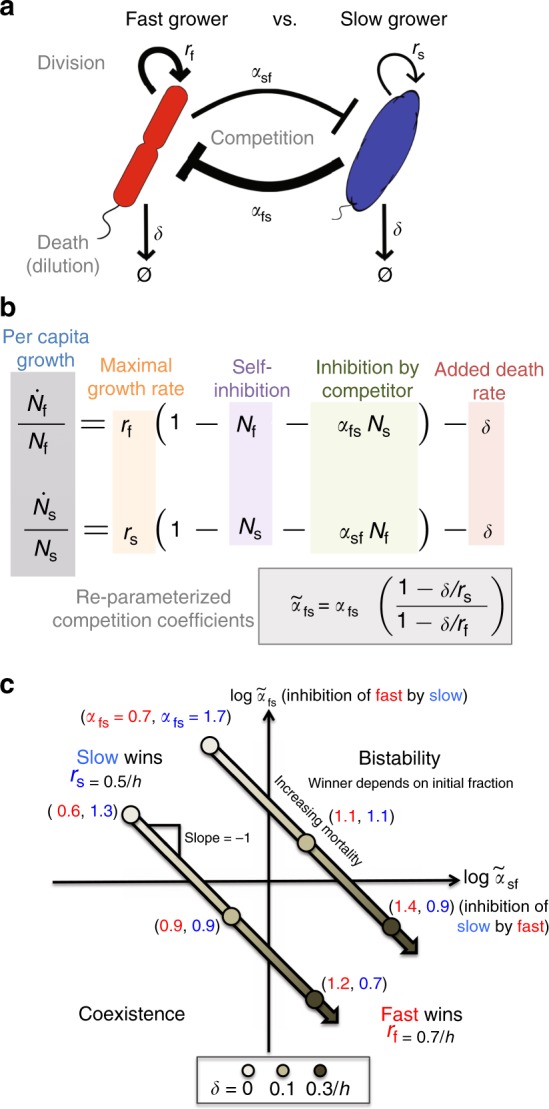
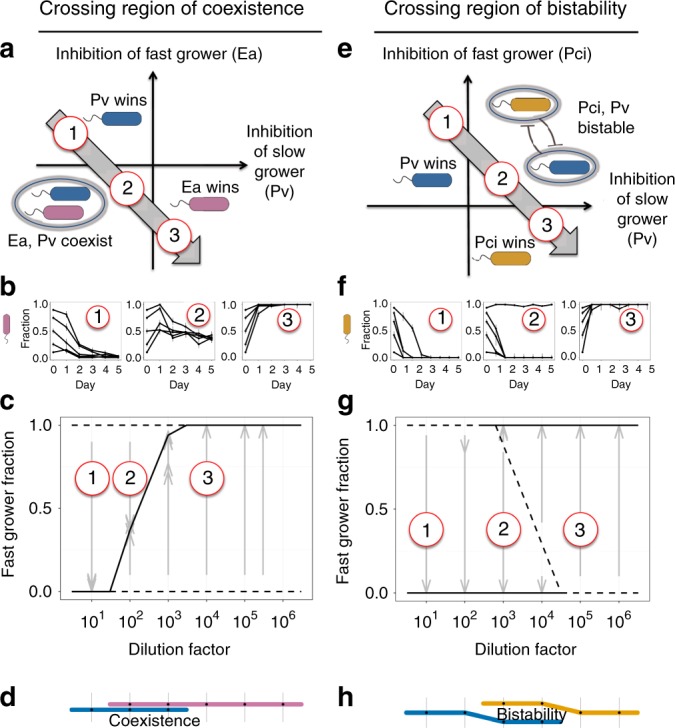
All organisms are sensitive to the abiotic environment, and a deteriorating environment can cause extinction. However, survival in a multispecies community depends upon interactions, and some species may even be favored by a harsh environment that impairs others, leading to potentially surprising community transitions as environments deteriorate. Here we combine theory and laboratory microcosms to predict how simple microbial communities will change under added mortality, controlled by varying dilution. We find that in a two-species coculture, increasing mortality favors the faster grower, confirming a theoretical prediction. Furthermore, if the slower grower dominates under low mortality, the outcome can reverse as mortality increases. We find that this tradeoff between growth and competitive ability is prevalent at low dilution, causing outcomes to shift dramatically as dilution increases, and that these two-species shifts propagate to simple multispecies communities. Our results argue that a bottom-up approach can provide insight into how communities change under stress.
所有生物都对非生物环境敏感,环境恶化会导致物种灭绝。然而,在多物种群落中生存取决于相互作用,有些物种甚至可能在恶劣环境中受益,而恶劣环境会损害其他物种,从而导致环境恶化时潜在的令人惊讶的群落转变。在这里,我们结合理论和实验室微宇宙来预测在添加死亡率的情况下,简单微生物群落将如何变化,死亡率由不同的稀释来控制。我们发现,在两种共生培养物中,死亡率的增加有利于生长更快的物种,这证实了一个理论预测。此外,如果在低死亡率下生长较慢的物种占主导地位,随着死亡率的增加,结果可能会逆转。我们发现,这种生长和竞争能力之间的权衡在低稀释度下很普遍,导致稀释度增加时结果发生巨大变化,并且这两种物种的转变会传播到简单的多物种群落。我们的结果表明,自下而上的方法可以深入了解社区在压力下如何变化。