Hillel Inbar, Gazit Eran, Nieuwboer Alice, Avanzino Laura, Rochester Lynn, Cereatti Andrea, Croce Ugo Della, Rikkert Marcel Olde, Bloem Bastiaan R, Pelosin Elisa, Del Din Silvia, Ginis Pieter, Giladi Nir, Mirelman Anat, Hausdorff Jeffrey M
1Center for the Study of Movement, Cognition and Mobility, Neurological Institute, Tel Aviv Sourasky Medical Center, Tel Aviv, Israel.
Department of Rehabilitation Sciences, Neuromotor Rehabilitation Research Group, Leuven, KU Belgium.
Eur Rev Aging Phys Act. 2019 May 3;16:6. doi: 10.1186/s11556-019-0214-5. eCollection 2019.
The traditional evaluation of gait in the laboratory during structured testing has provided important insights, but is limited by its "snapshot" character and observation in an unnatural environment. Wearables enable monitoring of gait in real-world environments over a week. Initial findings show that in-lab and real-world measures differ. As a step towards better understanding these gaps, we directly compared in-lab usual-walking (UW) and dual-task walking (DTW) to daily-living measures of gait.
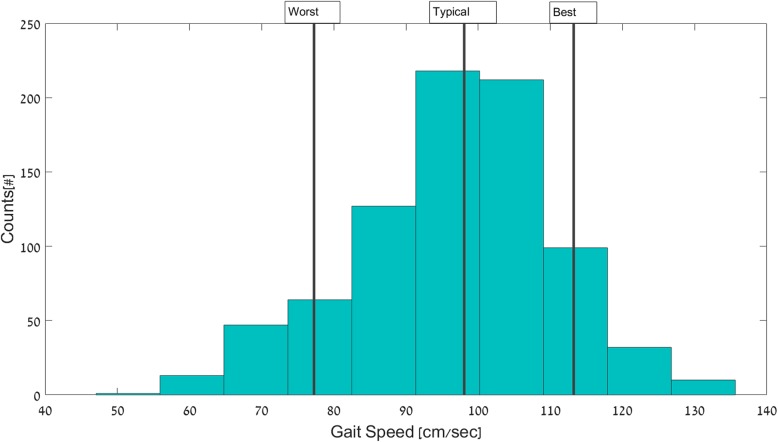
In-lab gait features (e.g., gait speed, step regularity, and stride regularity) derived from UW and DTW were compared to the same gait features during daily-living in 150 elderly fallers (age: 76.5 ± 6.3 years, 37.6% men). In both settings, features were extracted from a lower-back accelerometer. In the real-world setting, subjects were asked to wear the device for 1 week and pre-processing detected 30-s daily-living walking bouts. A histogram of all walking bouts was determined for each walking feature for each subject and then each subject's typical (percentile 50, median), worst (percentile 10) and the best (percentile 90) values over the week were determined for each feature. Statistics of reliability were assessed using Intra-Class correlations and Bland-Altman plots.
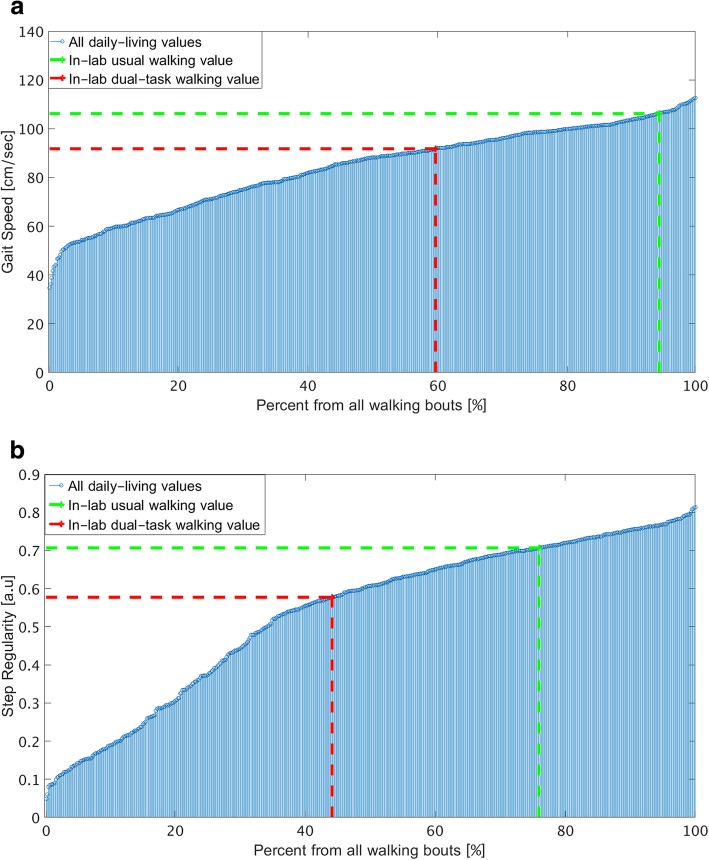
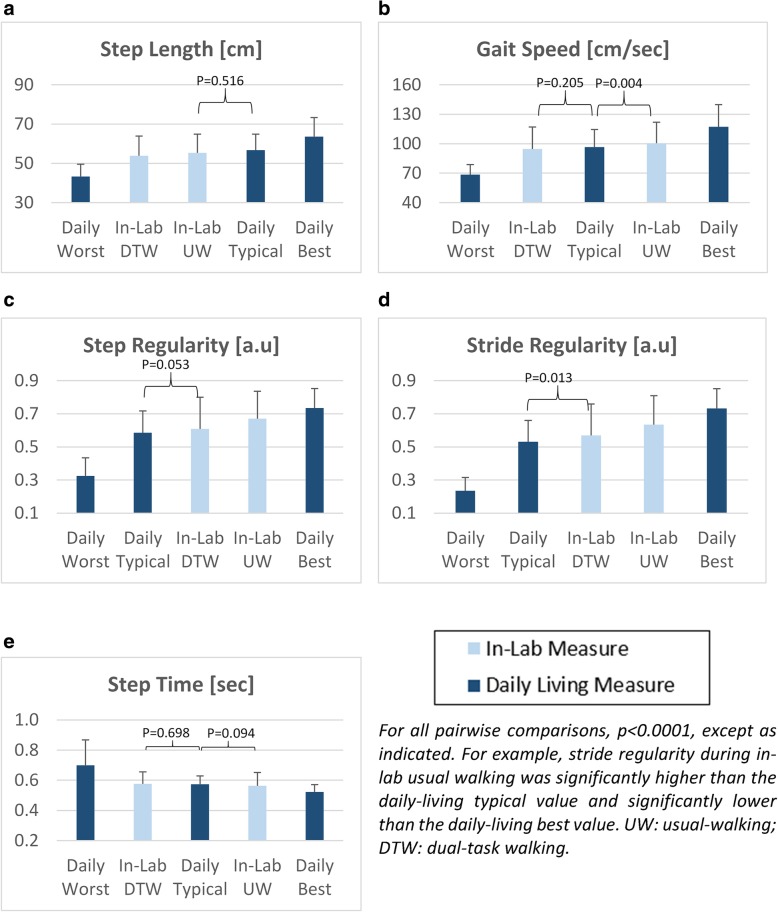
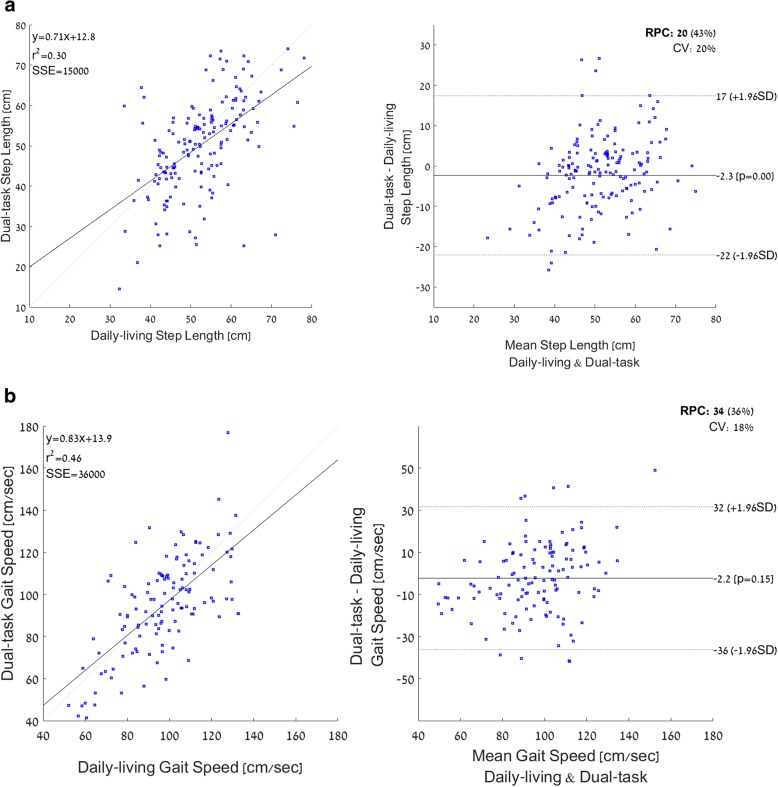
As expected, in-lab gait speed, step regularity, and stride regularity were worse during DTW, compared to UW. In-lab gait speed, step regularity, and stride regularity during UW were significantly higher (i.e., better) than the typical daily-living values ( < 0.001) and different ( < 0.001) from the worst and best values. DTW values tended to be similar to typical daily-living values ( = 0.205, = 0.053, = 0.013 respectively). ICC assessment and Bland-Altman plots indicated that in-lab values do not reliably reflect the daily-walking values.
Gait values measured during relatively long (30-s) daily-living walking bouts are more similar to the corresponding values obtained in the lab during dual-task walking, as compared to usual walking. Still, gait performance during most daily-living walking bouts is worse than that measured during usual and dual-tasking in the lab. The values measured in the lab do not reliably reflect daily-living measures. That is, an older adult's typical daily-living gait cannot be estimated by simply measuring walking in a structured, laboratory setting.
在实验室进行结构化测试时对步态的传统评估提供了重要见解,但受其“快照”特性以及在非自然环境中观察的限制。可穿戴设备能够在一周时间内对现实世界环境中的步态进行监测。初步研究结果表明,实验室测量值与现实世界测量值存在差异。为了更好地理解这些差距,我们直接将实验室中的正常行走(UW)和双任务行走(DTW)与日常生活中的步态测量值进行了比较。
将从150名老年跌倒者(年龄:76.5±6.3岁,男性占37.6%)的UW和DTW中得出的实验室步态特征(如步态速度、步频规律性和步幅规律性)与日常生活中的相同步态特征进行比较。在两种情况下,均从腰部加速度计提取特征。在现实世界环境中,要求受试者佩戴该设备1周,预处理检测出30秒的日常生活行走片段。为每个受试者的每个行走特征确定所有行走片段的直方图,然后为每个特征确定每个受试者在一周内的典型值(第50百分位数,中位数)、最差值(第10百分位数)和最佳值(第90百分位数)。使用组内相关性和布兰德 - 奥特曼图评估可靠性统计量。
正如预期的那样,与UW相比,DTW期间的实验室步态速度、步频规律性和步幅规律性更差。UW期间的实验室步态速度、步频规律性和步幅规律性显著高于(即更好)日常生活中的典型值(P<0.001),且与最差值和最佳值不同(P<0.001)。DTW值往往与日常生活中的典型值相似(分别为P = 0.205、P = 0.053、P = 0.013)。组内相关性评估和布兰德 - 奥特曼图表明,实验室测量值不能可靠地反映日常行走值。
与正常行走相比,在相对较长(30秒)的日常生活行走片段中测量的步态值与在实验室双任务行走期间获得的相应值更相似。然而,大多数日常生活行走片段中的步态表现仍比在实验室正常行走和双任务行走期间测量的表现更差。实验室测量值不能可靠地反映日常生活测量值。也就是说,不能通过简单地在结构化的实验室环境中测量行走来估计老年人的典型日常生活步态。