Research Program for Receptor Biochemistry and Tumor Metabolism, Department of Pediatrics, University Hospital of the Paracelsus Medical University, Salzburg, Austria.
University Clinic of Ophthalmology and Optometry, Research Program for Ophthalmology and Glaucoma Research, University Hospital of the Paracelsus Medical University, Salzburg, Austria.
Ann N Y Acad Sci. 2019 Nov;1455(1):185-195. doi: 10.1111/nyas.14111. Epub 2019 May 10.
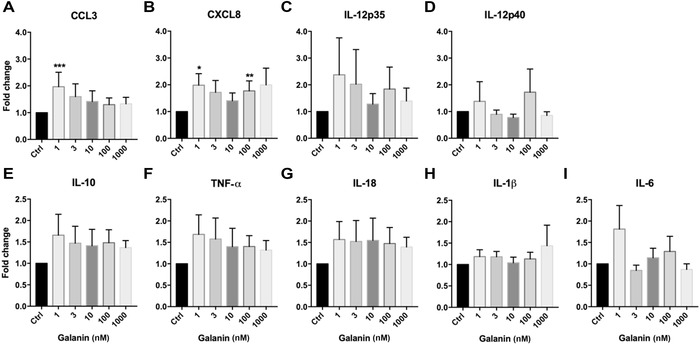
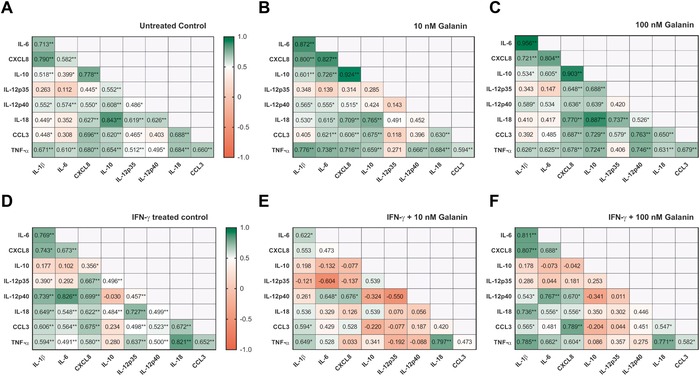
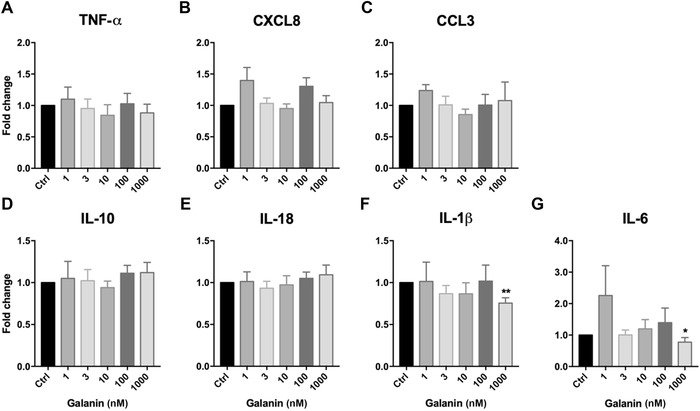
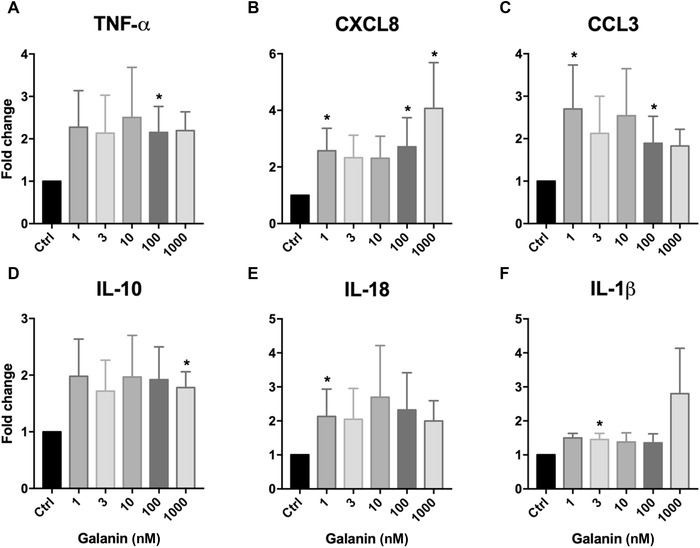
Current research into neuropeptides is bringing to light many remarkable functions of these endocrine/neurocrine/paracrine factors, such as their roles in modulating immune responses. Galanin is a neuropeptide expressed in both neural and non-neural tissues and exerts its effects through three G protein-coupled receptors, GAL -R. It has been demonstrated that galanin has modulatory effects on immune cells, including neutrophils and natural killer cells. Because monocytes express GAL -R, and therefore are expected to be a target of galanin, we analyzed the effect of galanin on the expression of cytokines and chemokines by monocytes. Galanin increased the expression of IL-1β up to 1.5-fold, TNF-α, IL-10, IL-18, and CCL3 up to twofold, and CXCL8 up to fourfold in nonactivated monocytes, but had no major effect on activated monocytes. A cross-correlation analysis of cytokine expression profiles, irrespective of the activation status of the monocytes, revealed that galanin changed the cross-correlation of the expression of certain cytokines. Galanin abolished several significant correlations in IFN-γ-stimulated monocytes. For example, treatment with 10 nM galanin changed the Spearman's rank coefficient of IL-18 and CXCL8 from 0.622 (P ≤ 0.01) to 0.126. These results further emphasize the importance of neuroregulatory peptides, such as galanin and their therapeutic potential to treat inflammatory diseases.
目前对神经肽的研究揭示了这些内分泌/神经内分泌/旁分泌因子的许多显著功能,例如它们在调节免疫反应中的作用。甘丙肽是一种在神经和非神经组织中表达的神经肽,通过三种 G 蛋白偶联受体(GAL-R)发挥作用。已经证明甘丙肽对免疫细胞(包括中性粒细胞和自然杀伤细胞)具有调节作用。由于单核细胞表达 GAL-R,因此预计它们是甘丙肽的靶标,我们分析了甘丙肽对单核细胞细胞因子和趋化因子表达的影响。甘丙肽在非激活的单核细胞中使 IL-1β的表达增加了 1.5 倍,TNF-α、IL-10、IL-18 和 CCL3 的表达增加了 2 倍,CXCL8 的表达增加了 4 倍,但对激活的单核细胞没有重大影响。无论单核细胞的激活状态如何,对细胞因子表达谱进行的相关性分析表明,甘丙肽改变了某些细胞因子表达的相关性。甘丙肽在 IFN-γ刺激的单核细胞中消除了几个显著的相关性。例如,用 10 nM 甘丙肽处理会将 IL-18 和 CXCL8 的 Spearman 秩相关系数从 0.622(P≤0.01)改变为 0.126。这些结果进一步强调了神经调节肽(如甘丙肽)的重要性及其治疗炎症性疾病的潜在治疗价值。