State Key Laboratory of Soil and Sustainable Agriculture, Institute of Soil Science, Chinese Academy of Sciences, Nanjing, China.
University of Chinese Academy of Sciences, Beijing, China.
Microbiologyopen. 2019 Sep;8(9):e00851. doi: 10.1002/mbo3.851. Epub 2019 May 10.
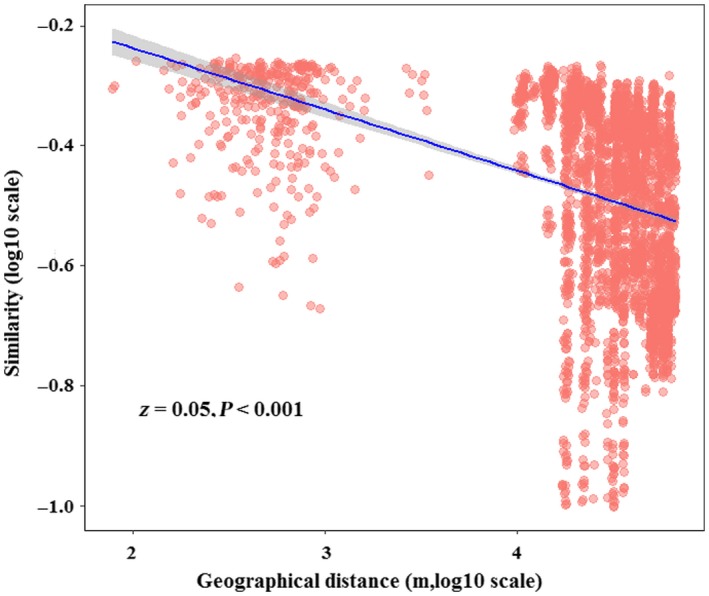
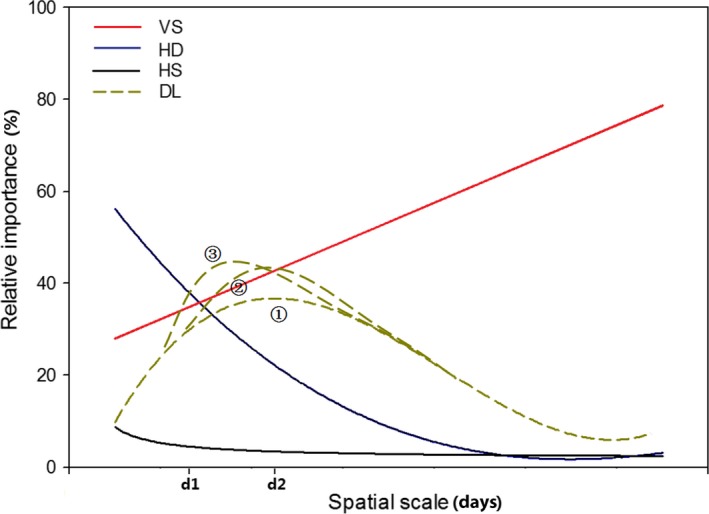
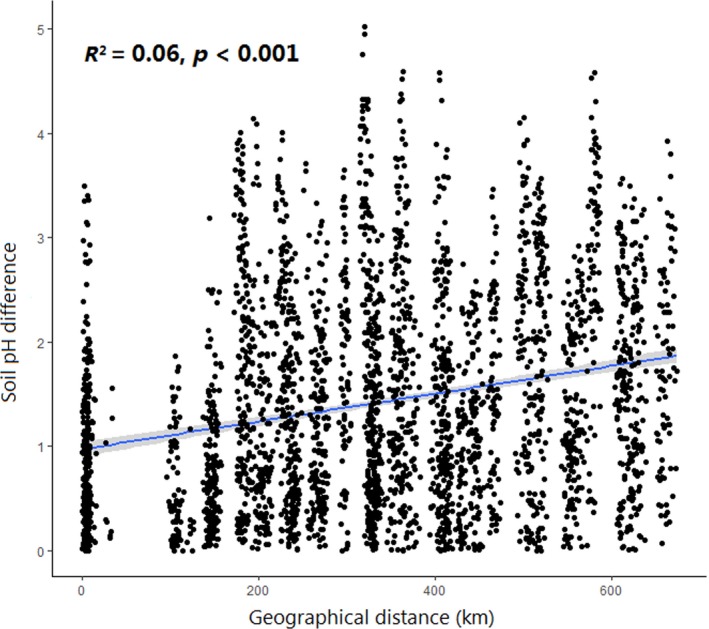
It has been widely accepted that there is a distance-decay pattern in the soil microbiome. However, few studies have attempted to interpret the microbial distance-decay pattern from the perspective of quantifying underlying processes. In this study, we examined the processes governing bacterial community assembly at multiple spatial scales in maize fields of Northeast China using Illumina MiSeq sequencing. Results showed that the processes governing spatial turnover in bacterial community composition shifted regularly with spatial scale, with homogenizing dispersal dominating at small spatial scales and variable selection dominating at larger scales, which in turn explained the distance-decay pattern that closer located sites tended to have higher community similarity. Together, homogenizing dispersal and dispersal limitation resulting from geographic factors governed about 33% of spatial turnover in bacterial community composition. Deterministic selection processes had the strongest influence, at 57%, with biotic factors and abiotic environmental filtering (mainly imposed by soil pH) respectively contributing about 37% and 63% of variation. Our results provided a novel and comprehensive way to explain the distance-decay pattern of soil microbiome via quantifying the assembly processes at multiple spatial scales, as well as the method to quantify the influence of abiotic, biotic, and geographic factors in shaping microbial community structure, thus enabling understanding of widely acknowledged microbial biogeographic patterns and microbial ecology.
人们普遍认为土壤微生物组存在距离衰减模式。然而,很少有研究试图从量化潜在过程的角度来解释微生物的距离衰减模式。在这项研究中,我们使用 Illumina MiSeq 测序技术,在中国东北地区的玉米田中,在多个空间尺度上检查了控制细菌群落组装的过程。结果表明,控制细菌群落组成空间周转率的过程随着空间尺度的变化而规律变化,小尺度上的同质化扩散占主导地位,大尺度上的可变选择占主导地位,这反过来解释了距离衰减模式,即位置较近的地点往往具有更高的群落相似性。同质化扩散和由地理因素引起的扩散限制共同控制了细菌群落组成的约 33%的空间周转率。确定性选择过程的影响最大,为 57%,生物因素和非生物环境过滤(主要由土壤 pH 值决定)分别贡献了约 37%和 63%的变异。我们的研究结果通过在多个空间尺度上量化组装过程,为解释土壤微生物组的距离衰减模式提供了一种新颖而全面的方法,同时也提供了一种量化非生物、生物和地理因素对微生物群落结构形成影响的方法,从而有助于理解广泛认可的微生物生物地理模式和微生物生态学。