Population Health, University of Bristol, Bristol, UK.
Faculty of Health Sciences, Simon Fraser University, Burnaby, British Columbia, Canada.
BMJ Open. 2019 May 9;9(5):e028428. doi: 10.1136/bmjopen-2018-028428.
Early onset eczema is associated with food allergy, and allergic reactions to foods can cause acute exacerbations of eczema. Parents often pursue dietary restrictions as a way of managing eczema and seek allergy testing for their children to guide dietary management. However, it is unclear whether test-guided dietary management improves eczema symptoms, and whether the practice causes harm through reduced use of conventional eczema treatment or unnecessary dietary restrictions. The aim of the Trial of Eczema allergy Screening Tests Study is to determine the feasibility of conducting a trial comparing food allergy testing and dietary advice versus usual care, for the management of eczema in children.
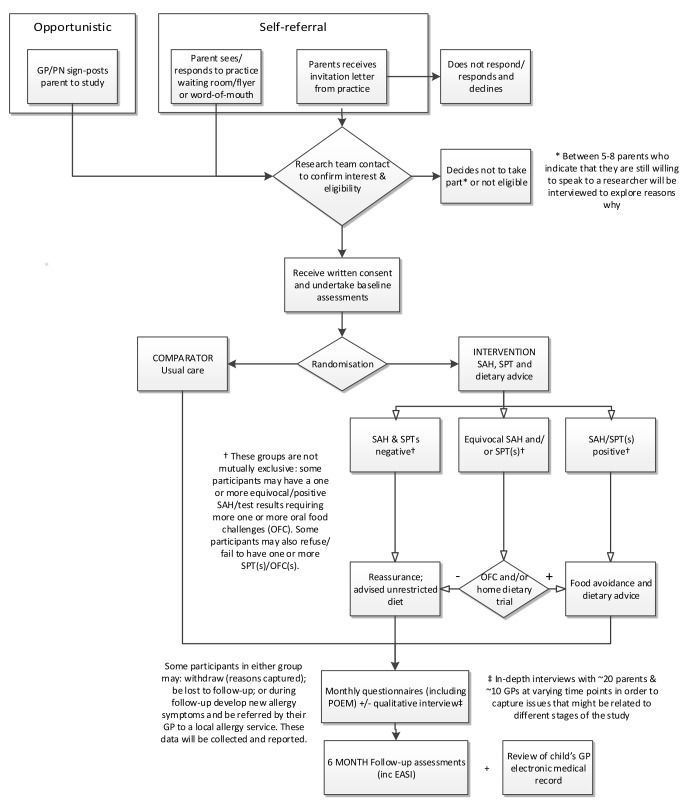
Design: A single centre, two-group, individually randomised, feasibility randomised controlled trial (RCT) with economic scoping and a nested qualitative study.
General Practioner (GP) surgeries in the west of England.
children aged over 3 months and less than 5 years with mild to severe eczema.
allergy testing (structured allergy history and skin prick tests) or usual care. Sample size and outcome measures: we aim to recruit 80 participants and follow them up using 4-weekly questionnaires for 24 weeks. Nested qualitative study: We will conduct ~20 interviews with parents of participating children, 5-8 interviews with parents who decline or withdraw from the trial and ~10 interviews with participating GPs. Economic scoping: We will gather data on key costs and outcomes to assess the feasibility of carrying out a cost-effectiveness analysis in a future definitive trial.
The study has been reviewed by the Health Research Authority and given a favourable opinion by the NHS REC (West Midlands - South Birmingham Research Ethics Committee, Reference Number 18/WM/0124). Findings will be submitted for presentation at conferences and written up for publication in peer-reviewed journals, which may include mixed-method triangulation and integration of the quantitative and qualitative findings.
ISRCTN15397185; Pre-results.
早发性湿疹与食物过敏有关,食物过敏会导致湿疹急性发作。父母通常会通过限制饮食来控制湿疹,并为孩子进行过敏测试以指导饮食管理。然而,目前尚不清楚针对食物过敏的测试指导饮食管理是否能改善湿疹症状,以及这种做法是否会因减少常规湿疹治疗或不必要的饮食限制而造成危害。湿疹过敏筛查测试研究的目的是确定在英格兰西部的全科医生诊所中进行比较食物过敏测试和饮食建议与常规护理对儿童湿疹管理的可行性的试验。
设计:一项单中心、两臂、个体随机、可行性随机对照试验(RCT),并进行经济范围界定和嵌套定性研究。
英格兰西部的全科医生诊所。
年龄在 3 个月以上和 5 岁以下、患有轻度至重度湿疹的儿童。
过敏测试(结构化过敏史和皮肤点刺测试)或常规护理。
我们计划招募 80 名参与者,并通过 4 周一次的问卷调查对其进行 24 周的随访。嵌套定性研究:我们将对参与研究的儿童的父母进行约 20 次访谈,对拒绝或退出试验的父母进行 5-8 次访谈,对参与的全科医生进行 10 次访谈。经济范围界定:我们将收集关键成本和结局的数据,以评估在未来的确定性试验中进行成本效益分析的可行性。
该研究已由健康研究管理局审查,并得到了英国国民保健制度伦理委员会(西米德兰兹-南伯明翰研究伦理委员会,注册号 18/WM/0124)的批准。研究结果将提交会议报告,并撰写成同行评审期刊的文章,可能包括定量和定性结果的混合方法三角测量和整合。
ISRCTN87310061;预结果。