Ethiopian Public Health Institute, Addis Ababa, Ethiopia.
Department of Medical Laboratory Science, College of Health Sciences, Addis Ababa University, Addis Ababa, Ethiopia.
BMC Infect Dis. 2019 May 10;19(1):407. doi: 10.1186/s12879-019-4009-0.
In co-endemic areas, rate of intestinal parasites and tuberculosis (TB) co-infection thought to be high. However, there are limited studies on the epidemiology of this co-infection in Ethiopia. Therefore, the present study aimed to generate evidence on intestinal parasites co-infection rate and associated factors among pulmonary tuberculosis patients (PTB) and their household contacts in Addis Ababa, Ethiopia.
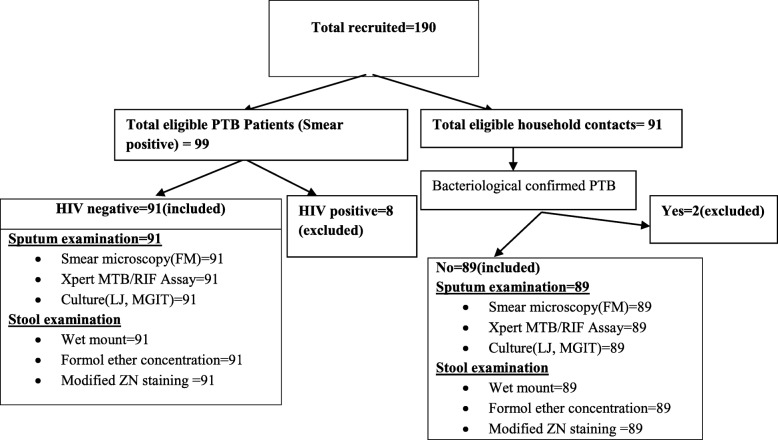
Unmatched case-control study was conducted. Data were collected from 91 PTB patients (cases) and 89 household contacts (controls). Socio-demographic characteristics and associated factors were collected using structured questionnaire. Sputum, stool and blood specimens were collected, processed and examined for PTB, intestinal parasites and Human Immunodeficiency virus anti-body test, respectively. Data were entered and analyzed by Statistical Packages for Social Sciences (SPSS) Version 20. Descriptive statistics, Fisher's exact test, binary logistic regression, and odds ratio were used. P-value of < 0.05 was considered as statistically significant.
The infection rate of intestinal parasites based on one stool samples in PTB patients and controls was 22 and 9%, respectively. The difference was statistically significant (COR = 2.85;95% CI = 1.18-6.87). The most prevalent intestinal parasite in PTB patients was Gardia lamblia (8.8%, 8), followed equally by Ascaris lumbricoides, Haymenolopsis nana and Entamoeba histolytica/dispar (4.4%, 4). Co-infection in PTB patients was associated with body mass index (BMI) < 18.5 (AOR = 6.71;95% CI = 1.65-27.25) and dirty material in finger nails (AOR = 8.99;95% CI = 2.46-32.78). There was no variable associated with parasitic infections in controls in our analysis, which might be due to the low prevalence of intestinal parasites'.
There was a statistical significant difference in the infection rate of intestinal parasites in PTB patients compared to healthy household contacts. The consequence of co-infection on developing an active disease, disease severity and treatment efficacy needs to be investigated in future.
在流行地区,肠道寄生虫和结核病(TB)的合并感染率被认为很高。然而,关于埃塞俄比亚这种合并感染的流行病学研究有限。因此,本研究旨在提供关于肠道寄生虫合并感染率以及在埃塞俄比亚亚的斯亚贝巴的肺结核患者(PTB)及其家庭接触者中的相关因素的证据。
采用非匹配病例对照研究。数据来自 91 名肺结核患者(病例)和 89 名家庭接触者(对照)。使用结构化问卷收集社会人口统计学特征和相关因素。收集痰液、粪便和血液标本,分别进行结核分枝杆菌检测、肠道寄生虫检测和人类免疫缺陷病毒抗体检测。数据由社会科学统计软件包(SPSS)版本 20 录入和分析。采用描述性统计、Fisher 确切检验、二项逻辑回归和优势比进行分析。P 值<0.05 被认为具有统计学意义。
基于一项粪便样本,PTB 患者和对照组的肠道寄生虫感染率分别为 22%和 9%。差异具有统计学意义(COR=2.85;95%CI=1.18-6.87)。PTB 患者中最常见的肠道寄生虫是蓝氏贾第鞭毛虫(8.8%,8 例),其次是蛔虫、哈门内拉包囊和溶组织内阿米巴/迪斯帕拉。PTB 患者的合并感染与 BMI<18.5(AOR=6.71;95%CI=1.65-27.25)和指甲上有污垢(AOR=8.99;95%CI=2.46-32.78)有关。在我们的分析中,对照组中没有与寄生虫感染相关的变量,这可能是由于肠道寄生虫的低流行率所致。
PTB 患者的肠道寄生虫感染率与健康家庭接触者相比有统计学显著差异。需要进一步研究合并感染对活动性疾病、疾病严重程度和治疗效果的影响。