Scheibner David, Blaurock Claudia, Mettenleiter Thomas C, Abdelwhab Elsayed M
Institute of Molecular Virology and Cell Biology, Friedrich-Loeffler-Institut, Federal Research Institute for Animal Health, Südufer 10, 17493, Greifswald, Insel Riems, Germany.
BMC Vet Res. 2019 May 10;15(1):142. doi: 10.1186/s12917-019-1899-4.
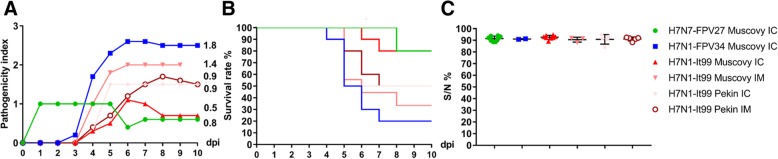
There is paucity of data on the virulence of highly pathogenic (HP) avian influenza viruses (AIV) H7 in ducks compared to HPAIV H5. Here, the virulence of HPAIV H7N1 (designated H7N1-FPV34 and H7N1-It99) and H7N7 (designated H7N7-FPV27) was assessed in Pekin and/or Muscovy ducklings after intrachoanal (IC) or intramuscular (IM) infection.
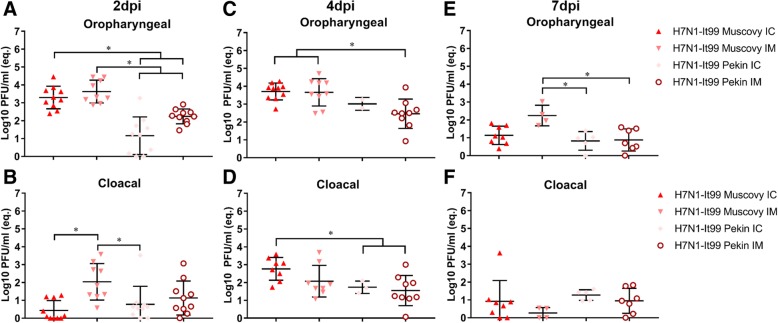
The morbidity rate ranged from 60 to 100% and mortality rate from 20 to 80% depending on the duck species, virus strain and/or challenge route. All Muscovy ducklings inoculated IC with H7N7-FPV27 or H7N1-FPV34 exhibited mild to severe clinical signs resulting in the death of 2/10 and 8/10 ducklings, respectively. Also, 2/10 and 6/9 of inoculated Muscovy ducklings died after IC or IM infection with H7N1-It99, respectively. Moreover, 5/10 Pekin ducklings inoculated IC or IM with H7N1-It99 died. The level of virus detected in the oropharyngeal swabs was higher than in the cloacal swabs.
Taken together, HPAIV H7 cause mortality and morbidity in Muscovy and Pekin ducklings. The severity of disease in Muscovy ducklings depended on the virus strain and/or route of infection. Preferential replication of the virus in the respiratory tract compared to the gut merits further investigation.
与高致病性禽流感病毒H5相比,关于高致病性(HP)禽流感病毒H7在鸭中的毒力的数据较少。在此,通过鼻内(IC)或肌肉内(IM)感染,评估了高致病性禽流感病毒H7N1(命名为H7N1 - FPV34和H7N1 - It99)和H7N7(命名为H7N7 - FPV27)在北京鸭和/或番鸭雏鸭中的毒力。
发病率在60%至100%之间,死亡率在20%至80%之间,这取决于鸭的种类、病毒株和/或攻毒途径。所有经鼻内接种H7N7 - FPV27或H7N1 - FPV34的番鸭雏鸭均表现出轻度至重度临床症状,分别导致2/10和8/10的雏鸭死亡。此外,经鼻内或肌肉内感染H7N1 - It99后,分别有2/10和6/9的接种番鸭雏鸭死亡。而且,5/10经鼻内或肌肉内接种H7N1 - It99的北京鸭雏鸭死亡。在口咽拭子中检测到的病毒水平高于泄殖腔拭子中的病毒水平。
综上所述,高致病性禽流感病毒H7可导致番鸭和北京鸭雏鸭死亡和发病。番鸭雏鸭疾病的严重程度取决于病毒株和/或感染途径。与肠道相比,病毒在呼吸道中的优先复制值得进一步研究。