Institute of Molecular Virology and Cell Biology, Friedrich-Loeffler-Institut, Federal Research Institute for Animal Health, Südufer 10, 17493 Greifswald-Insel Riems, Greifswald, Germany.
Department of Experimental Animal Facilities and Biorisk Management, Friedrich-Loeffler-Institut, Federal Research Institute for Animal Health, Südufer 10, 17493 Greifswald-Insel Riems, Greifswald, Germany.
Sci Rep. 2019 Aug 9;9(1):11556. doi: 10.1038/s41598-019-47938-3.
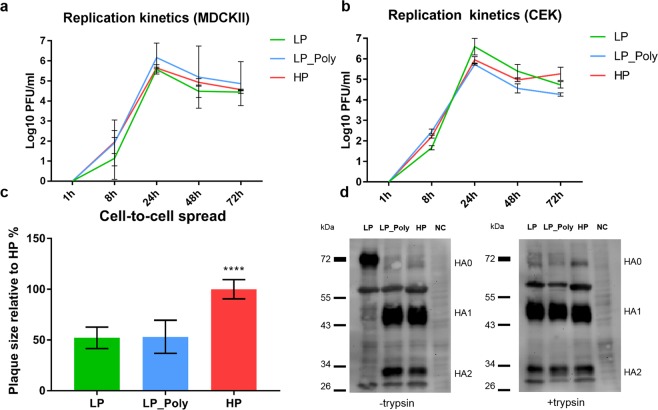
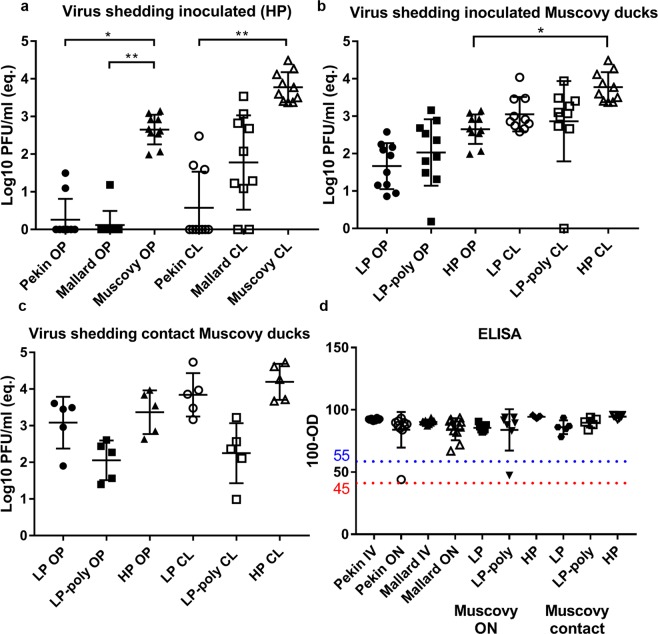
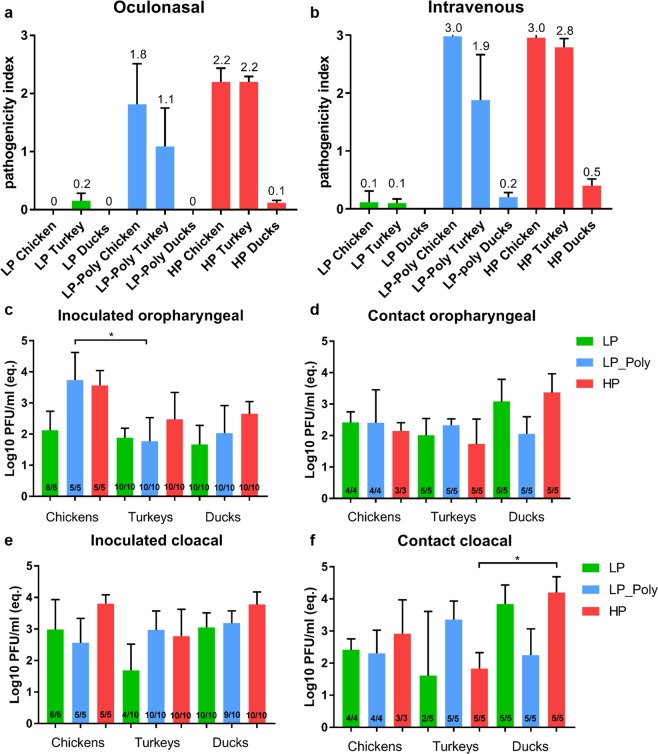
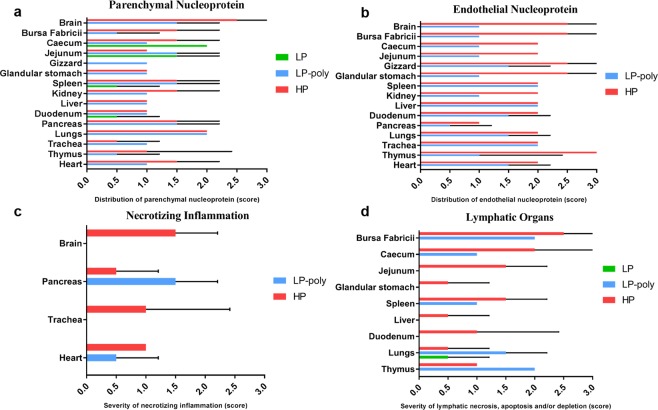
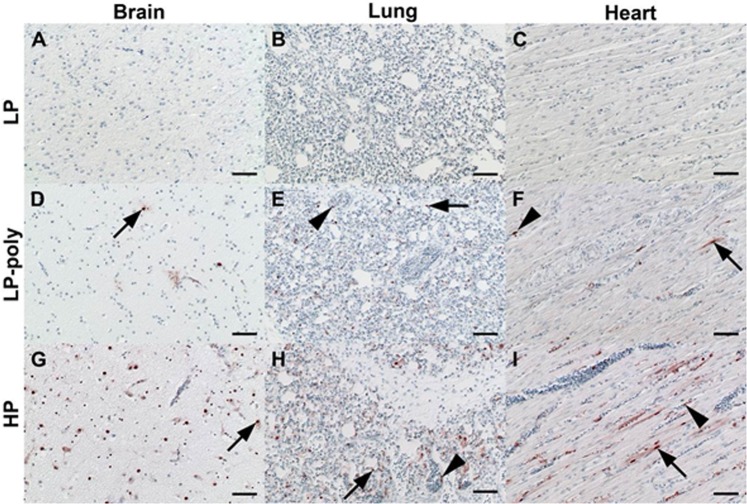
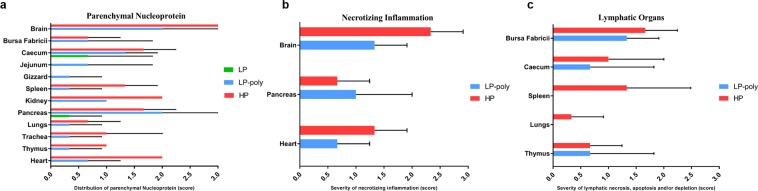
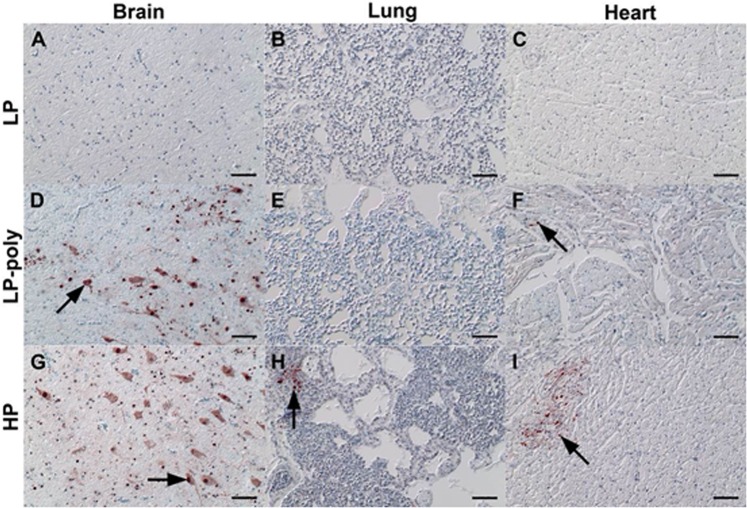
Avian influenza viruses (AIV) are classified into 16 hemagglutinin (HA; H1-H16) and 9 neuraminidase (NA; N1-N9) subtypes. All AIV are low pathogenic (LP) in birds, but subtypes H5 and H7 AIV can evolve into highly pathogenic (HP) forms. In the last two decades evolution of HPAIV H7 from LPAIV has been frequently reported. However, little is known about the pathogenesis and evolution of HP H7 from LP ancestors particularly, in non-chicken hosts. In 2015, both LP and HP H7N7 AIV were isolated from chickens in two neighbouring farms in Germany. Here, the virulence of these isogenic H7N7 LP, HP and LP virus carrying a polybasic HA cleavage site (HACS) from HP (designated LP-Poly) was studied in chickens, turkeys and different duck breeds. The LP precursor was avirulent in all birds. In contrast, all inoculated and contact chickens and turkeys died after infection with HP. HP infected Pekin and Mallard ducks remained clinically healthy, while Muscovy ducks exhibited moderate depression and excreted viruses at significantly higher amounts. The polybasic HACS increased virulence in a species-specific manner with intravenous pathogenicity indices of 3.0, 1.9 and 0.2 in chickens, turkeys and Muscovy ducks, respectively. Infection of endothelial cells was only observed in chickens. In summary, Pekin and Mallard were more resistant to HPAIV H7N7 than chickens, turkeys and Muscovy ducks. The polybasic HACS was the main determinant for virulence and endotheliotropism of HPAIV H7N7 in chickens, whereas other viral and/or host factors play an essential role in virulence and pathogenesis in turkeys and ducks.
禽流感病毒(AIV)分为 16 种血凝素(HA;H1-H16)和 9 种神经氨酸酶(NA;N1-N9)亚型。所有 AIV 在鸟类中都是低致病性(LP)的,但 H5 和 H7 AIV 亚型可进化为高致病性(HP)形式。在过去的二十年中,经常有报道称 HPAIV H7 从 LPAIV 进化而来。然而,对于 HP H7 从 LP 祖先进化而来的发病机制和进化过程,特别是在非鸡宿主中,人们知之甚少。2015 年,德国两个相邻农场的鸡群中均分离出 LP 和 HP H7N7 AIV。在此,研究了这些同源性 H7N7 LP、HP 和 LP 病毒在鸡、火鸡和不同鸭品种中的毒力,这些病毒携带来自 HP 的多碱性 HA 裂解位点(HACS)(命名为 LP-Poly)。LP 前体在所有鸟类中均无毒性。相比之下,所有接种和接触的鸡和火鸡在感染 HP 后均死亡。HP 感染的北京鸭和绿头鸭保持临床健康,而麝香鸭则表现出中度抑郁,并以更高的量排泄病毒。多碱性 HACS 以物种特异性的方式增加了毒力,在鸡、火鸡和麝香鸭中的静脉致病性指数分别为 3.0、1.9 和 0.2。仅在鸡中观察到内皮细胞感染。综上所述,与鸡、火鸡和麝香鸭相比,北京鸭和绿头鸭对 HPAIV H7N7 的抵抗力更强。多碱性 HACS 是 HPAIV H7N7 在鸡中致病性和内皮嗜性的主要决定因素,而其他病毒和/或宿主因素在火鸡和鸭中发挥着重要作用。