Guangdong Provincial Key Laboratory of Social Cognitive Neuroscience and Mental Health, and Department of Psychology, Sun Yat-Sen University, Guangzhou, Guangdong 510275, China.
School of Psychology and Sociology, Shenzhen University, Shenzhen, Guangdong 518060, China; Shenzhen Key Laboratory of Affective and Social Cognitive Science, Shenzhen University, Shenzhen, Guangdong 518060, China.
Brain Behav Immun. 2019 Aug;80:657-666. doi: 10.1016/j.bbi.2019.05.011. Epub 2019 May 9.
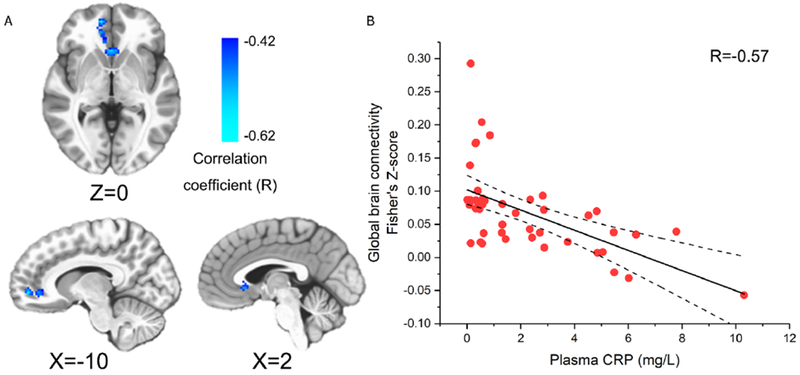
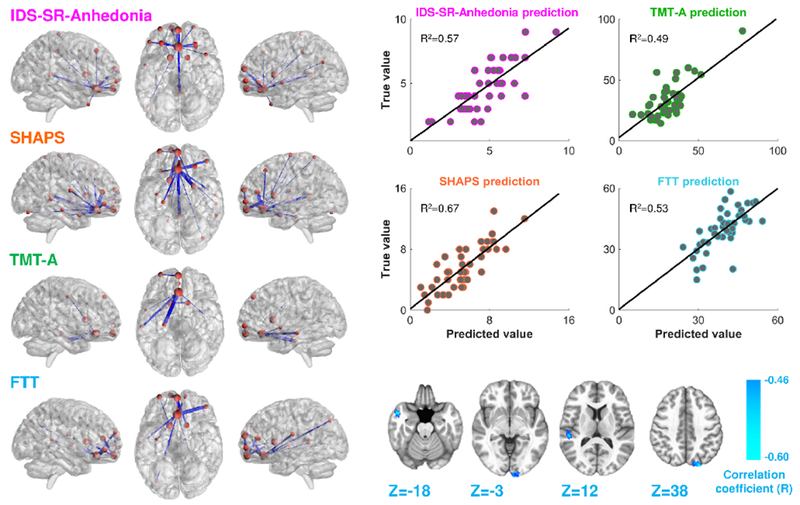
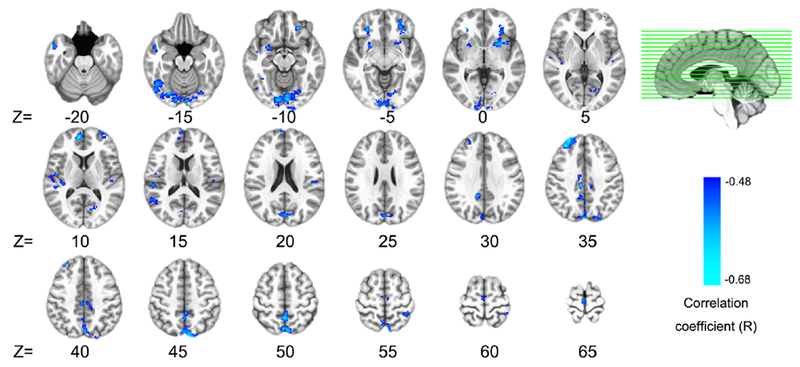
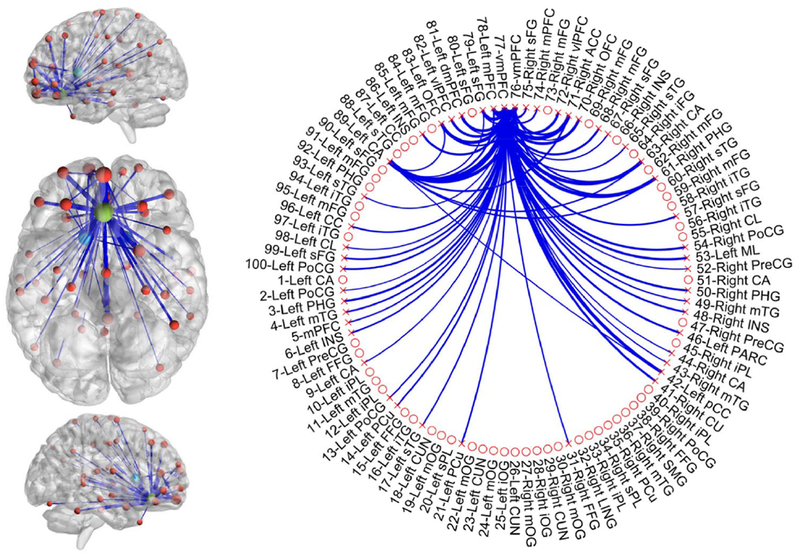
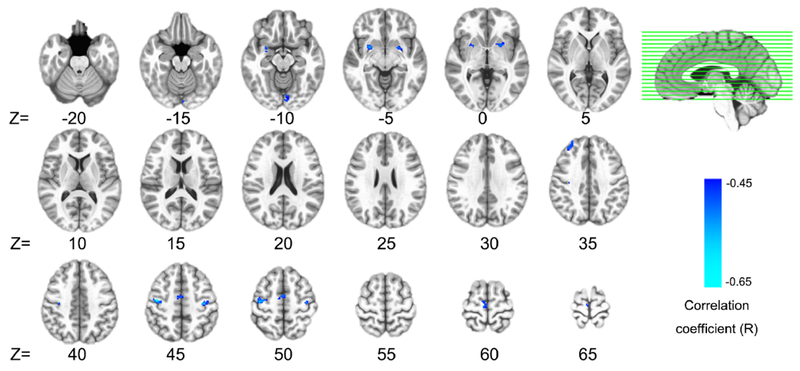
Major depressive disorder is a heterogeneous disease involving widespread disruptions in functional brain networks, the neurobiological mechanisms of which are poorly understood. Amassing evidence supports innate immune activation as one pathophysiologic mechanism contributing to depression in a subgroup of patients with elevated inflammatory markers. Although inflammation is known to alter monoamine and glutamate neurotransmitters, little work has been done to understand its role in network dysfunction in patients with depression. Here we conducted a large-scale network-based analyses of resting-state functional magnetic resonance imaging (rfMRI) data acquired from depressed patients with varying levels of inflammation to develop a comprehensive characterization of network alterations as an effect of inflammation. Complementary approaches of global brain connectivity and parcellation-based network analysis applied to the whole brain revealed that increased plasma C-reactive protein (CRP) was associated with reduced functional connectivity in a widely-distributed network including ventral striatum, parahippocampal gyrus/amygdala, orbitofrontal and insular cortices, and posterior cingulate cortex. These broad alterations were centralized in the ventral medial prefrontal cortex (vmPFC), representing a hub for the effects of inflammation on network function in the whole brain. When feeding the identified multivariate network features into a machine learning algorithm of support vector regression, we achieved high prediction accuracies for depressive symptoms that have been associated with inflammation in previous studies including anhedonia and motor slowing. These findings extend and broaden previous observations from hypothesis-driven studies, providing further support for inflammation as a distinct contributing factor to network dysfunction and symptom severity in depression.
重度抑郁症是一种涉及广泛功能脑网络紊乱的异质性疾病,其神经生物学机制尚未完全了解。越来越多的证据支持固有免疫激活是导致部分炎症标志物升高的患者发生抑郁症的一种病理生理机制。尽管炎症已知会改变单胺和谷氨酸神经递质,但对于其在抑郁症患者网络功能障碍中的作用,研究甚少。在这里,我们对具有不同炎症水平的抑郁症患者的静息态功能磁共振成像(rfMRI)数据进行了大规模基于网络的分析,以全面描述炎症作为影响因素导致的网络改变。我们应用于整个大脑的全局脑连接和基于分割的网络分析的互补方法表明,血浆 C 反应蛋白(CRP)升高与腹侧纹状体、海马旁回/杏仁核、眶额和岛叶皮质以及后扣带回皮质等广泛分布的网络中的功能连接减少有关。这些广泛的改变集中在腹内侧前额皮质(vmPFC),代表了炎症对整个大脑网络功能影响的枢纽。当将识别出的多元网络特征输入支持向量回归的机器学习算法时,我们实现了对以前研究中与炎症相关的抑郁症状(包括快感缺失和运动迟缓)的高预测精度。这些发现扩展和拓宽了以前基于假设的研究的观察结果,进一步支持炎症作为抑郁症网络功能障碍和症状严重程度的一个独特影响因素。