Hindley Guy, Stephenson Lucy A, Ruck Keene Alex, Rifkin Larry, Gergel Tania, Owen Gareth
Institute of Psychiatry, Psychology and Neuroscience, King's College London, London, London, SE5 8AB, UK.
39 Essex Chambers, London, WC2A 1DD, UK.
Wellcome Open Res. 2019 Apr 23;4:16. doi: 10.12688/wellcomeopenres.14989.2. eCollection 2019.
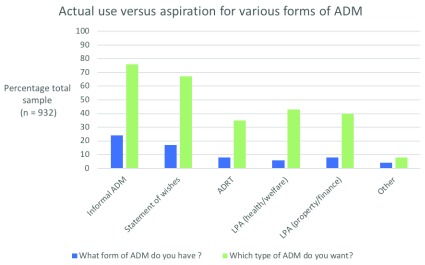
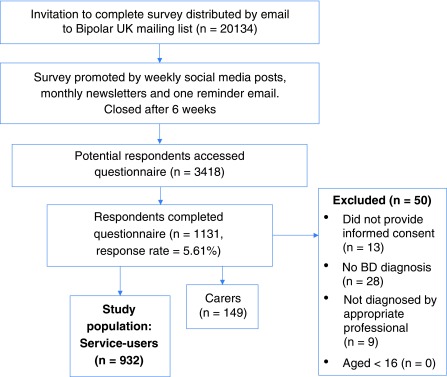
The idea that people with severe mental illness should be able to plan in advance for periods of illness as a means of enhancing autonomy has been long debated and is increasingly being enshrined in codes of practice and mental health legislation. It has been argued that the ethical imperative for this is especially pronounced in bipolar (BP), a condition in which sufferers often experience episodic crises interspersed with periods of wellness. However, there is a paucity of published research investigating experiences of advance decision making (ADM) in people with BP or their attitudes towards it. An online survey of BPUK's mailing list was conducted. 932 people with BP completed the survey (response rate 5.61%). Descriptive statistics and regression analysis were conducted to compare experience of with attitudes towards ADM and variables associated with interest in ADM. A majority indicated a desire to plan care in advance of losing capacity (88%) but most had not done so (64%). High numbers of respondents expressed a wish to request as well as refuse treatment and most wanted to collaborate with psychiatrists, including on issues around self-binding. The most frequent motivation to utilise ADM was a desire to be more involved in mental health decisions. Interest in self-binding was associated with experience of compulsory treatment and trust in mental health services. Interest in refusals of all medication was associated with younger age and lack of trust in mental health services. Interest in ADM in general was associated with younger age but not educational level, ethnicity or gender. This study demonstrates an appetite for ADM amongst people with bipolar that is independent of educational status and ethnicity. As states reform their mental health laws, attention needs to be given to the distinctive attitudes toward ADM amongst people with bipolar.
严重精神疾病患者应能够提前为患病期制定计划,以此增强自主性,这一观点长期以来一直备受争议,并且越来越多地被纳入实践准则和精神卫生立法之中。有人认为,对于双相情感障碍(BP)患者而言,这样做在伦理上的必要性尤为突出,因为该病患者经常经历间歇性危机,其间穿插着病情缓解期。然而,关于双相情感障碍患者的预先决策(ADM)经历或他们对此的态度,鲜有已发表的研究。对英国双相情感障碍协会邮件列表进行了一项在线调查。932名双相情感障碍患者完成了调查(回复率5.61%)。进行了描述性统计和回归分析,以比较预先决策的经历与对预先决策的态度,以及与对预先决策的兴趣相关的变量。大多数人表示希望在失去行为能力之前就规划护理(88%),但大多数人尚未这样做(64%)。大量受访者表示希望既能够请求治疗,也能够拒绝治疗,并且大多数人希望与精神科医生合作,包括在自我约束问题上。利用预先决策的最常见动机是希望更多地参与精神卫生决策。对自我约束的兴趣与强制治疗经历以及对精神卫生服务的信任有关。对拒绝所有药物治疗的兴趣与年龄较小以及对精神卫生服务缺乏信任有关。总体而言,对预先决策的兴趣与年龄较小有关,但与教育水平、种族或性别无关。这项研究表明,双相情感障碍患者对预先决策有兴趣,且这种兴趣与教育状况和种族无关。随着各国改革其精神卫生法律,需要关注双相情感障碍患者对预先决策的独特态度。