Navarro Grisel, Bravo Viviana, Gallo Carmen, Phillips Clive J C
Centre of Animal Welfare and Ethics, School of Veterinary Science, University of Queensland, Gatton, Queensland 4343, Australia.
Instituto de Ciencia Animal, Facultad de Ciencias Veterinarias, OIE Collaborating Centre for Animal Welfare and Livestock Production Systems-Chile, Universidad Austral de Chile, Valdivia 5090000, Chile.
Animals (Basel). 2019 May 10;9(5):229. doi: 10.3390/ani9050229.
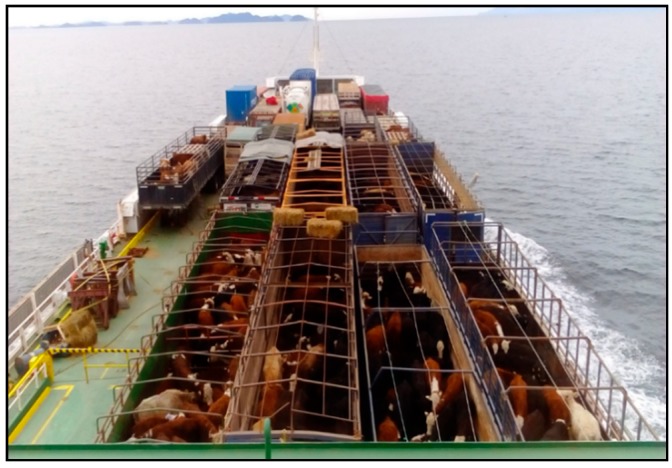
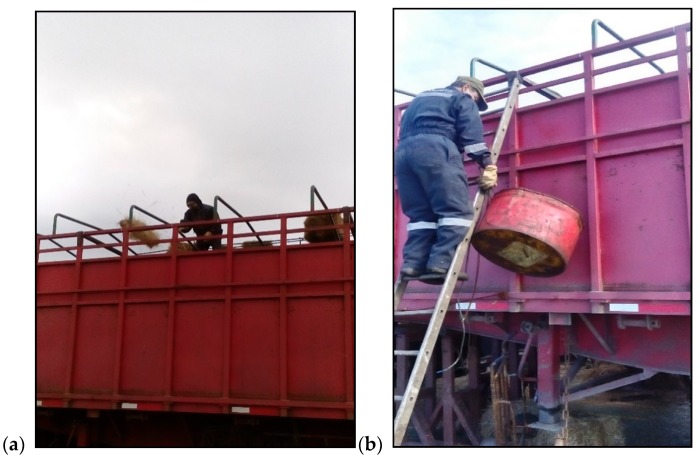
Long distance transport of livestock from Patagonia to central Chile involves both road and sea transport and has a potential impact on the welfare of animals. Fifty cattle of approximate age six months were exposed to a journey of four days, with both the sea and road components undertaken in a truck (roll-off roll-on system) with two pens of different dimensions. Thirty-two and eighteen cattle were randomly allocated to two treatment groups: Low and High welfare standards, which were provided 0.66 m/head and 0.86 m/head, respectively, and a fixed amount of feed and water daily to each pen, 1.25 kg hay/head and 3.1 L water/head in the Low welfare treatment and 2.22 kg/head and 5.6 L/head in the High welfare treatment, respectively. Low welfare animals had increased plasma total protein and albumin, which is suggested to be due to limited water availability, and also haptoglobin, suggesting inflammatory responses. Cattle in the High welfare treatment spent more time eating and ruminating than those in the Low space allowance, but they had increased cortisol at the end of the journey, perhaps reflecting increased fighting with more space. Cattle welfare in both treatments was adversely affected by the limited feed and water supplies, with increased beta-hydroxybutyrate at the end of the voyage; total protein was increased in just the low welfare standard group where low space allowance and less food and water was provided. Creatine phosphokinase also increased after the journey, compared with before, indicating bruising. Limiting feed and water availability to cattle in the low welfare treatment resulted in physiological evidence of undernutrition and low hydration status, but it also reduced the stress response, probably because there was less fighting.
将牲畜从巴塔哥尼亚长途运输到智利中部,涉及公路和海上运输,这对动物福利可能产生影响。五十头年龄约六个月的牛经历了为期四天的旅程,海路和公路运输均在一辆配备两个不同尺寸围栏的卡车(滚装滚卸系统)中进行。32头和18头牛被随机分配到两个处理组:低福利标准组和高福利标准组,分别为每头牛提供0.66平方米和0.86平方米的空间,并且每天给每个围栏固定量的饲料和水,低福利处理组为每头牛提供1.25千克干草和3.1升水,高福利处理组分别为每头牛提供2.22千克干草和5.6升水。低福利组动物的血浆总蛋白和白蛋白增加,这可能是由于水供应有限所致,同时触珠蛋白也增加,表明存在炎症反应。高福利处理组的牛比低空间组的牛进食和反刍时间更长,但在旅程结束时它们的皮质醇增加,这可能反映出有更多空间导致争斗增加。两种处理方式下的牛福利均受到饲料和水供应有限的不利影响,航行结束时β-羟基丁酸增加;仅在提供低空间且食物和水较少的低福利标准组中,总蛋白增加。与旅程前相比,旅程后肌酸磷酸激酶也增加,表明有瘀伤。在低福利处理中限制牛的饲料和水供应,导致出现营养不良和低水合状态的生理证据,但这也降低了应激反应,可能是因为争斗减少了。