Department of Social and Behavioural Sciences, City University of Hong Kong, Hong Kong, China.
School of Social Sciences, Caritas Institute of Higher Education, Hong Kong, China.
Int J Environ Res Public Health. 2019 May 11;16(9):1643. doi: 10.3390/ijerph16091643.
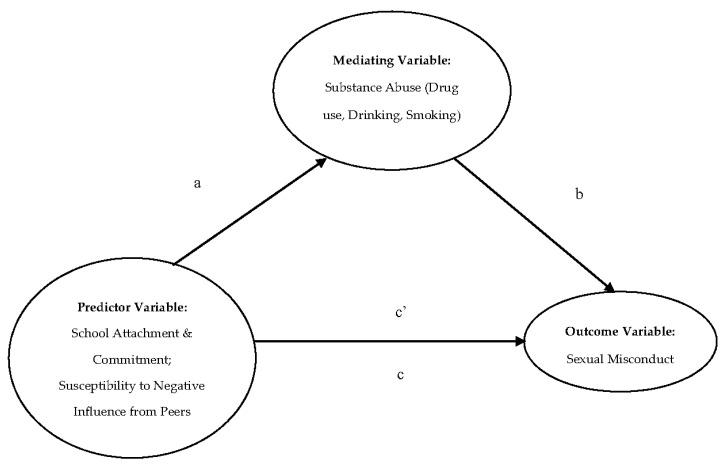
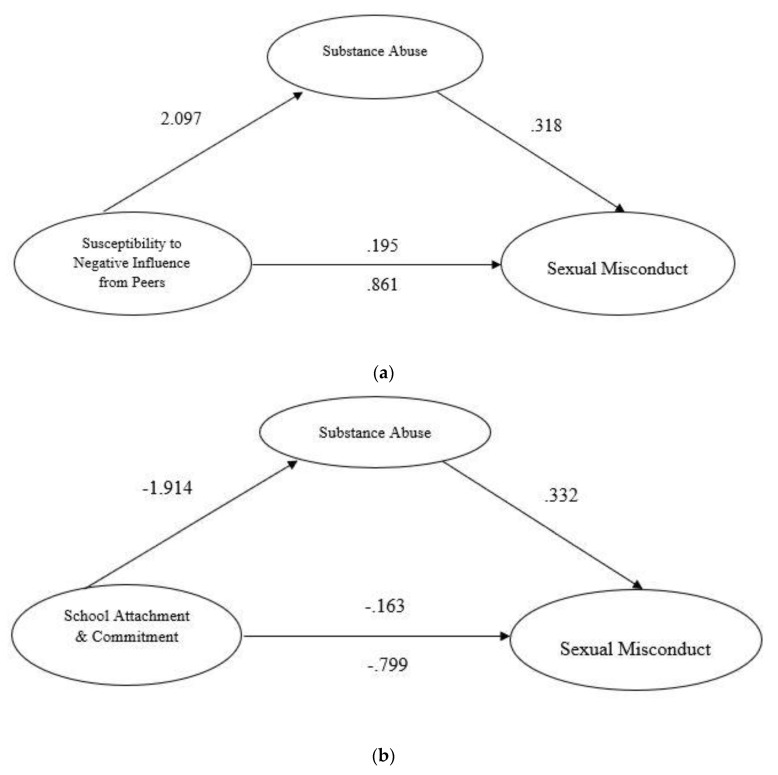
This study investigates how peer influence, school attachment, and substance abuse are related to sexual behavior, with particular interest in exploring the relationship between substance abuse and sexual misconduct, while using a stratified random sample of adolescents in Macau. Mediation analyses were employed. The results show that substance abuse, apart from susceptibility to peer influence and school attachment/commitment, was significantly related to sexual misconduct. Substance abuse was the best predictor of sexual misconduct, and it significantly mediated the relationship between susceptibility to peer influence, as well as school attachment and sexual misconduct. This reflects that the use of substances, including drugs, alcohol, and cigarettes, can be viewed as a catalyst for triggering engagement in sexual misconduct. The implications of this study involve taking measures to reduce the rate of substance abuse as a way of decreasing sexual misconduct in adolescents. Future research directions in exploring the relationship between adolescent substance abuse and risky sexual behavior are discussed.
本研究调查了同伴影响、学校依恋和药物滥用与性行为的关系,特别关注探索药物滥用与不当性行为之间的关系,同时使用澳门青少年的分层随机抽样。采用中介分析。结果表明,除了易受同伴影响和学校依恋/承诺的影响外,药物滥用与不当性行为显著相关。药物滥用是不当性行为的最佳预测指标,它显著中介了易受同伴影响以及学校依恋与不当性行为之间的关系。这反映出使用包括毒品、酒精和香烟在内的物质可以被视为引发不当性行为的催化剂。本研究的意义在于采取措施降低药物滥用率,从而减少青少年的不当性行为。讨论了探索青少年药物滥用与危险性行为之间关系的未来研究方向。