Guo Ying, Liu Lixin, Wang Jianjun
Department of Cardiology, The Affiliated Hospital of Jining Medical University, Jining 272049, China.
Department of Cardiology, The Affiliated Hospital of Jining Medical University, Jining 272049, China
Biosci Rep. 2019 Jun 10;39(6). doi: 10.1042/BSR20182284. Print 2019 Jun 28.
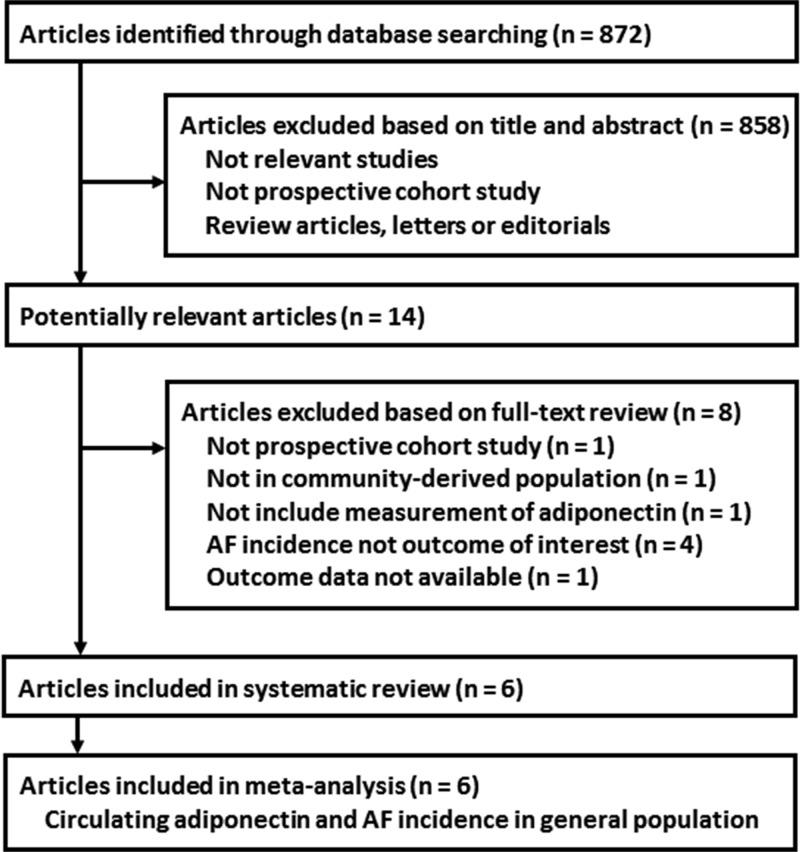
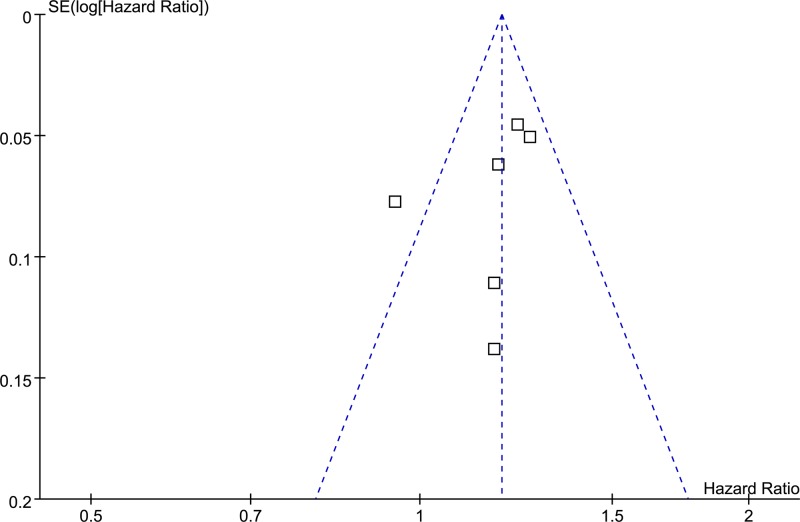
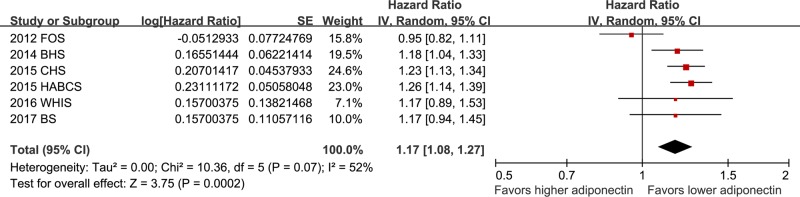
Adiponectin has been suggested as a marker of many cardiovascular diseases. However, the association between serum adiponectin and incidence of atrial fibrillation (AF) in general population remains unclear. A meta-analysis was performed to systematically evaluate the potential influence of serum adiponectin at baseline on the incidence of AF during follow-up in general population. Prospective cohort studies were identified via electronic search of PubMed and Embase databases. A randomized effect model was applied to combine the results. Predefined subgroup analyses were performed to evaluate the influence of study characteristics on the association between baseline adiponectin and risk of new-onset AF. Six cohort studies with 18558 community-derived participants were included, and 3165 AF cases were developed with a mean follow-up duration of up to 22 years. Meta-analysis showed that higher baseline circulating adiponectin was significantly associated with higher risk of new-onset AF during follow-up (hazard ratio [HR]: 1.17, 95% confidence interval [CI]: 1.08-1.27, <0.001, = 52%). Subgroup analyses showed that the association between adiponectin and new-onset AF was significant in studies with mean follow-up duration over 10 years (five cohorts, HR = 1.22, <0.001), but not in that with a follow-up duration < 10 years (one cohort, HR = 0.95, =0.51; for subgroup difference = 0.002). Higher circulating adiponectin at baseline may be an independent risk factor for the development of new-onset AF during follow-up, particularly in cohort studies with longer follow-up durations.
脂联素已被认为是多种心血管疾病的标志物。然而,一般人群中血清脂联素与房颤(AF)发生率之间的关联仍不明确。进行了一项荟萃分析,以系统评估基线时血清脂联素对一般人群随访期间房颤发生率的潜在影响。通过电子检索PubMed和Embase数据库确定前瞻性队列研究。应用随机效应模型合并结果。进行预定义的亚组分析,以评估研究特征对基线脂联素与新发房颤风险之间关联的影响。纳入了6项队列研究,共18558名社区参与者,其中3165例发生房颤,平均随访时间长达22年。荟萃分析表明,较高的基线循环脂联素与随访期间新发房颤的较高风险显著相关(风险比[HR]:1.17,95%置信区间[CI]:1.08 - 1.27,P<0.001,I² = 52%)。亚组分析表明,脂联素与新发房颤之间的关联在平均随访时间超过10年的研究中显著(5项队列研究,HR = 1.22,P<0.001),但在随访时间<10年的研究中不显著(1项队列研究,HR = 0.95,P = 0.51;亚组差异P = 0.002)。基线时较高的循环脂联素可能是随访期间新发房颤发生的独立危险因素,特别是在随访时间较长的队列研究中。