Department of Neurosurgery, Beijing Tiantan Hospital, Capital Medical University, Fanyang Road, Fengtai District, Beijing, 100070, People's Republic of China.
Department of Neurosurgery, First Affiliated Hospital of Xinjiang Medical University, Ürümqi, China.
Cardiovasc Diabetol. 2019 Aug 14;18(1):105. doi: 10.1186/s12933-019-0908-z.
Although adiponectin is a major adipocytokine that affects the pathogenesis of various cardiovascular diseases, its clinical significance in stroke remains controversial. The purpose of this study was to assess the impact of serum adiponectin levels on functional prognosis in patients with ischemic stroke.
This was a prospective, observational cohort study. Consecutive first-ever ischemic stroke patients without any pre-morbid handicap admitted to our hospital were identified from December 2017 to December 2018. Serum concentration of adiponectin was routinely measured within the first 24 h after admission by a commercially available sandwich ELISA. Associations between adiponectin and either clinical severity at admission, poor outcomes or mortality at 3-month after admission were analyzed using logistic regression to obtain odds ratios (OR) and 95% confidence intervals (CI).
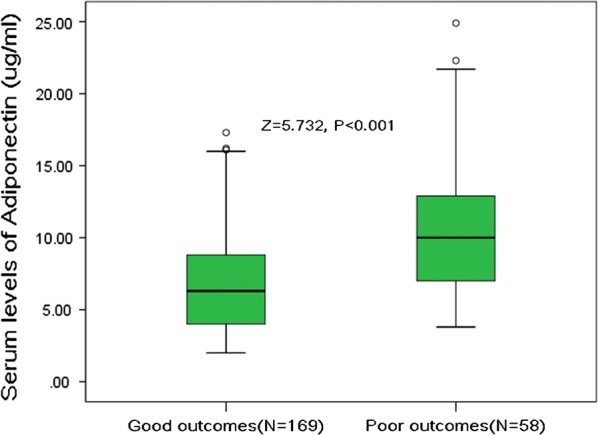
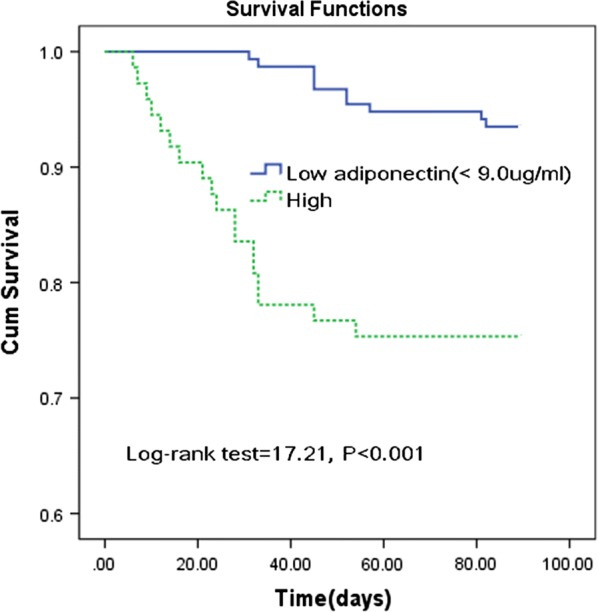
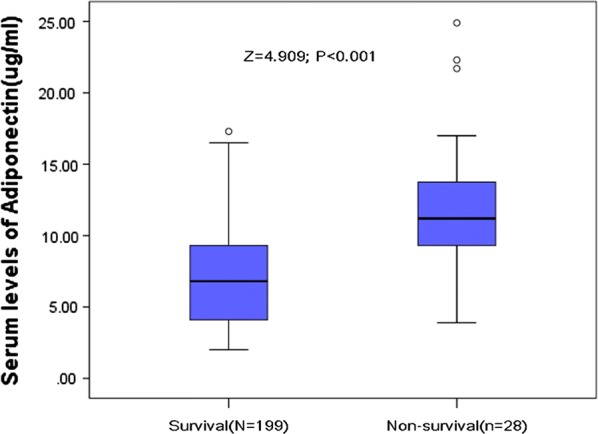
The serum level of adiponectin was obtained in 227 patients with a median value of 7.0 μg/ml, which was significantly higher (P < 0.001) than in those heathy control. Adiponectin levels were associated with moderate-to-high stroke, and risk increased by 12% (OR = 1.12; 95% CI 1.03-1.25; P = 0.002). Patients with a poor outcome and nonsurvivors had significantly increased adiponectin levels on admission (P < 0.001, all). In multivariate logistic regression analysis, adiponectin was an independent predictor of functional outcome and mortality, and risk increased by 24% (OR = 1.24, 95% CI 1.13-1.37; P < 0.001) and 31% (1.31 [1.18-1.46], P < 0.001), respectively. Kaplan-Meier analysis suggested that the patients with high serum adiponectin levels had a higher risk of death than those patients with low levels (log-rank test P < 0.001).
Our results show that high adiponectin is associated with stroke severity and support the hypothesis that adiponectin can be serve as a biomarker of poor outcome after stroke, independent of baseline variables. Trial registration ChiCTR-OPC-17013501. Retrospectively Registered 21 September 2017.
脂联素是一种主要的脂肪细胞因子,可影响各种心血管疾病的发病机制,但它在中风中的临床意义仍存在争议。本研究旨在评估血清脂联素水平对缺血性中风患者功能预后的影响。
这是一项前瞻性、观察性队列研究。连续纳入 2017 年 12 月至 2018 年 12 月期间我院收治的无脑前残疾的首次缺血性中风患者。通过商业夹心 ELISA 法在入院后 24 小时内常规测定血清脂联素浓度。采用 logistic 回归分析脂联素与入院时临床严重程度、不良结局或入院后 3 个月死亡率之间的关系,以获得比值比(OR)和 95%置信区间(CI)。
共 227 例患者获得血清脂联素水平,中位数为 7.0μg/ml,明显高于健康对照组(P<0.001)。脂联素水平与中重度中风相关,风险增加 12%(OR=1.12;95%CI 1.03-1.25;P=0.002)。不良结局和死亡患者入院时的脂联素水平显著升高(均 P<0.001)。多变量 logistic 回归分析显示,脂联素是功能结局和死亡率的独立预测因子,风险分别增加 24%(OR=1.24,95%CI 1.13-1.37;P<0.001)和 31%(1.31[1.18-1.46],P<0.001)。Kaplan-Meier 分析表明,血清脂联素水平较高的患者死亡风险高于水平较低的患者(对数秩检验 P<0.001)。
我们的结果表明,高水平的脂联素与中风严重程度相关,并支持脂联素可作为中风后不良结局的生物标志物的假说,独立于基线变量。试验注册 ChiCTR-OPC-17013501。回顾性注册 2017 年 9 月 21 日。