Key Laboratory of Control of Biological Hazard Factors (Plant Origin) for Agri-product Quality and Safety, Ministry of Agriculture and Rural Affairs of the People's Republic of China, Institute of Plant protection, Chinese Academy of Agricultural Sciences, Beijing, 100193, China.
Sci Rep. 2019 May 14;9(1):7330. doi: 10.1038/s41598-019-43433-x.
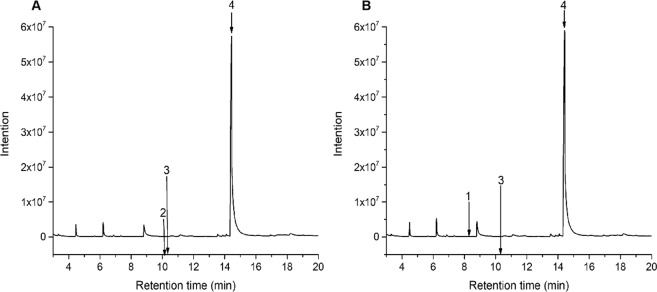
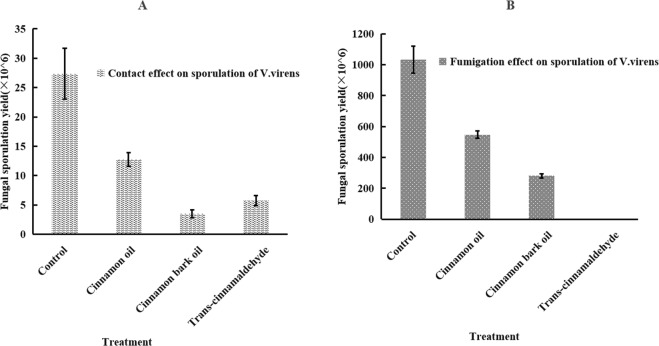
Rice false smut (RFS), caused by Villosiclava virens, is an emerging devastating disease of rice panicles worldwide and produces yield loss and mycotoxin residues in rice. In this study, 18 plant essential oils (PEOs) were selected to evaluate antifungal activity via fumigation and contact methods against the mycelial growth and conidial germination of V. virens. The primary compositions of PEOs with stronger fungistatic activity were analyzed using gas chromatography (GC)-mass spectrometry (MS), and the changes in the mycelial morphology were observed using scanning electron microscopy (SEM). Antifungal tests showed that cinnamon bark oil and cinnamon oil had stronger fumigation and contact effects on V. virens than the other oils tested. The primary active composition in both cinnamon bark oil and cinnamon oil was trans-cinnamaldehyde, which exhibited contact activities with EC values of 2.13 and 35.9 μg/mL against mycelial growth and conidial germination, respectively. The hyphae surface morphological alterations caused by cinnamon bark oil, cinnamon oil and trans-cinnamaldehyde included shriveling, vacuolation and exfoliation. In conclusion, cinnamon bark oil and cinnamon oil have the potential to prevent and control RFS, and trans-cinnamaldehyde is a promising natural lead compound for new fungicide discoveries to control RFS contamination and mycotoxin residues in rice.
稻曲病菌(Villosiclava virens)引起的稻曲病是一种全球范围内新兴的毁灭性稻穗病害,可导致稻米减产和真菌毒素残留。本研究采用熏蒸和接触法,选择了 18 种植物精油(PEOs),评估其对稻曲病菌菌丝生长和分生孢子萌发的抑菌活性。采用气相色谱(GC)-质谱(MS)分析抑菌活性较强的 PEO 的主要成分,并通过扫描电子显微镜(SEM)观察菌丝形态的变化。抑菌试验表明,肉桂皮油和肉桂油对稻曲病菌的熏蒸和接触作用均强于其他测试油。肉桂皮油和肉桂油中的主要活性成分均为反式肉桂醛,对菌丝生长和分生孢子萌发的 EC 值分别为 2.13 和 35.9μg/mL,表现出接触活性。肉桂皮油、肉桂油和反式肉桂醛导致的菌丝表面形态变化包括皱缩、空泡化和剥落。综上所述,肉桂皮油和肉桂油具有防治稻曲病的潜力,反式肉桂醛是一种很有前途的天然先导化合物,可用于发现新的杀菌剂,以控制稻曲病污染和稻米中的真菌毒素残留。