Center for Engineering in Medicine at Massachusetts General Hospital, Harvard Medical School, and Shriners Hospital for Children, 51 Blossom St., Boston, MA, 02114, USA.
Department of Chemical and Biological Engineering, Tufts University, 4 Colby Street, Medford, MA, 02474, USA.
Sci Rep. 2019 May 14;9(1):7377. doi: 10.1038/s41598-019-43625-5.
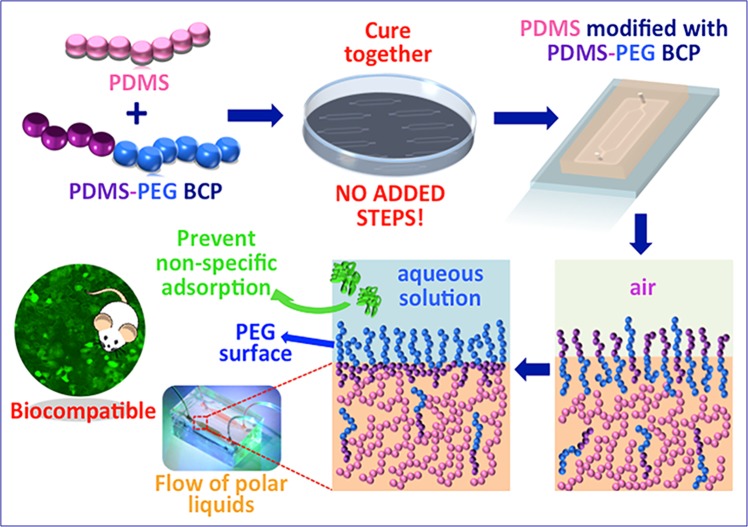
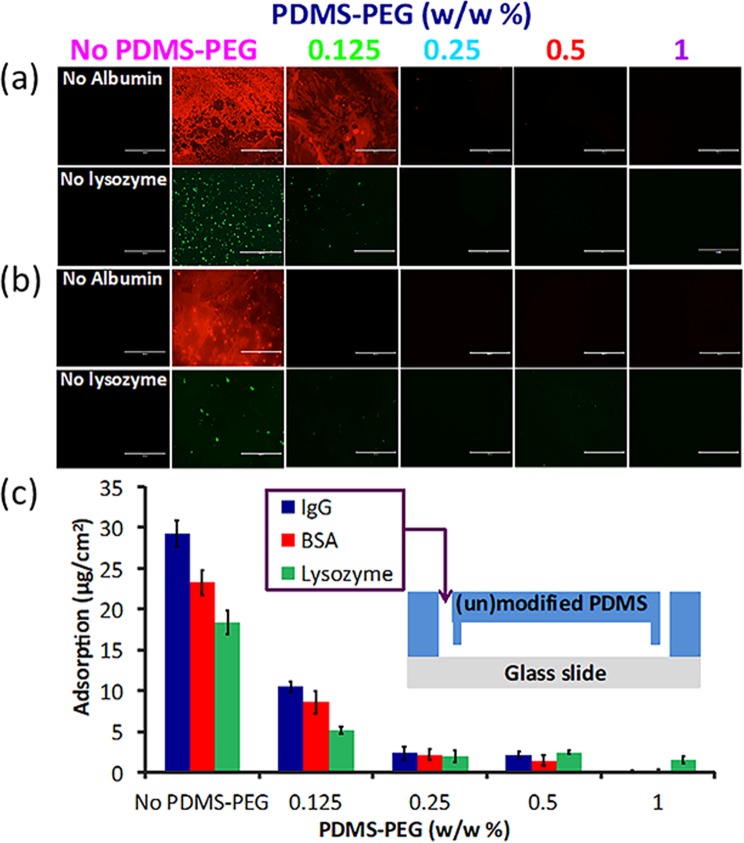
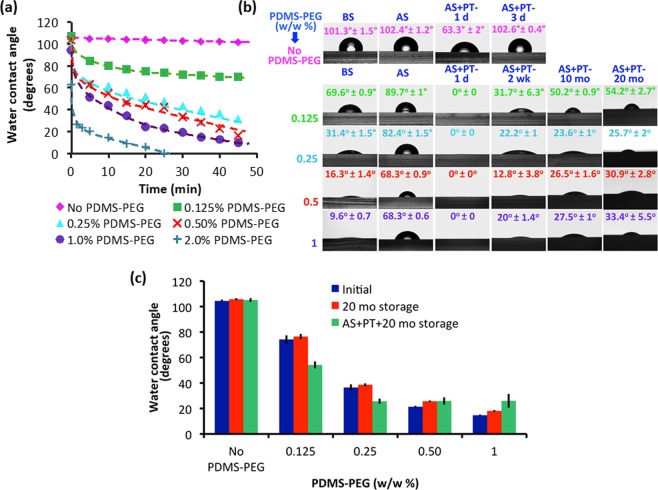
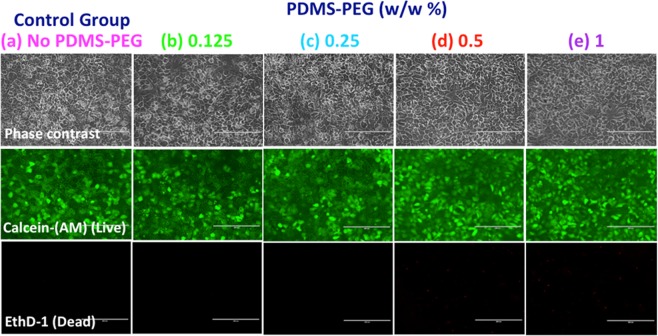
Poly(dimethylsiloxane) (PDMS) is likely the most popular material for microfluidic devices in lab-on-a-chip and other biomedical applications. However, the hydrophobicity of PDMS leads to non-specific adsorption of proteins and other molecules such as therapeutic drugs, limiting its broader use. Here, we introduce a simple method for preparing PDMS materials to improve hydrophilicity and decrease non-specific protein adsorption while retaining cellular biocompatibility, transparency, and good mechanical properties without the need for any post-cure surface treatment. This approach utilizes smart copolymers comprised of poly(ethylene glycol) (PEG) and PDMS segments (PDMS-PEG) that, when blended with PDMS during device manufacture, spontaneously segregate to surfaces in contact with aqueous solutions and reduce the hydrophobicity without any added manufacturing steps. PDMS-PEG-modified PDMS samples showed contact angles as low as 23.6° ± 1° and retained this hydrophilicity for at least twenty months. Their improved wettability was confirmed using capillary flow experiments. Modified devices exhibited considerably reduced non-specific adsorption of albumin, lysozyme, and immunoglobulin G. The modified PDMS was biocompatible, displaying no adverse effects when used in a simple liver-on-a-chip model using primary rat hepatocytes. This PDMS modification method can be further applied in analytical separations, biosensing, cell studies, and drug-related studies.
聚二甲基硅氧烷(PDMS)很可能是用于微流控芯片和其他生物医学应用的最流行的材料。然而,PDMS 的疏水性导致蛋白质和其他分子(如治疗药物)的非特异性吸附,限制了其更广泛的应用。在这里,我们介绍了一种简单的 PDMS 材料制备方法,该方法可以提高亲水性,减少非特异性蛋白质吸附,同时保持细胞生物相容性、透明度和良好的机械性能,而无需任何后固化表面处理。这种方法利用由聚乙二醇(PEG)和 PDMS 段组成的智能共聚物(PDMS-PEG),当在器件制造过程中与 PDMS 混合时,会在与水溶液接触的表面自动分离,并降低疏水性,而无需任何额外的制造步骤。PDMS-PEG 改性的 PDMS 样品的接触角低至 23.6°±1°,并且至少保持 20 个月的亲水性。使用毛细管流动实验证实了其润湿性的提高。改性器件对白蛋白、溶菌酶和免疫球蛋白 G 的非特异性吸附有明显减少。改性的 PDMS 具有生物相容性,在使用原代大鼠肝细胞的简单肝芯片模型中使用时没有不良影响。这种 PDMS 改性方法可以进一步应用于分析分离、生物传感、细胞研究和与药物相关的研究。