Soegiarto Gatot, Abdullah Mai Shihah, Damayanti Luki Agustina, Suseno Arief, Effendi Chaerul
Allergy and Clinical Immunology Division, Department of Internal Medicine, Faculty of Medicine, Universitas Airlangga, Surabaya, Indonesia.
Department of Biology, Science and Technology Faculty, Universiti Pendidikan Sultan Idris, Tanjong Malim, Malaysia.
Asia Pac Allergy. 2019 Apr 20;9(2):e17. doi: 10.5415/apallergy.2019.9.e17. eCollection 2019 Apr.
The prevalence of allergy among Surabaya school children is currently unknown.
To identify the prevalence of the common allergic sensitization and allergic diseases among school children and undergraduate students in suburban of Surabaya by epidemiologic data collection.
A multistage simple random sampling was done to select 5 primary schools, 8 secondary schools (4 of junior high schools and senior high schools, respectively), and 1 university from 5 districts in Surabaya city. Out of 550 invited respondents, 499 (128 primary school, 221 secondary school, and 150 undergraduate) respondents gave their consent. A complete personal history, allergic symptoms, environmental exposure of common allergens was obtained from interview and the physical examinations were performed. Skin prick test (SPT) was done using 45 different allergen extracts. Total serum IgE and specific IgE radioallergosorbent test levels were measured for respondents with allergic manifestations.
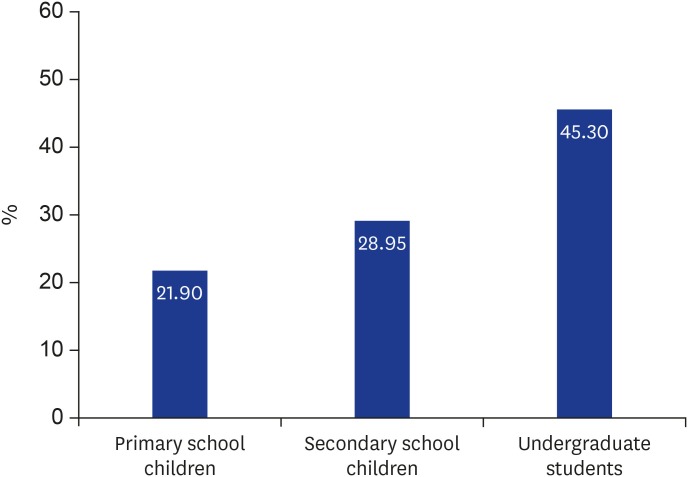
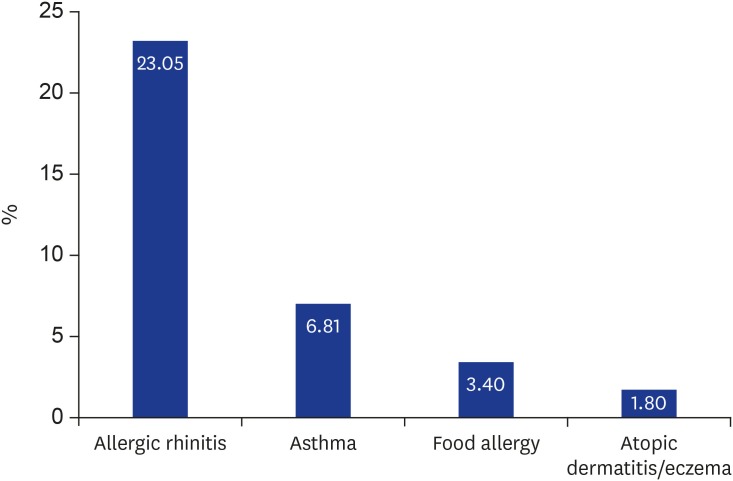
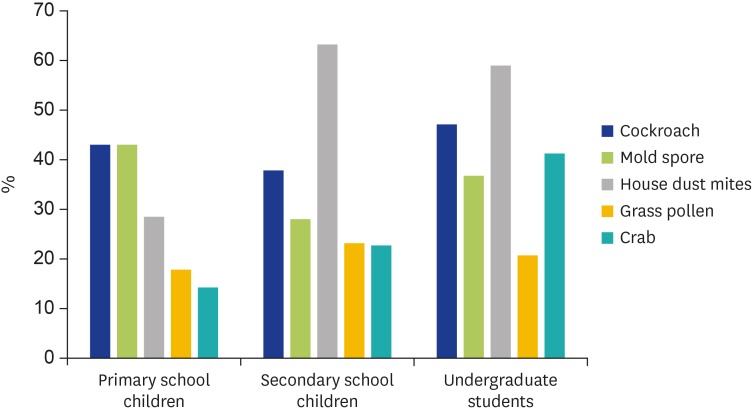
There was an increasing SPT positivity among study respondents, from primary school, secondary school, to undergraduate students (21.90%, 28.95%, to 45.30% respectively). Cockroach (42.85%) and fungi/mold spore (42.85%) were the most common allergens in primary school children. House dust mites was the most common allergen in secondary school (63.16%) and undergraduate students (58.82%). Urticaria and rhinitis were the commonest allergic diseases manifestation. History of atopy was positive in 60.79% of the allergic respondents.
The prevalence of allergic sensitization among school children and undergraduate students in Surabaya suburb areas were increased compared to previous estimates in 1998. While house dust mites are known as important allergens, surprisingly cockroach was the common allergen among the younger school children.
目前尚不清楚泗水学童的过敏患病率。
通过流行病学数据收集,确定泗水郊区学童和大学生中常见过敏致敏和过敏性疾病的患病率。
采用多阶段简单随机抽样法,从泗水市5个区中选取5所小学、8所中学(初中和高中各4所)和1所大学。在550名受邀受访者中,499名(128名小学生、221名中学生和150名大学生)受访者表示同意。通过访谈获取完整的个人病史、过敏症状、常见过敏原的环境暴露情况,并进行体格检查。使用45种不同的过敏原提取物进行皮肤点刺试验(SPT)。对有过敏表现的受访者测量总血清IgE和特异性IgE放射变应原吸附试验水平。
研究受访者的SPT阳性率呈上升趋势,从小学生、中学生到大学生(分别为21.90%、28.95%和45.30%)。蟑螂(42.85%)和真菌/霉菌孢子(42.85%)是小学生中最常见的过敏原。屋尘螨是中学生(63.16%)和大学生(58.82%)中最常见 的过敏原。荨麻疹和鼻炎是最常见的过敏性疾病表现。60.79%的过敏受访者的特应性病史呈阳性。
与1998年之前的估计相比,泗水郊区学童和大学生的过敏致敏患病率有所增加。虽然屋尘螨是已知的重要过敏原,但令人惊讶的是,蟑螂是较小学龄儿童中常见的过敏原。