CSIRO Agriculture and Food, Canberra, ACT, Australia.
J Exp Bot. 2019 Sep 24;70(18):4963-4974. doi: 10.1093/jxb/erz232.
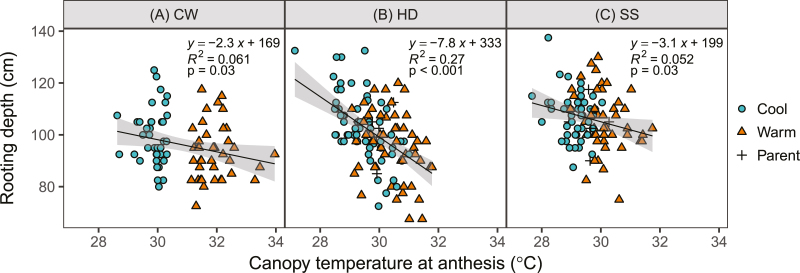
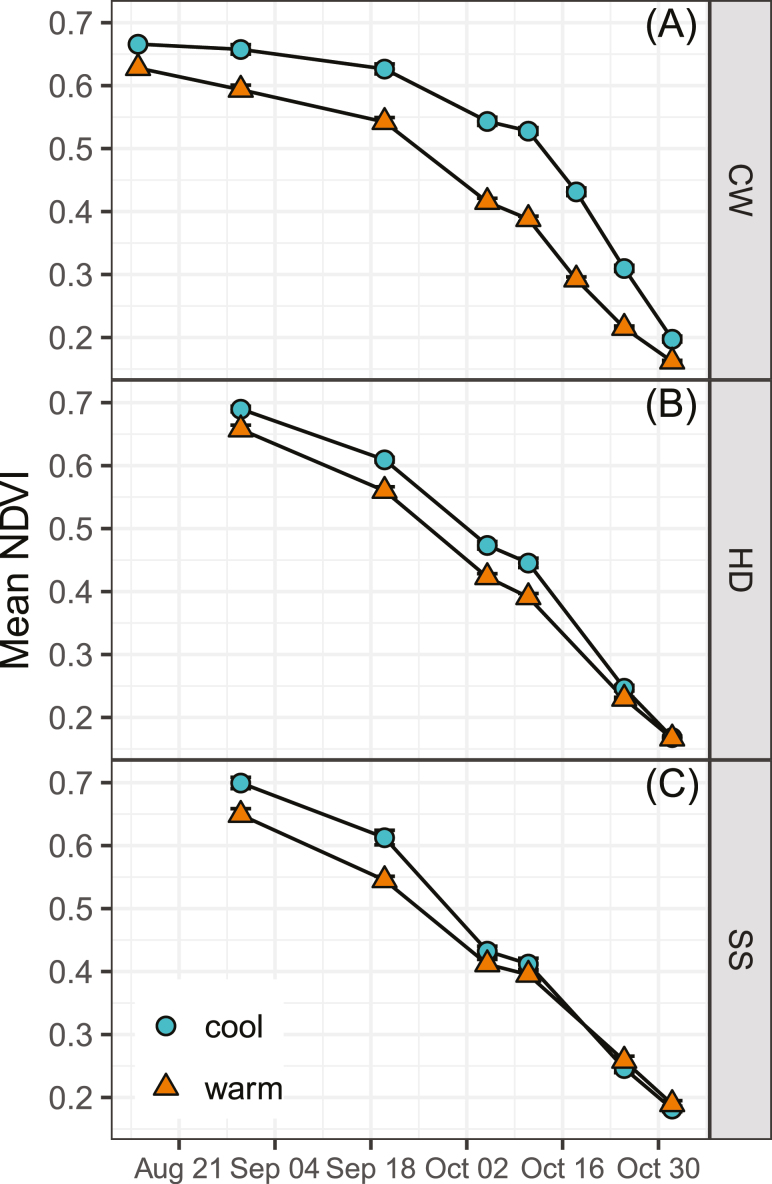
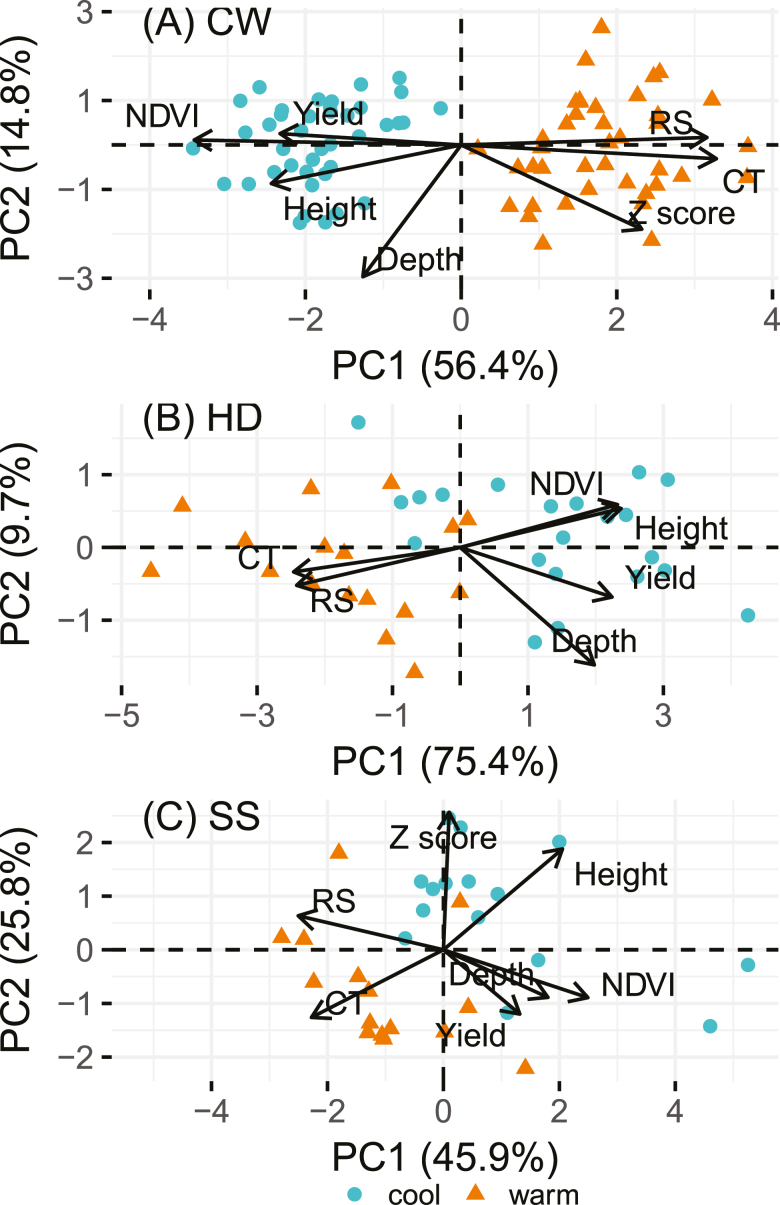
Simple and repeatable methods are needed to select for deep roots under field conditions. A large-scale field experiment was conducted to assess the association between canopy temperature (CT) measured by airborne thermography and rooting depth determined by the core-break method. Three wheat populations, C306×Westonia (CW), Hartog×Drysdale (HD), and Sundor×Songlen (SS), were grown on stored soil water in NSW Australia in 2017 (n=196-252). Cool and warm CT extremes ('tails') were cored after harvest (13-32% of each population). Rooting depth was significantly correlated with CT at late flowering (r= -0.25, -0.52, and -0.23 for CW, HD, and SS, respectively, P<0.05 hereafter), with normalized difference vegetation index (NDVI) at early grain filling (r=0.30-0.39), and with canopy height (r=0.23-0.48). The cool tails showed significantly deeper roots than the respective warm tails by 8.1 cm and 6.2 cm in CW and HD, and correspondingly, greater yields by an average 19% and 7%, respectively. This study highlighted that CT measured rapidly by airborne thermography or NDVI at early grain filling could be used to guide selection of lines with deeper roots to increase wheat yields. The remote measurement methods in this study were repeatable and high throughput, making them well suited to use in breeding programmes.
需要简单且可重复的方法来在田间条件下选择深根。本研究进行了一项大规模田间试验,以评估机载热成像测量的冠层温度(CT)与芯样法确定的根系深度之间的关系。2017 年,在澳大利亚新南威尔士州,利用储存的土壤水分种植了三个小麦群体,C306×Westonia(CW)、Hartog×Drysdale(HD)和 Sundor×Songlen(SS)(n=196-252)。收获后对凉爽和温暖 CT 极端值(“尾端”)进行芯样(每个群体分别占 13-32%)。在开花后期,根系深度与 CT 显著相关(CW、HD 和 SS 的 r 值分别为-0.25、-0.52 和-0.23,以下 P<0.05),与早期灌浆期的归一化差异植被指数(NDVI)(r 值为 0.30-0.39)和冠层高度(r 值为 0.23-0.48)显著相关。在 CW 和 HD 中,凉爽尾端的根系明显比各自的温暖尾端深 8.1 厘米和 6.2 厘米,相应地,产量分别增加了 19%和 7%。本研究强调,机载热成像或早期灌浆期 NDVI 快速测量的 CT 可以用于指导选择根系更深的品系,以提高小麦产量。本研究中使用的远程测量方法可重复且高通量,非常适合用于育种计划。