Deery David M, Rebetzke Greg J, Jimenez-Berni Jose A, James Richard A, Condon Anthony G, Bovill William D, Hutchinson Paul, Scarrow Jamie, Davy Robert, Furbank Robert T
CSIRO Agriculture and Food Canberra, ACT, Australia.
High Resolution Plant Phenomics Centre, Australian Plant Phenomics Facility, CSIRO Agriculture and Food Canberra, ACT, Australia.
Front Plant Sci. 2016 Dec 6;7:1808. doi: 10.3389/fpls.2016.01808. eCollection 2016.
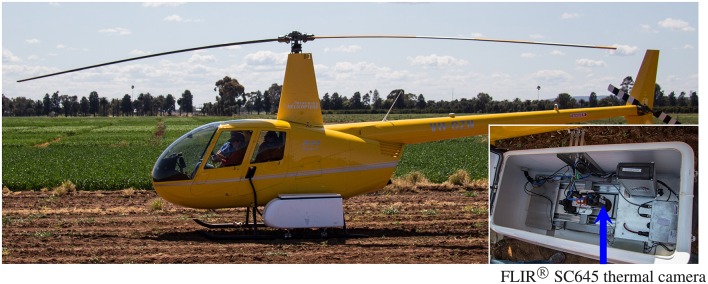
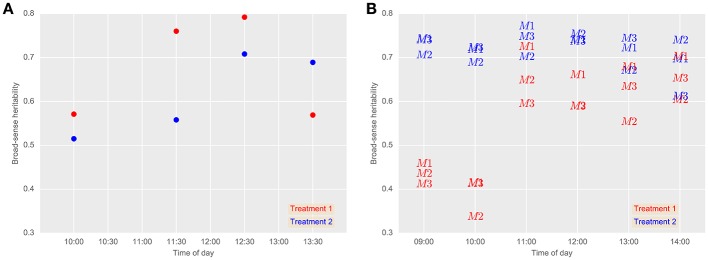
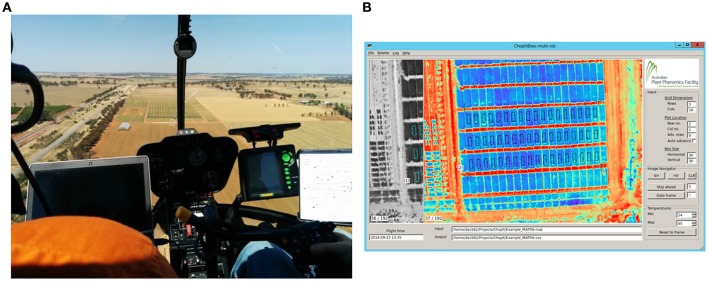
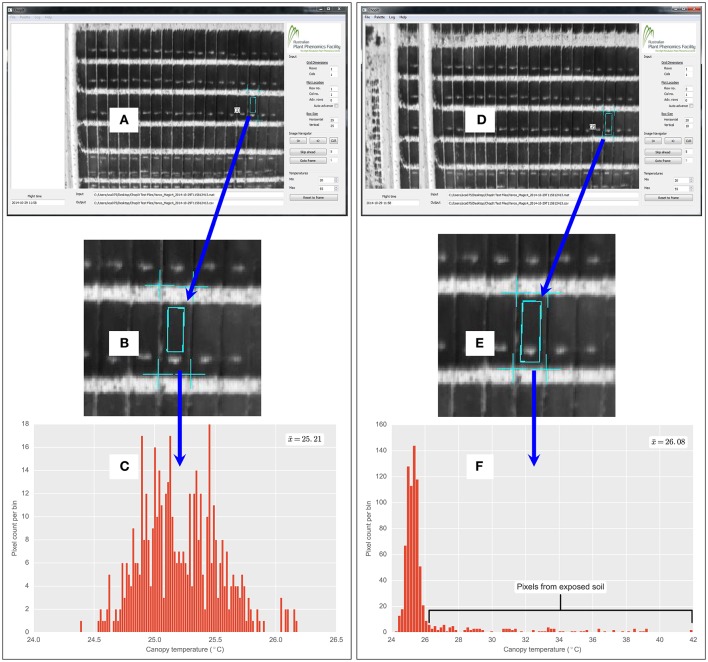
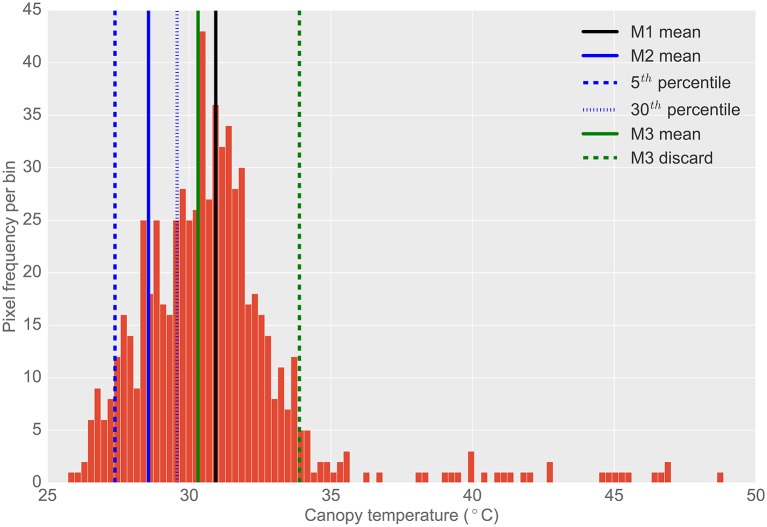
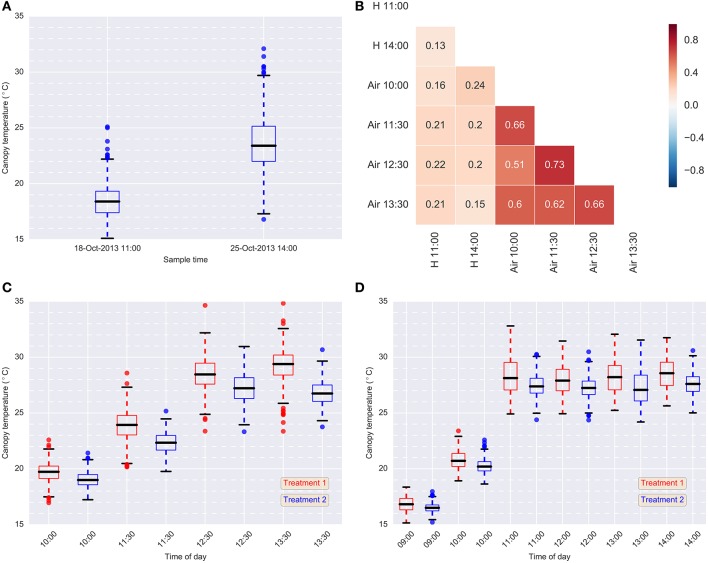
Lower canopy temperature (CT), resulting from increased stomatal conductance, has been associated with increased yield in wheat. Historically, CT has been measured with hand-held infrared thermometers. Using the hand-held CT method on large field trials is problematic, mostly because measurements are confounded by temporal weather changes during the time required to measure all plots. The hand-held CT method is laborious and yet the resulting heritability low, thereby reducing confidence in selection in large scale breeding endeavors. We have developed a reliable and scalable crop phenotyping method for assessing CT in large field experiments. The method involves airborne thermography from a manned helicopter using a radiometrically-calibrated thermal camera. Thermal image data is acquired from large experiments in the order of seconds, thereby enabling simultaneous measurement of CT on potentially 1000s of plots. Effects of temporal weather variation when phenotyping large experiments using hand-held infrared thermometers are therefore reduced. The method is designed for cost-effective and large-scale use by the non-technical user and includes custom-developed software for data processing to obtain CT data on a single-plot basis for analysis. Broad-sense heritability was routinely >0.50, and as high as 0.79, for airborne thermography CT measured near anthesis on a wheat experiment comprising 768 plots of size 2 × 6 m. Image analysis based on the frequency distribution of temperature pixels to remove the possible influence of background soil did not improve broad-sense heritability. Total image acquisition and processing time was 25 min and required only one person (excluding the helicopter pilot). The results indicate the potential to phenotype CT on large populations in genetics studies or for selection within a plant breeding program.
较低的冠层温度(CT)是由气孔导度增加引起的,与小麦产量增加有关。历史上,CT是用手持式红外温度计测量的。在大型田间试验中使用手持式CT方法存在问题,主要是因为在测量所有地块所需的时间内,测量会受到天气随时间变化的干扰。手持式CT方法费力且遗传力低,从而降低了大规模育种选择的可信度。我们开发了一种可靠且可扩展的作物表型分析方法,用于在大型田间试验中评估CT。该方法包括使用经过辐射校准的热成像相机从载人直升机上进行航空热成像。热图像数据可在几秒钟内从大型试验中获取,从而能够同时测量潜在的数千个地块的CT。因此,使用手持式红外温度计对大型试验进行表型分析时,天气随时间变化的影响得以降低。该方法专为非技术用户进行经济高效的大规模使用而设计,包括定制开发的用于数据处理的软件,以获取单地块的CT数据进行分析。在一个包含768个2×6米大小地块的小麦试验中,在花期附近测量的航空热成像CT的广义遗传力通常>0.50,高达0.79。基于温度像素频率分布的图像分析以消除背景土壤的可能影响,并没有提高广义遗传力。图像采集和处理总时间为25分钟,仅需一人(不包括直升机飞行员)。结果表明,在遗传学研究中或在植物育种计划中进行选择时,对大量群体进行CT表型分析具有潜力。