Department of Psychology.
Neuropsychology. 2019 Sep;33(6):883-892. doi: 10.1037/neu0000562. Epub 2019 May 16.
Deficits in the ability to perceive time have been proposed as an etiologic mechanism in the development of the cognitive and behavioral characteristics associated with ADHD. However, previous studies testing the presence of timing deficits have produced idiosyncratic results. This is in large part due to the underutilization of insights from basic timing research, and from the inherent difficulty that arises when a single index of performance (i.e., reaction time [RT] or accuracy) is used to index the health of what is essentially a multiple-component process. The current article utilizes a diffusion model approach to isolate the component processes involved in timing (i.e., internal clock speed, decision-making speed, speed/accuracy trade-off strategies, and nondecision time) using a well-validated timing task.
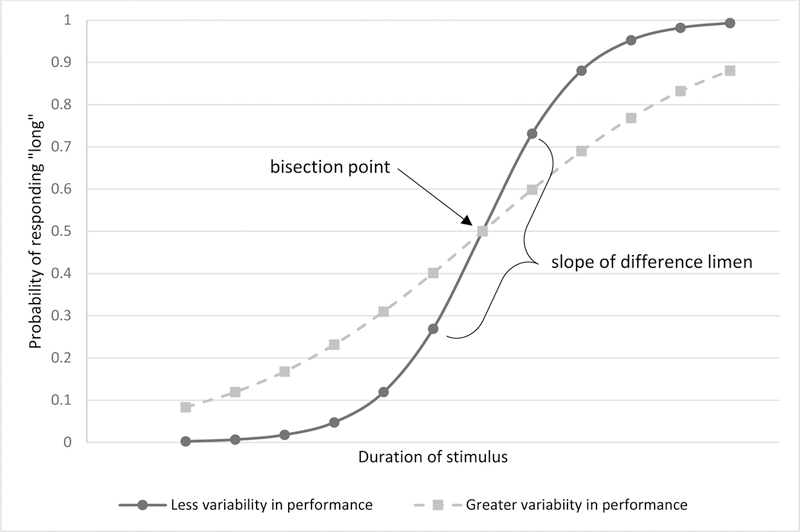
Fifty children with ADHD and 32 non-ADHD controls aged 8-12 completed a temporal bisection procedure.
Diffusion model parameters indicated that both the internal clock and decision-making speeds were slower among children with ADHD. However, the strength of evidence for slowed decision making far outweighed evidence for a slower internal clock.
Slower evidence accumulation during decision making is domain-general deficit in ADHD. Such slowing is consistent with adaptive-gain theories, which posit that a suboptimal ratio of neural signal-to-noise is characteristic of children with ADHD. (PsycINFO Database Record (c) 2019 APA, all rights reserved).
感知时间的能力缺陷被认为是 ADHD 相关认知和行为特征发展的一种病因机制。然而,之前测试时间缺陷存在的研究产生了特殊的结果。这在很大程度上是由于基本时间研究的见解未被充分利用,以及当使用单一的绩效指标(即反应时间[RT]或准确性)来指示本质上是多组件过程的健康状况时,会出现固有的困难。本文利用扩散模型方法,使用经过充分验证的计时任务,分离计时涉及的组件过程(即内部时钟速度、决策速度、速度/准确性权衡策略和非决策时间)。
50 名 ADHD 儿童和 32 名非 ADHD 对照者(年龄 8-12 岁)完成了时间二分程序。
扩散模型参数表明,ADHD 儿童的内部时钟和决策速度都较慢。然而,决策速度较慢的证据远远超过了内部时钟较慢的证据。
在决策过程中,证据积累速度较慢是 ADHD 的一种普遍缺陷。这种减速与自适应增益理论一致,该理论认为,神经信号与噪声的比例不理想是 ADHD 儿童的特征。(APA,保留所有权利)。