Department of Psychology and Social, Life, and Engineering Imaging Center (SLEIC).
Department of Psychology.
Neuropsychology. 2019 Oct;33(7):922-933. doi: 10.1037/neu0000559. Epub 2019 May 16.
To examine the role that intrinsic functional networks, specifically the default mode network, have on metacognitive accuracy for individuals with moderate to severe traumatic brain injury (TBI).
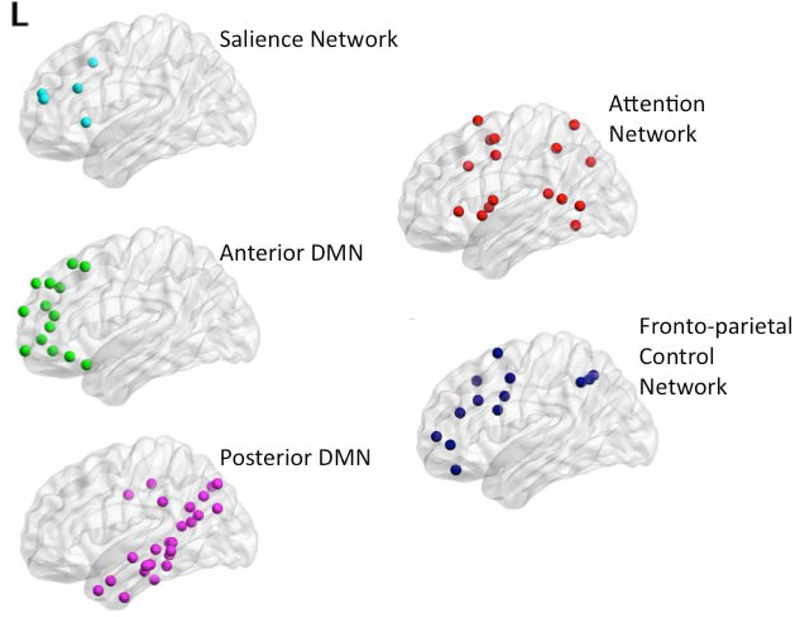
A sample of 44 individuals (TBI, n = 21; healthy controls [HCs], n = 23) were included in the study. All participants underwent an MRI scan and completed neuropsychological testing. Metacognitive accuracy was defined as participants' ability to correctly judge their item-by-item performance on an abstract reasoning task. Metacognitive values were calculated using the signal detection theory approach of area under the receiver operating characteristic curve. Large-scale subnetworks were created using Power's 264 Functional Atlas. The graph theory metric of network strength was calculated for six subsystem networks to measure functional connectivity.
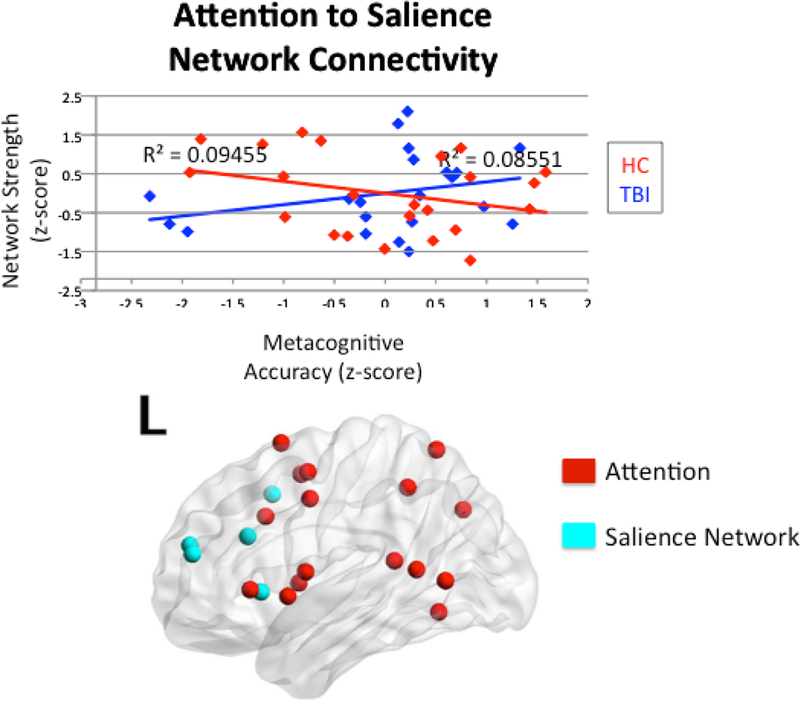
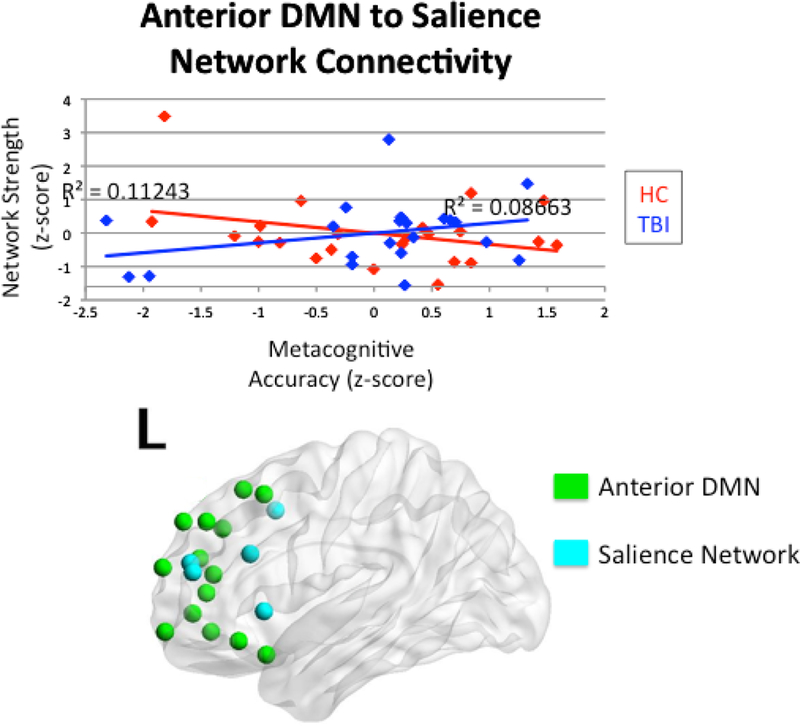
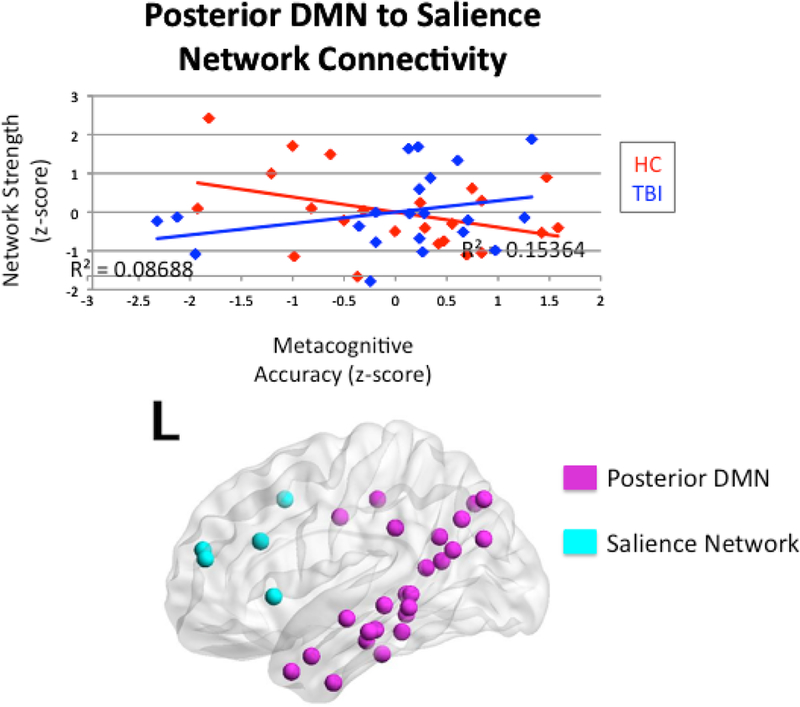
There were significant interactions between head injury status (TBI or HC) and internetwork connectivity between the anterior default mode network (DMN) and salience network on metacognitive accuracy (R2 = 0.13, p = .047) and between the posterior DMN and salience network on metacognitive accuracy (R2 = 0.15, p = .038). There was an interpretable interaction between head injury status and internetwork connectivity between the attention network and salience network on metacognitive accuracy (R2 = 0.13, p = .067). In all interactions, higher connectivity predicted better metacognitive accuracy in the TBI group, but this relationship was reversed for the HC group.
Enhanced connectivity to both anterior and posterior regions within the DMN facilitates metacognitive accuracy postinjury. These findings are integrated into a larger literature examining network plasticity in TBI. (PsycINFO Database Record (c) 2019 APA, all rights reserved).
探讨固有功能网络(尤其是默认模式网络)对中重度创伤性脑损伤(TBI)个体元认知准确性的作用。
本研究纳入了 44 名个体(TBI 组,n=21;健康对照组[HCs],n=23)。所有参与者均接受 MRI 扫描和神经心理学测试。元认知准确性定义为参与者正确判断其在抽象推理任务中逐项表现的能力。使用受试者工作特征曲线下的信号检测理论方法计算元认知值。使用 Power 的 264 功能图谱创建大规模子网。计算六个子系统网络的网络强度图论度量,以测量功能连接。
在元认知准确性方面,头部损伤状态(TBI 或 HCs)与前默认模式网络(DMN)和突显网络之间的网络间连通性之间存在显著的交互作用(R2=0.13,p=0.047),以及在后 DMN 和突显网络之间的网络间连通性(R2=0.15,p=0.038)。头部损伤状态和注意网络与突显网络之间的网络间连通性与元认知准确性之间存在可解释的交互作用(R2=0.13,p=0.067)。在所有交互作用中,较高的连通性预测 TBI 组的元认知准确性更高,但对 HCs 组则相反。
DMN 中前后区域的连通性增强有助于受伤后元认知的准确性。这些发现被纳入了一个更大的文献综述,其中包括 TBI 中网络可塑性的研究。(PsycINFO 数据库记录(c)2019 APA,保留所有权利)。