Sunshine Coast Mind and Neuroscience-Thompson Institute, University of the Sunshine Coast, Birtinya, Qld, Australia.
School of Health & Sport Sciences, University of the Sunshine Coast, Sippy Downs, Australia.
PLoS One. 2019 May 16;14(5):e0217082. doi: 10.1371/journal.pone.0217082. eCollection 2019.
Aging leads to alterations in cerebrovascular function, and these are thought to contribute to cognitive decline/dementia. Disturbances to cerebral blood flow regulation have been reported, but the findings are inconsistent and to date no study has comprehensively tested the collective and independent contribution of these parameters in the same age range. Such lines of enquiry are vital since aging is a heterogeneous and complex process, with cerebrovascular parameters being differentially affected depending on the individual. A multicomponent comprehensive measure of cerebrovascular function, which accounts for such diversity, is needed to differentiate between healthy young and old adults.
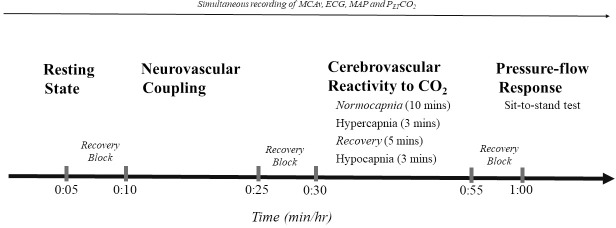
We tested the effect of aging on cerebrovascular function by comparing healthy young adults aged 18-30 and older adults aged 60-75, without cognitive impairments. Cerebrovascular blood flow velocity was assessed using transcranial Doppler ultrasound. Parameters included resting middle cerebral artery velocity (MCAv), neurovascular coupling, cerebrovascular reactivity to CO2 (hypercapnia and hypocapnia), and the pressure-flow response during a sit-to-stand procedure.
MANOVA revealed that collectively, the parameters discriminated the groups (p < .001). MCAv and pressure-flow responses were lower in the older group (p < .001). While there were no differences in hypercapnic responses (p = .908) and neurovascular coupling (p = .517), hypocapnic responses were elevated in the old (p = .002).
Collectively, cerebrovascular parameters can distinguish between healthy young and older adults, with aging leading to reductions in MCAv, and altering cerebrovascular reactivity and pressure-flow responses under hypotensive conditions.
衰老导致脑血管功能改变,这些改变被认为是认知能力下降/痴呆的原因。已经报道了脑血流调节的紊乱,但研究结果不一致,迄今为止,没有一项研究在相同的年龄范围内全面测试这些参数的集体和独立贡献。由于衰老过程是异质且复杂的,脑血管参数会根据个体的不同而受到不同的影响,因此进行此类研究至关重要。需要一种多组分的脑血管功能综合测量方法来区分健康的年轻和老年成年人。
我们通过比较年龄在 18-30 岁之间的健康年轻人和年龄在 60-75 岁之间的无认知障碍的老年人,来测试衰老对脑血管功能的影响。使用经颅多普勒超声评估脑血管血流速度。参数包括静息大脑中动脉速度(MCAv)、神经血管耦合、CO2 诱导的脑血管反应性(高碳酸血症和低碳酸血症)以及从坐立位转变期间的压力-血流反应。
MANOVA 显示,这些参数共同区分了两组(p <.001)。MCAv 和压力-血流反应在老年组中较低(p <.001)。虽然高碳酸血症反应(p =.908)和神经血管耦合(p =.517)没有差异,但老年人的低碳酸血症反应升高(p =.002)。
脑血管参数总体上可以区分健康的年轻和老年成年人,衰老导致 MCAv 降低,并改变低血压条件下的脑血管反应性和压力-血流反应。