Lykens James, Pilloton Molly, Silva Cara, Schlamm Emma, Wilburn Kate, Pence Emma
Center for Research and Education on Gender and Sexuality, San Francisco State University, San Francisco, CA, United States.
Youth Tech Health, Oakland, CA, United States.
JMIR Public Health Surveill. 2019 May 16;5(2):e10695. doi: 10.2196/10695.
According to a 2015 report from the Pew Research Center, nearly 24% of teens go online almost constantly and 92% of teens are accessing the internet daily; consequently, a large part of adolescent romantic exploration has moved online, where young people are turning to the Web for romantic relationship-building and sexual experience. This digital change in romantic behaviors among youth has implications for public health and sexual health programs, but little is known about the ways in which young people use online spaces for sexual exploration. An examination of youth sexual health and relationships online and the implications for adolescent health programs has yet to be fully explored.
Although studies have documented increasing rates of sexually transmitted infections and HIV among young people, many programs continue to neglect online spaces as avenues for understanding sexual exploration. Little is known about the online sexual health practices of young people, including digital flirting and online dating. This study explores the current behaviors and opinions of youth throughout online sexual exploration, relationship-building, and online dating, further providing insights into youth behavior for intervention opportunities.
From January through December 2016, an exploratory study titled TECHsex used a mixed-methods approach to document information-seeking behaviors and sexual health building behaviors of youth online in the United States. Data from a national quantitative survey of 1500 youth and 12 qualitative focus groups (66 youth) were triangulated to understand the experiences and desires of young people as they navigate their sexual relationships through social media, online chatting, and online dating.
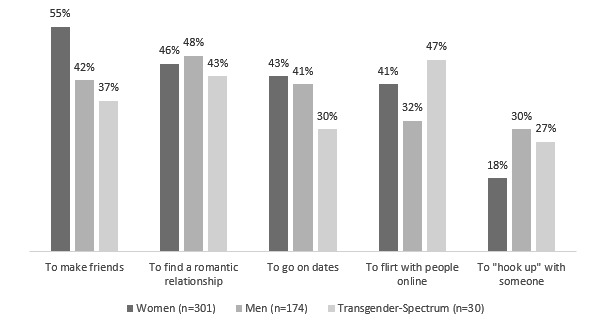
Young people are using the internet to begin sexual relationships with others, including dating, online flirting, and hooking up. Despite the fact that dating sites have explicit rules against minor use, under 18 youth are using these products regardless in order to make friends and begin romantic relationships, albeit at a lower rate than their older peers (19.0% [64/336] vs 37.8% [440/1163], respectively). Nearly 70% of youth who have used online dating sites met up with someone in person (44.78% [30/67] under 18 vs 74.0% [324/438] over 18). Focus group respondents provided further context into online sexual exploration; many learned of sex through pornography, online dating profiles, or through flirting on social media. Social media played an important role in vetting potential partners and beginning romantic relationships. Youth also reported using online dating and flirting despite fears of violence or catfishing, in which online profiles are used to deceive others.
Youth are turning to online spaces to build sexual relationships, particularly in areas where access to peers is limited. Although online dating site use is somewhat high, more youth turn to social media for online dating. Sexual relationship-building included online flirting and online dating websites and/or apps. These findings have implications for future sexual health programs interested in improving the sexual health outcomes of young people. Researchers may be neglecting to include social media as potential sources of youth hookup culture and dating. We implore researchers and organizations to consider the relationships young people have with technology in order to more strategically use these platforms to create successful and youth-centered programs to improve sexual health outcomes.
根据皮尤研究中心2015年的一份报告,近24%的青少年几乎持续上网,92%的青少年每天都上网;因此,青少年浪漫探索的很大一部分已经转移到网上,年轻人正在转向网络来建立恋爱关系和寻求性体验。青少年浪漫行为的这种数字变化对公共卫生和性健康项目有影响,但对于年轻人利用网络空间进行性探索的方式知之甚少。对青少年性健康及网络关系以及对青少年健康项目的影响尚未得到充分探讨。
尽管研究记录了年轻人中性传播感染和艾滋病毒感染率不断上升的情况,但许多项目仍然忽视网络空间作为了解性探索的途径。对于年轻人的网络性健康行为,包括数字调情和网上约会,了解甚少。本研究探讨了青少年在整个网络性探索、建立关系和网上约会过程中的当前行为和观点,进一步为干预机会提供了对青少年行为的见解。
2016年1月至12月,一项名为TECHsex的探索性研究采用混合方法记录了美国青少年在网上的信息寻求行为和性健康建立行为。对1500名青少年进行的全国性定量调查数据和12个定性焦点小组(66名青少年)的数据进行了三角测量,以了解年轻人在通过社交媒体、在线聊天和网上约会来处理他们的性关系时的经历和愿望。
年轻人正在利用互联网与他人建立性关系,包括约会、网上调情和勾搭。尽管约会网站有明确禁止未成年人使用的规定,但18岁以下的青少年仍在使用这些产品,以便交朋友和开始恋爱关系,尽管使用率低于年龄较大的同龄人(分别为19.0%[64/336]和37.8%[440/1163])。近70%使用过网上约会网站的青少年与某人见面(18岁以下为44.78%[30/67],18岁以上为74.0%[324/438])。焦点小组的受访者进一步阐述了网络性探索的情况;许多人通过色情制品、网上约会资料或在社交媒体上调情了解到性。社交媒体在审查潜在伴侣和开始恋爱关系方面发挥了重要作用。青少年还报告说,尽管担心暴力或网络钓鱼(即利用网上资料欺骗他人),他们仍在使用网上约会和调情。
年轻人正在转向网络空间建立性关系,特别是在同龄人接触机会有限的地区。尽管网上约会网站的使用率有所提高,但更多的青少年转向社交媒体进行网上约会。性建立关系包括网上调情和网上约会网站及/或应用程序。这些发现对未来有兴趣改善年轻人性健康结果的性健康项目有影响。研究人员可能忽略了将社交媒体视为青少年勾搭文化和约会的潜在来源。我们恳请研究人员和组织考虑年轻人与技术的关系,以便更有策略地利用这些平台来创建成功的、以青少年为中心的项目,以改善性健康结果。
