Wang Xiaofang, Zhang Yan, Hao Shiying, Zheng Le, Liao Jiayu, Ye Chengyin, Xia Minjie, Wang Oliver, Liu Modi, Weng Ching Ho, Duong Son Q, Jin Bo, Alfreds Shaun T, Stearns Frank, Kanov Laura, Sylvester Karl G, Widen Eric, McElhinney Doff B, Ling Xuefeng B
Shandong Provincial Key Laboratory of Network Based Intelligent Computing, University of Jinan, Jinan, China.
Department of Surgery, Stanford University, Stanford, CA, United States.
J Med Internet Res. 2019 May 16;21(5):e13260. doi: 10.2196/13260.
Lung cancer is the leading cause of cancer death worldwide. Early detection of individuals at risk of lung cancer is critical to reduce the mortality rate.
The aim of this study was to develop and validate a prospective risk prediction model to identify patients at risk of new incident lung cancer within the next 1 year in the general population.
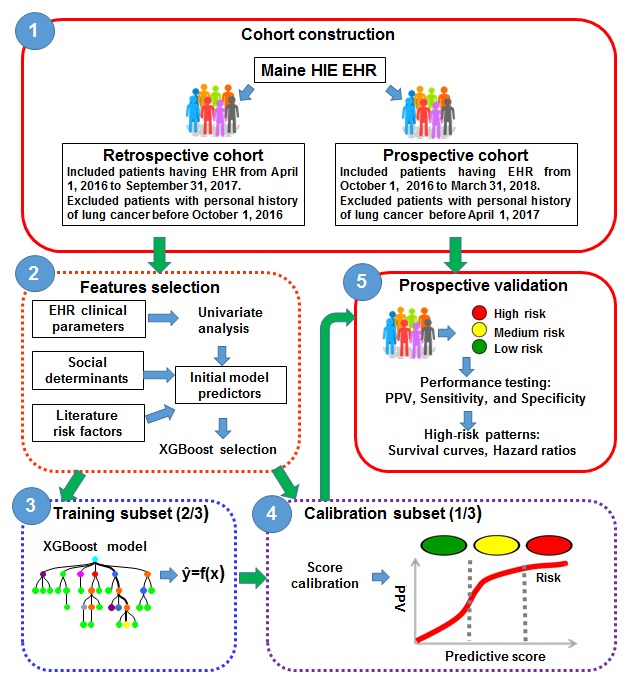
Data from individual patient electronic health records (EHRs) were extracted from the Maine Health Information Exchange network. The study population consisted of patients with at least one EHR between April 1, 2016, and March 31, 2018, who had no history of lung cancer. A retrospective cohort (N=873,598) and a prospective cohort (N=836,659) were formed for model construction and validation. An Extreme Gradient Boosting (XGBoost) algorithm was adopted to build the model. It assigned a score to each individual to quantify the probability of a new incident lung cancer diagnosis from October 1, 2016, to September 31, 2017. The model was trained with the clinical profile in the retrospective cohort from the preceding 6 months and validated with the prospective cohort to predict the risk of incident lung cancer from April 1, 2017, to March 31, 2018.
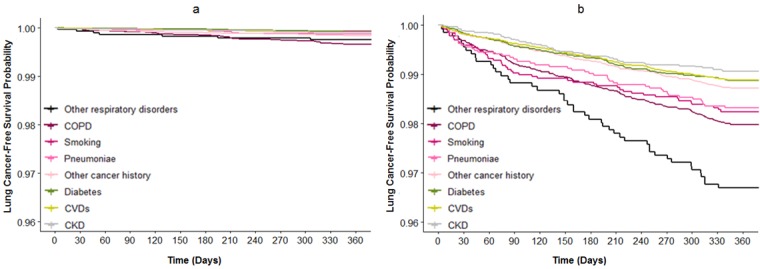
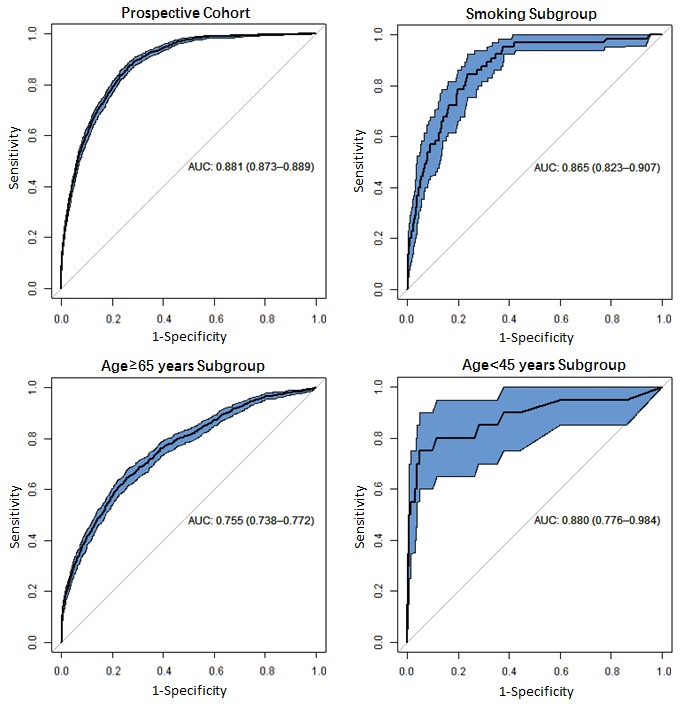
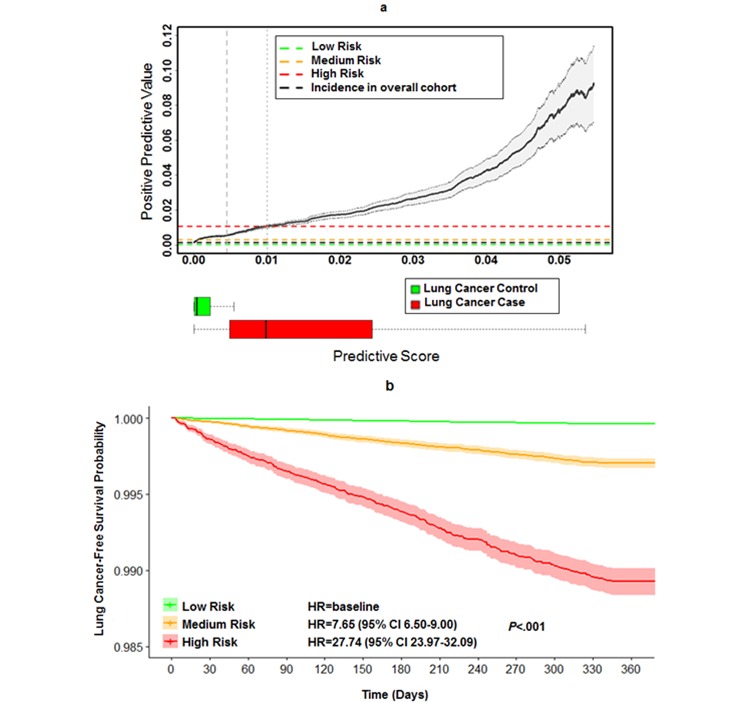
The model had an area under the curve (AUC) of 0.881 (95% CI 0.873-0.889) in the prospective cohort. Two thresholds of 0.0045 and 0.01 were applied to the predictive scores to stratify the population into low-, medium-, and high-risk categories. The incidence of lung cancer in the high-risk category (579/53,922, 1.07%) was 7.7 times higher than that in the overall cohort (1167/836,659, 0.14%). Age, a history of pulmonary diseases and other chronic diseases, medications for mental disorders, and social disparities were found to be associated with new incident lung cancer.
We retrospectively developed and prospectively validated an accurate risk prediction model of new incident lung cancer occurring in the next 1 year. Through statistical learning from the statewide EHR data in the preceding 6 months, our model was able to identify statewide high-risk patients, which will benefit the population health through establishment of preventive interventions or more intensive surveillance.
肺癌是全球癌症死亡的主要原因。早期发现肺癌高危个体对于降低死亡率至关重要。
本研究的目的是开发并验证一种前瞻性风险预测模型,以识别普通人群中未来1年内有新发肺癌风险的患者。
从缅因州健康信息交换网络中提取个体患者电子健康记录(EHR)的数据。研究人群包括在2016年4月1日至2018年3月31日期间至少有一份EHR且无肺癌病史的患者。形成了一个回顾性队列(N = 873,598)和一个前瞻性队列(N = 836,659)用于模型构建和验证。采用极端梯度提升(XGBoost)算法构建模型。该模型为每个个体分配一个分数,以量化从2016年10月1日至2017年9月31日新发肺癌诊断的概率。该模型以前6个月回顾性队列中的临床特征进行训练,并以前瞻性队列进行验证,以预测2017年4月1日至2018年3月31日期间肺癌发生的风险。
该模型在前瞻性队列中的曲线下面积(AUC)为0.881(95%CI 0.873 - 0.889)。将预测分数的两个阈值0.0045和0.01应用于对人群进行分层,分为低、中、高风险类别。高风险类别中的肺癌发病率(579/53,922,1.07%)比总体队列中的发病率(1167/836,659,0.14%)高7.7倍。发现年龄、肺部疾病和其他慢性疾病史、精神障碍用药以及社会差异与新发肺癌有关。
我们回顾性开发并前瞻性验证了一个准确的未来1年内新发肺癌风险预测模型。通过对前6个月全州EHR数据的统计学习,我们的模型能够识别全州的高危患者,这将通过建立预防干预措施或更密集的监测使人群健康受益。