College of Life Sciences, China Jiliang University, Hangzhou 310018, China.
Int J Mol Sci. 2019 May 16;20(10):2431. doi: 10.3390/ijms20102431.
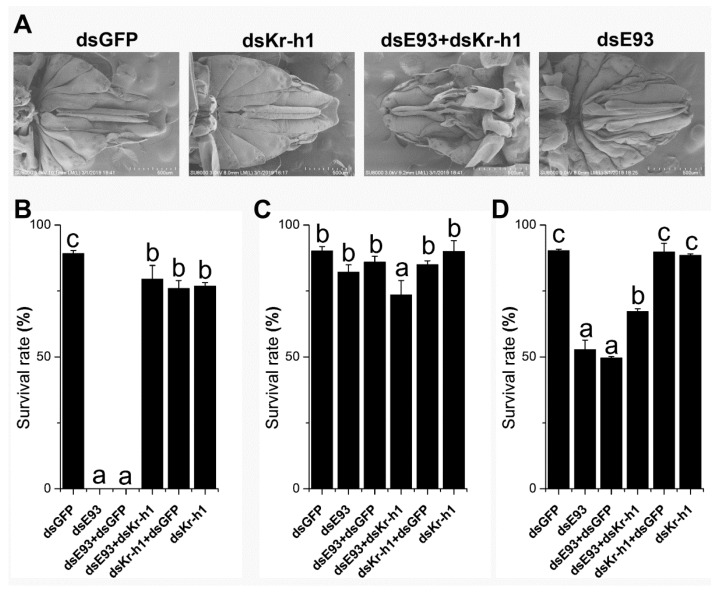
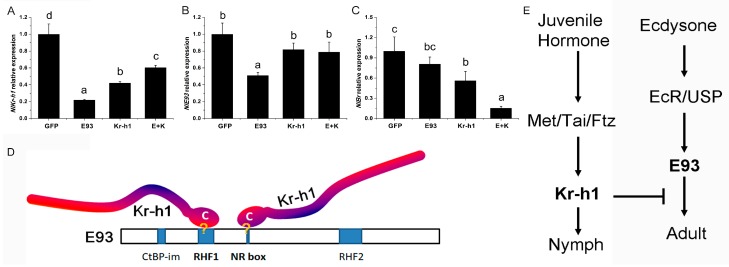
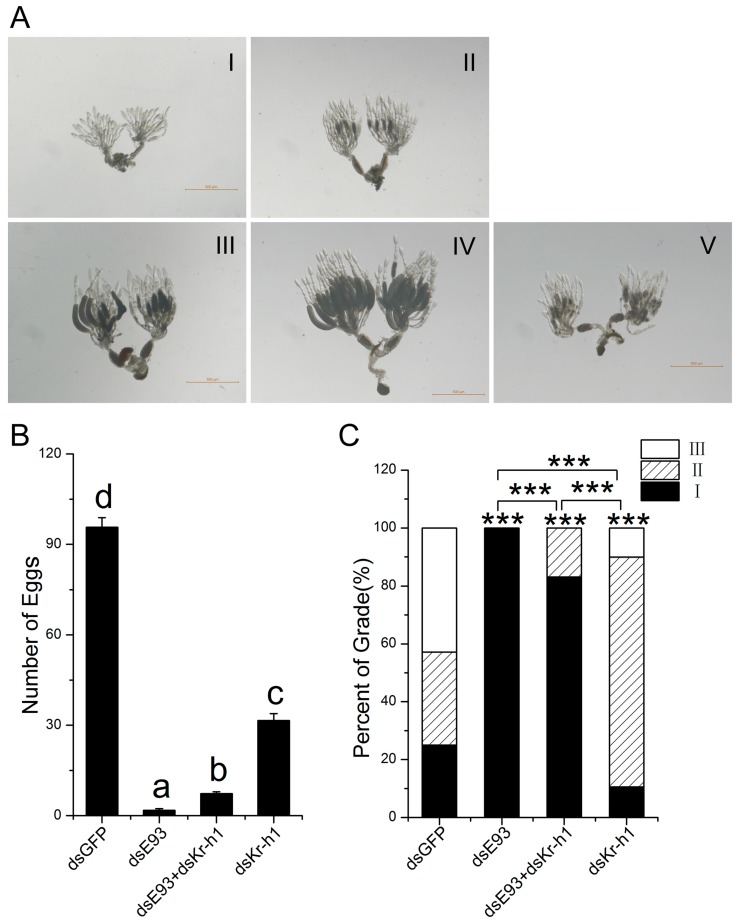
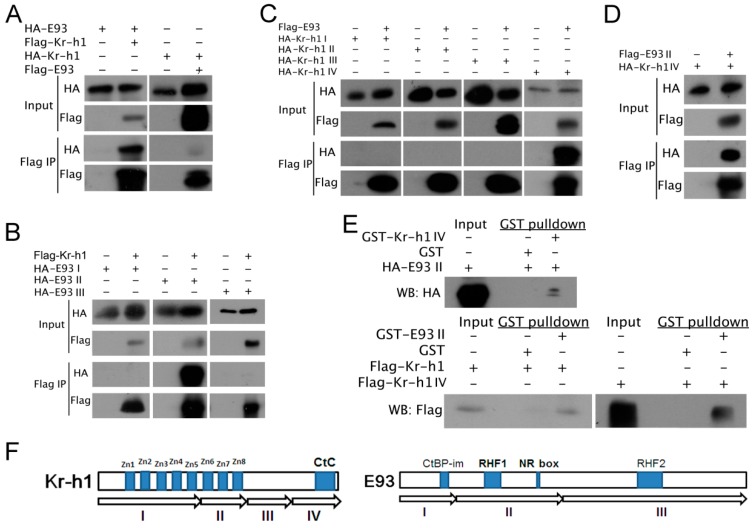
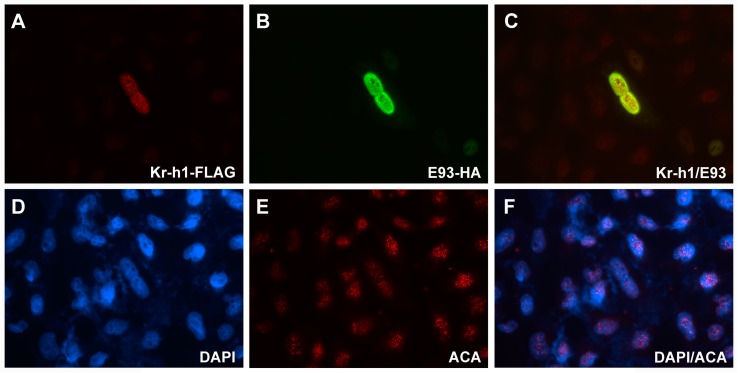
The juvenile hormone (JH) signalling and ecdysone signalling pathways are crucial endocrine signalling pathways that orchestrate the metamorphosis of insects. The metamorphic process, the morphological change from the immature to adult forms, is orchestrated by the dramatic reduction of JH and downstream transcription factors. The Krüppel-homologue 1 (Kr-h1), a downstream transcription factor of the JH signalling pathway, represses expression with an anti-metamorphic effect. However, the biochemical interaction between and and how the interaction regulates ovary development, a sensitive readout for endocrine regulation, remain unknown. In brown planthopper, , we found that the downregulation of partially recovered the deteriorating effect of knock-down on metamorphosis. Dual knock down of and increased ovary development and the number of eggs laid when compared to the effects of the knock down of alone, indicating that the knock down of partially recovered the deteriorating effect of the knock-down on ovary development. In summary, our results indicated that and have antagonistic effects on regulating metamorphosis and ovary development. We tested the biochemical interaction between these two proteins and found that these molecules interact directly. Kr-h1 V and E93 II undergo strong and specific interactions, indicating that the potential interacting domain may be located in these two regions. We inferred that the nuclear receptor interaction motif (NR-box) and helix-turn-helix DNA binding motifs of the pipsqueak family (RHF1) are candidate domains responsible for the protein-protein interaction between E93 and Kr-h1. Moreover, the HA-tagged E93 and FLAG-tagged Kr-h1 were co-localized in the nucleus, and the expression of was increased when was downregulated, supporting that these two proteins may interact antagonistically. JH and ecdysone signalling are critical for the control of ovary development and pest populations. Our result is important for understanding the interactions between E93 and related proteins, which makes it possible to identify potential targets and develop new pesticides for pest management.
保幼激素(JH)信号通路和蜕皮激素信号通路是调控昆虫变态的重要内分泌信号通路。变态过程是指从幼虫到成虫形态的剧烈变化,由 JH 和下游转录因子的急剧减少来调控。Krüppel 同源物 1(Kr-h1)是 JH 信号通路的下游转录因子,通过抗变态作用抑制 的表达。然而, 和 之间的生化相互作用以及这种相互作用如何调节卵巢发育(内分泌调节的敏感指标)仍然未知。在褐飞虱中,我们发现下调 部分恢复了 敲低对变态的恶化作用。与 敲低的效果相比, 和 双重敲低增加了卵巢发育和产卵数,表明 敲低部分恢复了 敲低对卵巢发育的恶化作用。总之,我们的结果表明 和 对调控变态和卵巢发育具有拮抗作用。我们测试了这两种蛋白质之间的生化相互作用,发现它们直接相互作用。Kr-h1 V 和 E93 II 发生强烈且特异性的相互作用,表明潜在的相互作用域可能位于这两个区域。我们推断核受体相互作用基序(NR 盒)和 pipsqueak 家族的螺旋-环-螺旋 DNA 结合基序(RHF1)是 E93 和 Kr-h1 之间蛋白-蛋白相互作用的候选结构域。此外,HA 标记的 E93 和 FLAG 标记的 Kr-h1 共定位于核内,并且当 下调时 的表达增加,支持这两种蛋白质可能相互拮抗。JH 和蜕皮激素信号通路对于控制卵巢发育和害虫种群至关重要。我们的结果对于理解 E93 与相关蛋白之间的相互作用很重要,这使得识别潜在的靶标和开发新的害虫管理农药成为可能。