• 文献检索
  • 文档翻译
  • 深度研究
  • 学术资讯
  • Suppr Zotero 插件Zotero 插件
  • 邀请有礼
  • 套餐&价格
  • 历史记录
应用&插件
Suppr Zotero 插件Zotero 插件浏览器插件Mac 客户端Windows 客户端微信小程序
定价
高级版会员购买积分包购买API积分包
服务
文献检索文档翻译深度研究API 文档MCP 服务
关于我们
关于 Suppr公司介绍联系我们用户协议隐私条款
关注我们

Suppr 超能文献

核心技术专利:CN118964589B侵权必究
粤ICP备2023148730 号-1Suppr @ 2026

文献检索

告别复杂PubMed语法,用中文像聊天一样搜索,搜遍4000万医学文献。AI智能推荐,让科研检索更轻松。

立即免费搜索

文件翻译

保留排版,准确专业,支持PDF/Word/PPT等文件格式,支持 12+语言互译。

免费翻译文档

深度研究

AI帮你快速写综述,25分钟生成高质量综述,智能提取关键信息,辅助科研写作。

立即免费体验

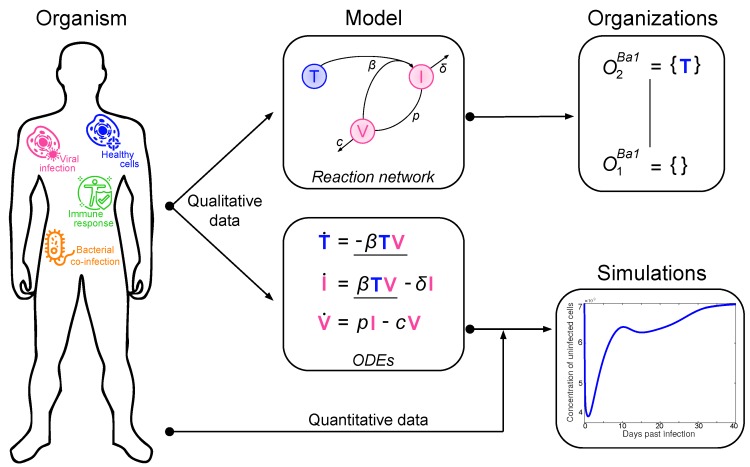
反应网络分析揭示流感病毒模型的结构和层次。

Structure and Hierarchy of Influenza Virus Models Revealed by Reaction Network Analysis.

机构信息

Ernst-Abbe University of Applied Sciences Jena, Carl-Zeiss-Promenade 2, 07745 Jena, Germany.

Bio Systems Analysis Group, Department of Mathematics and Computer Science, University of Jena, Ernst-Abbe-Platz 2, 07743 Jena, Germany.

出版信息

Viruses. 2019 May 16;11(5):449. doi: 10.3390/v11050449.

DOI:10.3390/v11050449
PMID:31100972
原文链接:https://pmc.ncbi.nlm.nih.gov/articles/PMC6563504/
Abstract

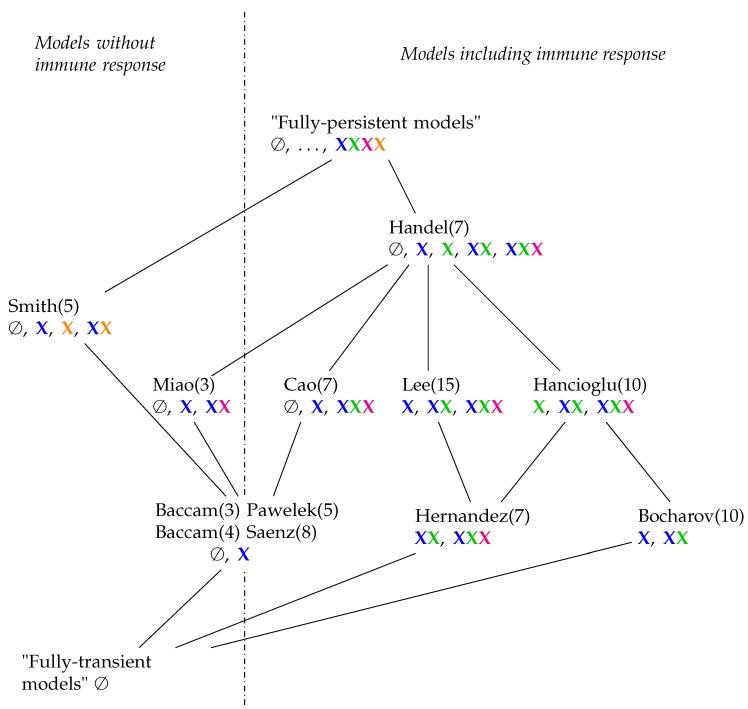
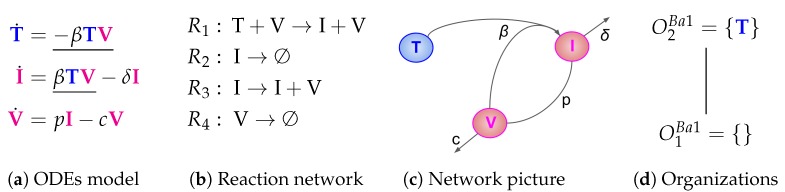
Influenza A virus is recognized today as one of the most challenging viruses that threatens both human and animal health worldwide. Understanding the control mechanisms of influenza infection and dynamics is crucial and could result in effective future treatment strategies. Many kinetic models based on differential equations have been developed in recent decades to capture viral dynamics within a host. These models differ in their complexity in terms of number of species elements and number of reactions. Here, we present a new approach to understanding the overall structure of twelve influenza A virus infection models and their relationship to each other. To this end, we apply chemical organization theory to obtain a hierarchical decomposition of the models into chemical organizations. The decomposition is based on the model structure (reaction rules) but is independent of kinetic details such as rate constants. We found different types of model structures ranging from two to eight organizations. Furthermore, the model's organizations imply a partial order among models entailing a hierarchy of model, revealing a high model diversity with respect to their long-term behavior. Our methods and results can be helpful in model development and model integration, also beyond the influenza area.

摘要

甲型流感病毒是目前被认为对全球人类和动物健康威胁最大的病毒之一。了解流感感染和动态的控制机制至关重要,这可能会导致未来有效的治疗策略。近几十年来,已经开发了许多基于微分方程的动力学模型来捕捉宿主内的病毒动态。这些模型在物种元素的数量和反应的数量方面在复杂性上有所不同。在这里,我们提出了一种新的方法来理解十二种甲型流感病毒感染模型的整体结构及其相互关系。为此,我们应用化学组织理论将模型分解为化学组织。该分解基于模型结构(反应规则),但与动力学细节(如速率常数)无关。我们发现了从两种到八种组织的不同类型的模型结构。此外,模型的组织意味着模型之间存在偏序,从而揭示了模型在长期行为方面的高度多样性。我们的方法和结果可有助于模型开发和模型集成,甚至超越流感领域。
https://cdn.ncbi.nlm.nih.gov/pmc/blobs/c11b/6563504/011be934869e/viruses-11-00449-g015.jpg
https://cdn.ncbi.nlm.nih.gov/pmc/blobs/c11b/6563504/a2fc6f448707/viruses-11-00449-g0A1.jpg
https://cdn.ncbi.nlm.nih.gov/pmc/blobs/c11b/6563504/98c559f8f44e/viruses-11-00449-g0A2.jpg
https://cdn.ncbi.nlm.nih.gov/pmc/blobs/c11b/6563504/3fca4267c309/viruses-11-00449-g0A3.jpg
https://cdn.ncbi.nlm.nih.gov/pmc/blobs/c11b/6563504/18af0d659764/viruses-11-00449-g0A4.jpg
https://cdn.ncbi.nlm.nih.gov/pmc/blobs/c11b/6563504/eaec1c3e7c36/viruses-11-00449-g0A5.jpg
https://cdn.ncbi.nlm.nih.gov/pmc/blobs/c11b/6563504/57266c34bc78/viruses-11-00449-g0A6.jpg
https://cdn.ncbi.nlm.nih.gov/pmc/blobs/c11b/6563504/166c49a4c9ec/viruses-11-00449-g0A7.jpg
https://cdn.ncbi.nlm.nih.gov/pmc/blobs/c11b/6563504/dd2cee2879fc/viruses-11-00449-g0A8.jpg
https://cdn.ncbi.nlm.nih.gov/pmc/blobs/c11b/6563504/d6e1afd96850/viruses-11-00449-g0A9.jpg
https://cdn.ncbi.nlm.nih.gov/pmc/blobs/c11b/6563504/4e6f4d935551/viruses-11-00449-g0A10.jpg
https://cdn.ncbi.nlm.nih.gov/pmc/blobs/c11b/6563504/2339391e74f4/viruses-11-00449-g001.jpg
https://cdn.ncbi.nlm.nih.gov/pmc/blobs/c11b/6563504/96ae5682b8cd/viruses-11-00449-g002.jpg
https://cdn.ncbi.nlm.nih.gov/pmc/blobs/c11b/6563504/06d201f0a8b2/viruses-11-00449-g003.jpg
https://cdn.ncbi.nlm.nih.gov/pmc/blobs/c11b/6563504/d93dfd094bbb/viruses-11-00449-g004.jpg
https://cdn.ncbi.nlm.nih.gov/pmc/blobs/c11b/6563504/481fb3e0a516/viruses-11-00449-g005.jpg
https://cdn.ncbi.nlm.nih.gov/pmc/blobs/c11b/6563504/c1124f42510b/viruses-11-00449-g006.jpg
https://cdn.ncbi.nlm.nih.gov/pmc/blobs/c11b/6563504/6fcee9071657/viruses-11-00449-g007.jpg
https://cdn.ncbi.nlm.nih.gov/pmc/blobs/c11b/6563504/838a7e3c657e/viruses-11-00449-g008.jpg
https://cdn.ncbi.nlm.nih.gov/pmc/blobs/c11b/6563504/1b321c08e1e2/viruses-11-00449-g009.jpg
https://cdn.ncbi.nlm.nih.gov/pmc/blobs/c11b/6563504/ef0c382fdff5/viruses-11-00449-g010.jpg
https://cdn.ncbi.nlm.nih.gov/pmc/blobs/c11b/6563504/a1500d39ad86/viruses-11-00449-g011.jpg
https://cdn.ncbi.nlm.nih.gov/pmc/blobs/c11b/6563504/1c5fba399231/viruses-11-00449-g012.jpg
https://cdn.ncbi.nlm.nih.gov/pmc/blobs/c11b/6563504/d8a37e779fa6/viruses-11-00449-g013.jpg
https://cdn.ncbi.nlm.nih.gov/pmc/blobs/c11b/6563504/1ee5f2696625/viruses-11-00449-g014a.jpg
https://cdn.ncbi.nlm.nih.gov/pmc/blobs/c11b/6563504/011be934869e/viruses-11-00449-g015.jpg
https://cdn.ncbi.nlm.nih.gov/pmc/blobs/c11b/6563504/a2fc6f448707/viruses-11-00449-g0A1.jpg
https://cdn.ncbi.nlm.nih.gov/pmc/blobs/c11b/6563504/98c559f8f44e/viruses-11-00449-g0A2.jpg
https://cdn.ncbi.nlm.nih.gov/pmc/blobs/c11b/6563504/3fca4267c309/viruses-11-00449-g0A3.jpg
https://cdn.ncbi.nlm.nih.gov/pmc/blobs/c11b/6563504/18af0d659764/viruses-11-00449-g0A4.jpg
https://cdn.ncbi.nlm.nih.gov/pmc/blobs/c11b/6563504/eaec1c3e7c36/viruses-11-00449-g0A5.jpg
https://cdn.ncbi.nlm.nih.gov/pmc/blobs/c11b/6563504/57266c34bc78/viruses-11-00449-g0A6.jpg
https://cdn.ncbi.nlm.nih.gov/pmc/blobs/c11b/6563504/166c49a4c9ec/viruses-11-00449-g0A7.jpg
https://cdn.ncbi.nlm.nih.gov/pmc/blobs/c11b/6563504/dd2cee2879fc/viruses-11-00449-g0A8.jpg
https://cdn.ncbi.nlm.nih.gov/pmc/blobs/c11b/6563504/d6e1afd96850/viruses-11-00449-g0A9.jpg
https://cdn.ncbi.nlm.nih.gov/pmc/blobs/c11b/6563504/4e6f4d935551/viruses-11-00449-g0A10.jpg
https://cdn.ncbi.nlm.nih.gov/pmc/blobs/c11b/6563504/2339391e74f4/viruses-11-00449-g001.jpg
https://cdn.ncbi.nlm.nih.gov/pmc/blobs/c11b/6563504/96ae5682b8cd/viruses-11-00449-g002.jpg
https://cdn.ncbi.nlm.nih.gov/pmc/blobs/c11b/6563504/06d201f0a8b2/viruses-11-00449-g003.jpg
https://cdn.ncbi.nlm.nih.gov/pmc/blobs/c11b/6563504/d93dfd094bbb/viruses-11-00449-g004.jpg
https://cdn.ncbi.nlm.nih.gov/pmc/blobs/c11b/6563504/481fb3e0a516/viruses-11-00449-g005.jpg
https://cdn.ncbi.nlm.nih.gov/pmc/blobs/c11b/6563504/c1124f42510b/viruses-11-00449-g006.jpg
https://cdn.ncbi.nlm.nih.gov/pmc/blobs/c11b/6563504/6fcee9071657/viruses-11-00449-g007.jpg
https://cdn.ncbi.nlm.nih.gov/pmc/blobs/c11b/6563504/838a7e3c657e/viruses-11-00449-g008.jpg
https://cdn.ncbi.nlm.nih.gov/pmc/blobs/c11b/6563504/1b321c08e1e2/viruses-11-00449-g009.jpg
https://cdn.ncbi.nlm.nih.gov/pmc/blobs/c11b/6563504/ef0c382fdff5/viruses-11-00449-g010.jpg
https://cdn.ncbi.nlm.nih.gov/pmc/blobs/c11b/6563504/a1500d39ad86/viruses-11-00449-g011.jpg
https://cdn.ncbi.nlm.nih.gov/pmc/blobs/c11b/6563504/1c5fba399231/viruses-11-00449-g012.jpg
https://cdn.ncbi.nlm.nih.gov/pmc/blobs/c11b/6563504/d8a37e779fa6/viruses-11-00449-g013.jpg
https://cdn.ncbi.nlm.nih.gov/pmc/blobs/c11b/6563504/1ee5f2696625/viruses-11-00449-g014a.jpg
https://cdn.ncbi.nlm.nih.gov/pmc/blobs/c11b/6563504/011be934869e/viruses-11-00449-g015.jpg

相似文献

1
Structure and Hierarchy of Influenza Virus Models Revealed by Reaction Network Analysis.反应网络分析揭示流感病毒模型的结构和层次。
Viruses. 2019 May 16;11(5):449. doi: 10.3390/v11050449.
2
Structure and Hierarchy of SARS-CoV-2 Infection Dynamics Models Revealed by Reaction Network Analysis.通过反应网络分析揭示 SARS-CoV-2 感染动力学模型的结构和层次
Viruses. 2020 Dec 23;13(1):14. doi: 10.3390/v13010014.
3
Innate Immunity and the Inter-exposure Interval Determine the Dynamics of Secondary Influenza Virus Infection and Explain Observed Viral Hierarchies.先天免疫和暴露间隔决定了二次流感病毒感染的动态变化,并解释了观察到的病毒层级关系。
PLoS Comput Biol. 2015 Aug 18;11(8):e1004334. doi: 10.1371/journal.pcbi.1004334. eCollection 2015 Aug.
4
Modelling the Effect of MUC1 on Influenza Virus Infection Kinetics and Macrophage Dynamics.模拟 MUC1 对流感病毒感染动力学和巨噬细胞动态的影响。
Viruses. 2021 May 7;13(5):850. doi: 10.3390/v13050850.
5
[Bioinformatics technologies for the analysis of antigenic evolution of influenza viruses].[用于分析流感病毒抗原进化的生物信息学技术]
Uirusu. 2011 Jun;61(1):3-13. doi: 10.2222/jsv.61.3.
6
Influenza A virus utilizes a suboptimal Kozak sequence to fine-tune virus replication and host response.甲型流感病毒利用一个次优的科扎克序列来微调病毒复制和宿主反应。
J Gen Virol. 2015 Apr;96(Pt 4):756-766. doi: 10.1099/vir.0.000030. Epub 2014 Dec 17.
7
Influenza Viruses in Mice: Deep Sequencing Analysis of Serial Passage and Effects of Sialic Acid Structural Variation.小鼠中的流感病毒:连续传代的深度测序分析及唾液酸结构变异的影响。
J Virol. 2019 Nov 13;93(23). doi: 10.1128/JVI.01039-19. Print 2019 Dec 1.
8
Cross talk between animal and human influenza viruses.动物流感病毒与人流感病毒之间的串扰。
Annu Rev Anim Biosci. 2013 Jan;1:21-42. doi: 10.1146/annurev-animal-031412-103733. Epub 2013 Jan 1.
9
Repurposing of Drugs as Novel Influenza Inhibitors From Clinical Gene Expression Infection Signatures.从临床基因表达感染特征重新利用药物作为新型流感抑制剂。
Front Immunol. 2019 Jan 29;10:60. doi: 10.3389/fimmu.2019.00060. eCollection 2019.
10
Sequencing Framework for the Sensitive Detection and Precise Mapping of Defective Interfering Particle-Associated Deletions across Influenza A and B Viruses.流感 A 型和 B 型病毒中缺陷干扰颗粒相关缺失的灵敏检测和精确作图测序框架。
J Virol. 2019 May 15;93(11). doi: 10.1128/JVI.00354-19. Print 2019 Jun 1.

引用本文的文献

1
Phylogenetic Insights into H7Nx Influenza Viruses: Uncovering Reassortment Patterns and Geographic Variability.对H7Nx流感病毒的系统发育研究:揭示重配模式和地理变异性
Viruses. 2024 Oct 23;16(11):1656. doi: 10.3390/v16111656.
2
Revealing the hierarchical structure of microbial communities.揭示微生物群落的层次结构。
Sci Rep. 2024 May 16;14(1):11202. doi: 10.1038/s41598-024-61836-3.
3
Computing all persistent subspaces of a reaction-diffusion system.计算反应扩散系统的所有持久子空间。

本文引用的文献

1
Multi-scale stochastic organization-oriented coarse-graining exemplified on the human mitotic checkpoint.多尺度随机组织导向粗粒化在人类有丝分裂检查点的实例研究。
Sci Rep. 2019 Mar 7;9(1):3902. doi: 10.1038/s41598-019-40648-w.
2
Mathematical Analysis of Viral Replication Dynamics and Antiviral Treatment Strategies: From Basic Models to Age-Based Multi-Scale Modeling.病毒复制动力学与抗病毒治疗策略的数学分析:从基本模型到基于年龄的多尺度建模
Front Microbiol. 2018 Jul 11;9:1546. doi: 10.3389/fmicb.2018.01546. eCollection 2018.
3
Influenza Virus Infection Model With Density Dependence Supports Biphasic Viral Decay.
Sci Rep. 2023 Oct 11;13(1):17169. doi: 10.1038/s41598-023-44244-x.
4
Personalized Virus Load Curves for Acute Viral Infections.个体化病毒载量曲线用于急性病毒感染。
Viruses. 2021 Sep 13;13(9):1815. doi: 10.3390/v13091815.
5
Structure and Hierarchy of SARS-CoV-2 Infection Dynamics Models Revealed by Reaction Network Analysis.通过反应网络分析揭示 SARS-CoV-2 感染动力学模型的结构和层次
Viruses. 2020 Dec 23;13(1):14. doi: 10.3390/v13010014.
6
Trends in mathematical modeling of host-pathogen interactions.宿主-病原体相互作用的数学建模趋势。
Cell Mol Life Sci. 2020 Feb;77(3):467-480. doi: 10.1007/s00018-019-03382-0. Epub 2019 Nov 27.
具有密度依赖性的流感病毒感染模型支持双相病毒衰减。
Front Microbiol. 2018 Jul 10;9:1554. doi: 10.3389/fmicb.2018.01554. eCollection 2018.
4
Organisation-Oriented Coarse Graining and Refinement of Stochastic Reaction Networks.面向组织的随机反应网络的粗粒化和细化。
IEEE/ACM Trans Comput Biol Bioinform. 2018 Jul-Aug;15(4):1152-1166. doi: 10.1109/TCBB.2018.2804395. Epub 2018 Feb 9.
5
Influenza.流感。
Nat Rev Dis Primers. 2018 Jun 28;4(1):3. doi: 10.1038/s41572-018-0002-y.
6
The evolution of seasonal influenza viruses.季节性流感病毒的演变
Nat Rev Microbiol. 2018 Jan;16(1):60. doi: 10.1038/nrmicro.2017.146. Epub 2017 Nov 7.
7
The Mechanisms for Within-Host Influenza Virus Control Affect Model-Based Assessment and Prediction of Antiviral Treatment.宿主体内流感病毒控制机制影响基于模型的抗病毒治疗评估与预测。
Viruses. 2017 Jul 26;9(8):197. doi: 10.3390/v9080197.
8
A Critical, Nonlinear Threshold Dictates Bacterial Invasion and Initial Kinetics During Influenza.一项关键的非线性阈值决定了流感期间细菌的入侵和初始动力学。
Sci Rep. 2016 Dec 15;6:38703. doi: 10.1038/srep38703.
9
Modeling Influenza Virus Infection: A Roadmap for Influenza Research.流感病毒感染建模:流感研究路线图
Viruses. 2015 Oct 12;7(10):5274-304. doi: 10.3390/v7102875.
10
Innate Immunity and the Inter-exposure Interval Determine the Dynamics of Secondary Influenza Virus Infection and Explain Observed Viral Hierarchies.先天免疫和暴露间隔决定了二次流感病毒感染的动态变化,并解释了观察到的病毒层级关系。
PLoS Comput Biol. 2015 Aug 18;11(8):e1004334. doi: 10.1371/journal.pcbi.1004334. eCollection 2015 Aug.