• 文献检索
  • 文档翻译
  • 深度研究
  • 学术资讯
  • Suppr Zotero 插件Zotero 插件
  • 邀请有礼
  • 套餐&价格
  • 历史记录
应用&插件
Suppr Zotero 插件Zotero 插件浏览器插件Mac 客户端Windows 客户端微信小程序
定价
高级版会员购买积分包购买API积分包
服务
文献检索文档翻译深度研究API 文档MCP 服务
关于我们
关于 Suppr公司介绍联系我们用户协议隐私条款
关注我们

Suppr 超能文献

核心技术专利:CN118964589B侵权必究
粤ICP备2023148730 号-1Suppr @ 2026

文献检索

告别复杂PubMed语法,用中文像聊天一样搜索,搜遍4000万医学文献。AI智能推荐,让科研检索更轻松。

立即免费搜索

文件翻译

保留排版,准确专业,支持PDF/Word/PPT等文件格式,支持 12+语言互译。

免费翻译文档

深度研究

AI帮你快速写综述,25分钟生成高质量综述,智能提取关键信息,辅助科研写作。

立即免费体验

通过反应网络分析揭示 SARS-CoV-2 感染动力学模型的结构和层次

Structure and Hierarchy of SARS-CoV-2 Infection Dynamics Models Revealed by Reaction Network Analysis.

机构信息

Ernst-Abbe University of Applied Sciences Jena, Department of Fundamental Sciences, Carl-Zeiss-Promenade 2, 07745 Jena, Germany.

Bio Systems Analysis Group, Department of Mathematics and Computer Science, University of Jena, Ernst-Abbe-Platz 2, 07743 Jena, Germany.

出版信息

Viruses. 2020 Dec 23;13(1):14. doi: 10.3390/v13010014.

DOI:10.3390/v13010014
PMID:33374824
原文链接:https://pmc.ncbi.nlm.nih.gov/articles/PMC7824261/
Abstract

This work provides a mathematical technique for analyzing and comparing infection dynamics models with respect to their potential long-term behavior, resulting in a hierarchy integrating all models. We apply our technique to coupled ordinary and partial differential equation models of SARS-CoV-2 infection dynamics operating on different scales, that is, within a single organism and between several hosts. The structure of a model is assessed by the theory of chemical organizations, not requiring quantitative kinetic information. We present the Hasse diagrams of organizations for the twelve virus models analyzed within this study. For comparing models, each organization is characterized by the types of species it contains. For this, each species is mapped to one out of four types, representing uninfected, infected, immune system, and bacterial species, respectively. Subsequently, we can integrate these results with those of our former work on Influenza-A virus resulting in a single joint hierarchy of 24 models. It appears that the SARS-CoV-2 models are simpler with respect to their long term behavior and thus display a simpler hierarchy with little dependencies compared to the Influenza-A models. Our results can support further development towards more complex SARS-CoV-2 models targeting the higher levels of the hierarchy.

摘要

这项工作提供了一种分析和比较感染动力学模型的数学技术,以研究它们的潜在长期行为,从而形成一个集成所有模型的层次结构。我们将我们的技术应用于 SARS-CoV-2 感染动力学的耦合常微分和偏微分方程模型,这些模型在不同的尺度上运作,即在单个生物体内部和几个宿主之间。模型的结构是通过化学组织理论来评估的,不需要定量的动力学信息。我们为在本研究中分析的 12 个病毒模型展示了组织的哈塞图。为了比较模型,每个组织都由它包含的物种类型来表示。为此,每个物种都映射到四个类型之一,分别代表未感染、感染、免疫系统和细菌物种。随后,我们可以将这些结果与我们之前关于甲型流感病毒的工作结果整合在一起,形成一个包含 24 个模型的单一联合层次结构。与甲型流感病毒模型相比,SARS-CoV-2 模型在其长期行为方面更为简单,因此在层次结构中显示出更为简单的层次结构,依赖性较小。我们的结果可以支持针对更高层次的 SARS-CoV-2 模型的进一步发展。
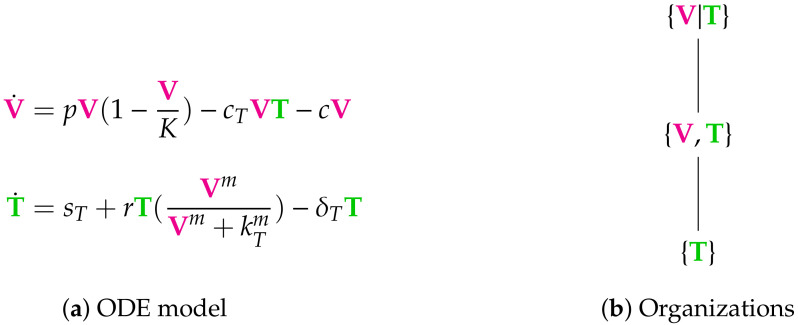
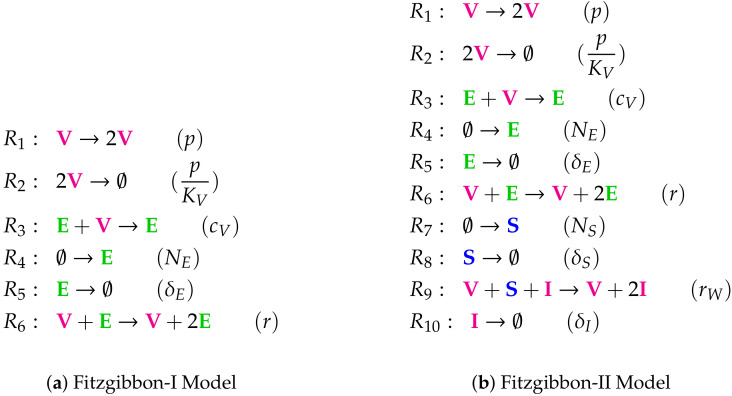
https://cdn.ncbi.nlm.nih.gov/pmc/blobs/7b48/7824261/b3ba27a14444/viruses-13-00014-g004.jpg
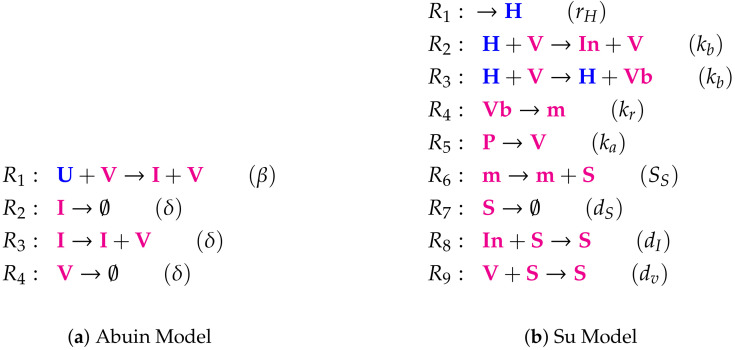
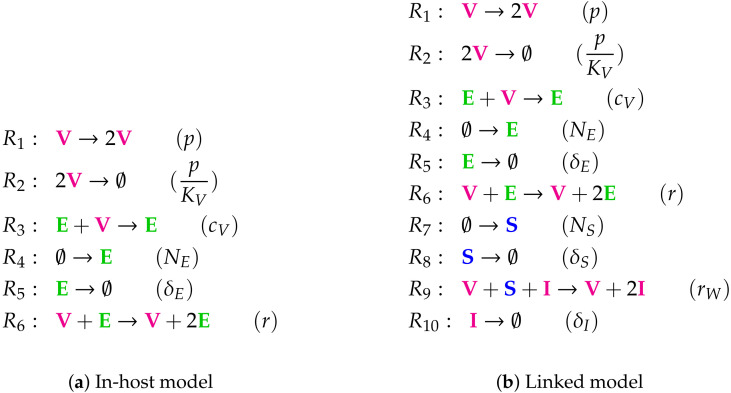
https://cdn.ncbi.nlm.nih.gov/pmc/blobs/7b48/7824261/71711210a705/viruses-13-00014-g0A1.jpg
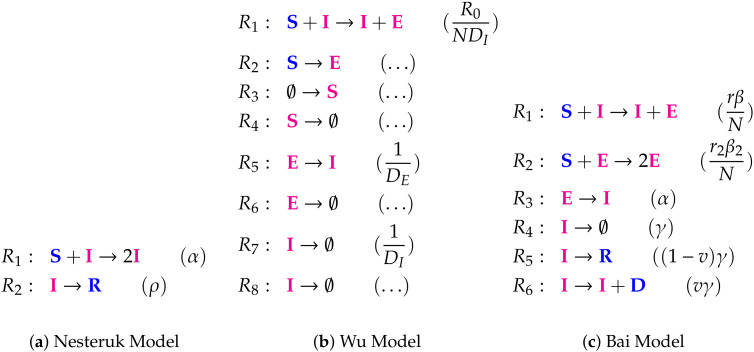
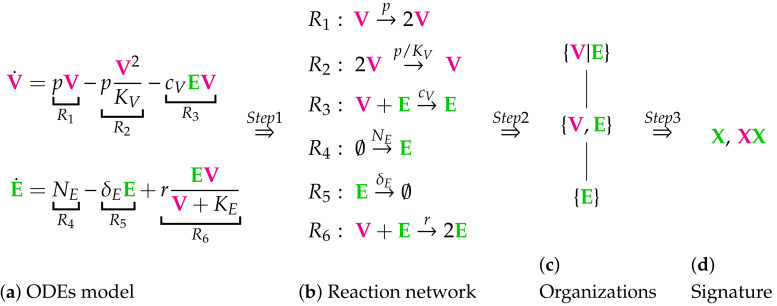
https://cdn.ncbi.nlm.nih.gov/pmc/blobs/7b48/7824261/500d5894f69a/viruses-13-00014-g0A2.jpg
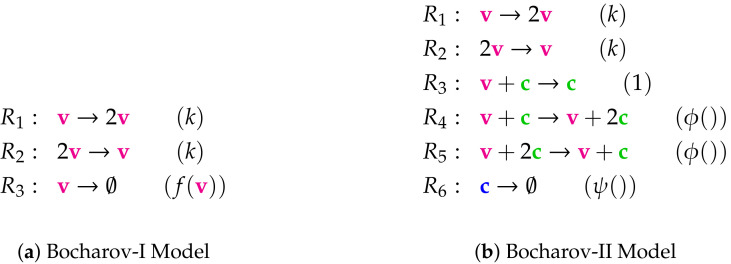
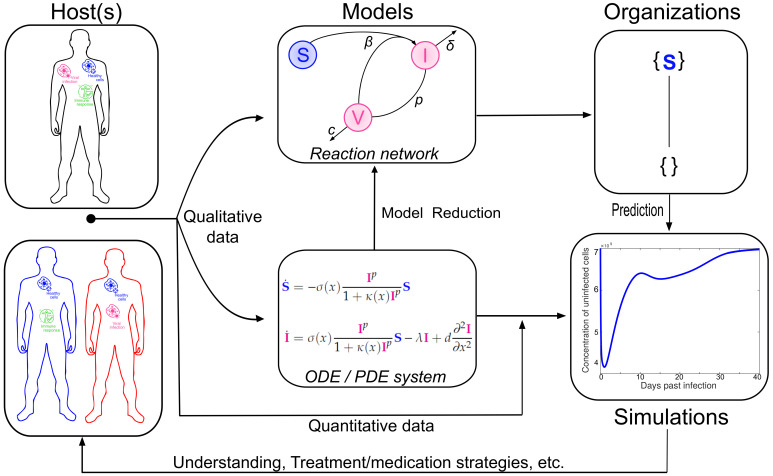
https://cdn.ncbi.nlm.nih.gov/pmc/blobs/7b48/7824261/640298022e54/viruses-13-00014-g0A3.jpg
https://cdn.ncbi.nlm.nih.gov/pmc/blobs/7b48/7824261/484b5427805f/viruses-13-00014-g0A4.jpg
https://cdn.ncbi.nlm.nih.gov/pmc/blobs/7b48/7824261/d6c1b6803e96/viruses-13-00014-g0A5.jpg
https://cdn.ncbi.nlm.nih.gov/pmc/blobs/7b48/7824261/91ac2c9dc4e7/viruses-13-00014-g0A6.jpg
https://cdn.ncbi.nlm.nih.gov/pmc/blobs/7b48/7824261/02df55fc14c6/viruses-13-00014-g001.jpg
https://cdn.ncbi.nlm.nih.gov/pmc/blobs/7b48/7824261/0bdf882e37bf/viruses-13-00014-g002.jpg
https://cdn.ncbi.nlm.nih.gov/pmc/blobs/7b48/7824261/7c3c5dde2729/viruses-13-00014-g003.jpg
https://cdn.ncbi.nlm.nih.gov/pmc/blobs/7b48/7824261/b3ba27a14444/viruses-13-00014-g004.jpg
https://cdn.ncbi.nlm.nih.gov/pmc/blobs/7b48/7824261/71711210a705/viruses-13-00014-g0A1.jpg
https://cdn.ncbi.nlm.nih.gov/pmc/blobs/7b48/7824261/500d5894f69a/viruses-13-00014-g0A2.jpg
https://cdn.ncbi.nlm.nih.gov/pmc/blobs/7b48/7824261/640298022e54/viruses-13-00014-g0A3.jpg
https://cdn.ncbi.nlm.nih.gov/pmc/blobs/7b48/7824261/484b5427805f/viruses-13-00014-g0A4.jpg
https://cdn.ncbi.nlm.nih.gov/pmc/blobs/7b48/7824261/d6c1b6803e96/viruses-13-00014-g0A5.jpg
https://cdn.ncbi.nlm.nih.gov/pmc/blobs/7b48/7824261/91ac2c9dc4e7/viruses-13-00014-g0A6.jpg
https://cdn.ncbi.nlm.nih.gov/pmc/blobs/7b48/7824261/02df55fc14c6/viruses-13-00014-g001.jpg
https://cdn.ncbi.nlm.nih.gov/pmc/blobs/7b48/7824261/0bdf882e37bf/viruses-13-00014-g002.jpg
https://cdn.ncbi.nlm.nih.gov/pmc/blobs/7b48/7824261/7c3c5dde2729/viruses-13-00014-g003.jpg
https://cdn.ncbi.nlm.nih.gov/pmc/blobs/7b48/7824261/b3ba27a14444/viruses-13-00014-g004.jpg

相似文献

1
Structure and Hierarchy of SARS-CoV-2 Infection Dynamics Models Revealed by Reaction Network Analysis.通过反应网络分析揭示 SARS-CoV-2 感染动力学模型的结构和层次
Viruses. 2020 Dec 23;13(1):14. doi: 10.3390/v13010014.
2
Structure and Hierarchy of Influenza Virus Models Revealed by Reaction Network Analysis.反应网络分析揭示流感病毒模型的结构和层次。
Viruses. 2019 May 16;11(5):449. doi: 10.3390/v11050449.
3
Global dynamics of IAV/SARS-CoV-2 coinfection model with eclipse phase and antibody immunity.带隐现阶段和抗体免疫的 IAV/SARS-CoV-2 共感染模型的全球动力学
Math Biosci Eng. 2023 Jan;20(2):3873-3917. doi: 10.3934/mbe.2023182. Epub 2022 Dec 13.
4
Competitive Endogenous RNA Network Activates Host Immune Response in SARS-CoV-2-, panH1N1 (A/California/07/2009)-, and H7N9 (A/Shanghai/1/2013)-Infected Cells.竞争性内源性 RNA 网络激活 SARS-CoV-2、panH1N1(A/California/07/2009)和 H7N9(A/Shanghai/1/2013)感染细胞中的宿主免疫反应。
Cells. 2022 Jan 30;11(3):487. doi: 10.3390/cells11030487.
5
Intracellular Life Cycle Kinetics of SARS-CoV-2 Predicted Using Mathematical Modelling.利用数学模型预测 SARS-CoV-2 的细胞内生命周期动力学。
Viruses. 2021 Aug 31;13(9):1735. doi: 10.3390/v13091735.
6
Human Organotypic Airway and Lung Organoid Cells of Bronchiolar and Alveolar Differentiation Are Permissive to Infection by Influenza and SARS-CoV-2 Respiratory Virus.人器官型气道和肺泡分化的肺类器官细胞允许流感和 SARS-CoV-2 呼吸道病毒感染。
Front Cell Infect Microbiol. 2022 Mar 14;12:841447. doi: 10.3389/fcimb.2022.841447. eCollection 2022.
7
A mathematical model for the within-host (re)infection dynamics of SARS-CoV-2.一个关于 SARS-CoV-2 宿主内(再)感染动力学的数学模型。
Math Biosci. 2024 May;371:109178. doi: 10.1016/j.mbs.2024.109178. Epub 2024 Mar 13.
8
Evaluation of Three Multiplex Real-time Reverse Transcription PCR Assays for Simultaneous Detection of SARS-CoV-2, Influenza A/B, and Respiratory Syncytial Virus in Nasopharyngeal Swabs.评价三种多重实时逆转录聚合酶链反应检测试剂盒在鼻咽拭子标本中同时检测新型冠状病毒、甲型/乙型流感病毒和呼吸道合胞病毒的效果。
J Korean Med Sci. 2021 Dec 13;36(48):e328. doi: 10.3346/jkms.2021.36.e328.
9
A multiscale multicellular spatiotemporal model of local influenza infection and immune response.局部流感感染和免疫反应的多尺度多细胞时空模型。
J Theor Biol. 2022 Jan 7;532:110918. doi: 10.1016/j.jtbi.2021.110918. Epub 2021 Sep 27.
10
Modeling Within-Host Dynamics of SARS-CoV-2 Infection: A Case Study in Ferrets.建模 SARS-CoV-2 感染的宿主内动力学:以雪貂为例的案例研究。
Viruses. 2021 Aug 18;13(8):1635. doi: 10.3390/v13081635.

引用本文的文献

1
Carbon dots: A promising tool for viral infection treatment.碳点:一种用于病毒感染治疗的有前景的工具。
Mater Today Bio. 2025 Jul 16;33:102091. doi: 10.1016/j.mtbio.2025.102091. eCollection 2025 Aug.
2
Dynamics of spindle assembly and position checkpoints: Integrating molecular mechanisms with computational models.纺锤体组装与位置检查点的动力学:将分子机制与计算模型相结合
Comput Struct Biotechnol J. 2025 Jan 10;27:321-332. doi: 10.1016/j.csbj.2024.12.021. eCollection 2025.
3
Cell Cycle Complexity: Exploring the Structure of Persistent Subsystems in 414 Models.

本文引用的文献

1
Computational strategies to combat COVID-19: useful tools to accelerate SARS-CoV-2 and coronavirus research.计算策略应对 COVID-19:加速 SARS-CoV-2 和冠状病毒研究的有用工具。
Brief Bioinform. 2021 Mar 22;22(2):642-663. doi: 10.1093/bib/bbaa232.
2
Characterization of SARS-CoV-2 dynamics in the host.新冠病毒在宿主体内的动态特征
Annu Rev Control. 2020;50:457-468. doi: 10.1016/j.arcontrol.2020.09.008. Epub 2020 Oct 6.
3
In-host Mathematical Modelling of COVID-19 in Humans.新冠病毒在人体内的宿主数学建模
细胞周期复杂性:探索414个模型中持久子系统的结构
Biomedicines. 2024 Oct 14;12(10):2334. doi: 10.3390/biomedicines12102334.
4
Revealing the hierarchical structure of microbial communities.揭示微生物群落的层次结构。
Sci Rep. 2024 May 16;14(1):11202. doi: 10.1038/s41598-024-61836-3.
5
The spatial dynamics of immune response upon virus infection through hybrid dynamical computational model.通过混合动态计算模型研究病毒感染时免疫反应的空间动力学。
Front Immunol. 2023 Nov 6;14:1257953. doi: 10.3389/fimmu.2023.1257953. eCollection 2023.
6
Computing all persistent subspaces of a reaction-diffusion system.计算反应扩散系统的所有持久子空间。
Sci Rep. 2023 Oct 11;13(1):17169. doi: 10.1038/s41598-023-44244-x.
7
Infectious Disease Modeling with Socio-Viral Behavioral Aspects-Lessons Learned from the Spread of SARS-CoV-2 in a University.结合社会病毒行为因素的传染病建模——从新冠病毒在一所大学的传播中吸取的教训
Trop Med Infect Dis. 2022 Oct 9;7(10):289. doi: 10.3390/tropicalmed7100289.
8
Uncertainty Modeling of a Modified SEIR Epidemic Model for COVID-19.一种针对新冠肺炎的改进型SEIR流行病模型的不确定性建模
Biology (Basel). 2022 Aug 2;11(8):1157. doi: 10.3390/biology11081157.
9
A hybrid PDE-ABM model for viral dynamics with application to SARS-CoV-2 and influenza.一种用于病毒动力学的混合偏微分方程-基于主体的模型及其在SARS-CoV-2和流感中的应用。
R Soc Open Sci. 2021 Nov 3;8(11):210787. doi: 10.1098/rsos.210787. eCollection 2021 Nov.
10
Mathematical modeling of ventilator-induced lung inflammation.呼吸机相关性肺炎症的数学建模。
J Theor Biol. 2021 Oct 7;526:110738. doi: 10.1016/j.jtbi.2021.110738. Epub 2021 Apr 27.
Annu Rev Control. 2020;50:448-456. doi: 10.1016/j.arcontrol.2020.09.006. Epub 2020 Sep 30.
4
Mathematical models for COVID-19: applications, limitations, and potentials.2019冠状病毒病的数学模型:应用、局限性与潜力
J Public Health Emerg. 2020 Jun;4. doi: 10.21037/jphe-2020-05. Epub 2020 Jun 25.
5
Mathematical modelling on phase based transmissibility of Coronavirus.基于阶段的冠状病毒传播性的数学建模。
Infect Dis Model. 2020 Jun 30;5:375-385. doi: 10.1016/j.idm.2020.06.005. eCollection 2020.
6
Mathematical modeling of interaction between innate and adaptive immune responses in COVID-19 and implications for viral pathogenesis.COVID-19 中先天免疫和适应性免疫反应相互作用的数学建模及其对病毒发病机制的影响。
J Med Virol. 2020 Sep;92(9):1615-1628. doi: 10.1002/jmv.25866. Epub 2020 May 13.
7
Virological assessment of hospitalized patients with COVID-2019.住院 COVID-19 患者的病毒学评估。
Nature. 2020 May;581(7809):465-469. doi: 10.1038/s41586-020-2196-x. Epub 2020 Apr 1.
8
Nowcasting and forecasting the potential domestic and international spread of the 2019-nCoV outbreak originating in Wuhan, China: a modelling study.实时预测和预报源自中国武汉的 2019-nCoV 疫情在国内和国际的潜在传播:一项建模研究。
Lancet. 2020 Feb 29;395(10225):689-697. doi: 10.1016/S0140-6736(20)30260-9. Epub 2020 Jan 31.
9
Trends in mathematical modeling of host-pathogen interactions.宿主-病原体相互作用的数学建模趋势。
Cell Mol Life Sci. 2020 Feb;77(3):467-480. doi: 10.1007/s00018-019-03382-0. Epub 2019 Nov 27.
10
Structure and Hierarchy of Influenza Virus Models Revealed by Reaction Network Analysis.反应网络分析揭示流感病毒模型的结构和层次。
Viruses. 2019 May 16;11(5):449. doi: 10.3390/v11050449.