Centre for Health and Environmental Risk Research, National Institute for Environmental Studies, Tsukuba, Ibaraki, Japan.
Department of Nutrition, College of Nutrition, Koshien University, Takarazuka, Hyogo, Japan.
Environ Health Prev Med. 2019 May 17;24(1):35. doi: 10.1186/s12199-019-0783-y.
The effects of prenatal exposure to toxic elements on birth outcomes and child development have been an area of concern. This study aimed to assess the profile of prenatal exposure to toxic elements, arsenic (As), bismuth (Bi), cadmium (Cd), mercury (total mercury (THg), methylmercury (MHg), inorganic mercury (IHg)), lead (Pb), antimony (Sb) and tin (Sn), and essential trace elements, copper (Cu), selenium (Se) and zinc (Zn), using the maternal blood, cord blood and placenta in the Tohoku Study of Child Development of Japan (N = 594-650).
Inductively coupled plasma mass spectrometry was used to determine the concentrations of these elements (except mercury). Levels of THg and MeHg were measured using cold vapour atomic absorption spectrophotometry and a gas chromatograph-electron capture detector, respectively.
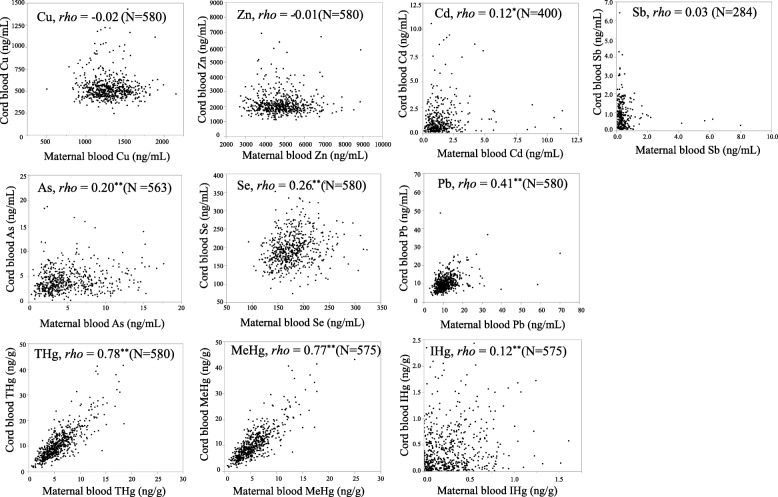
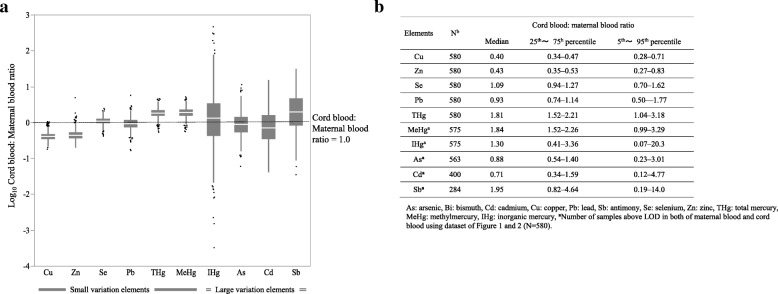
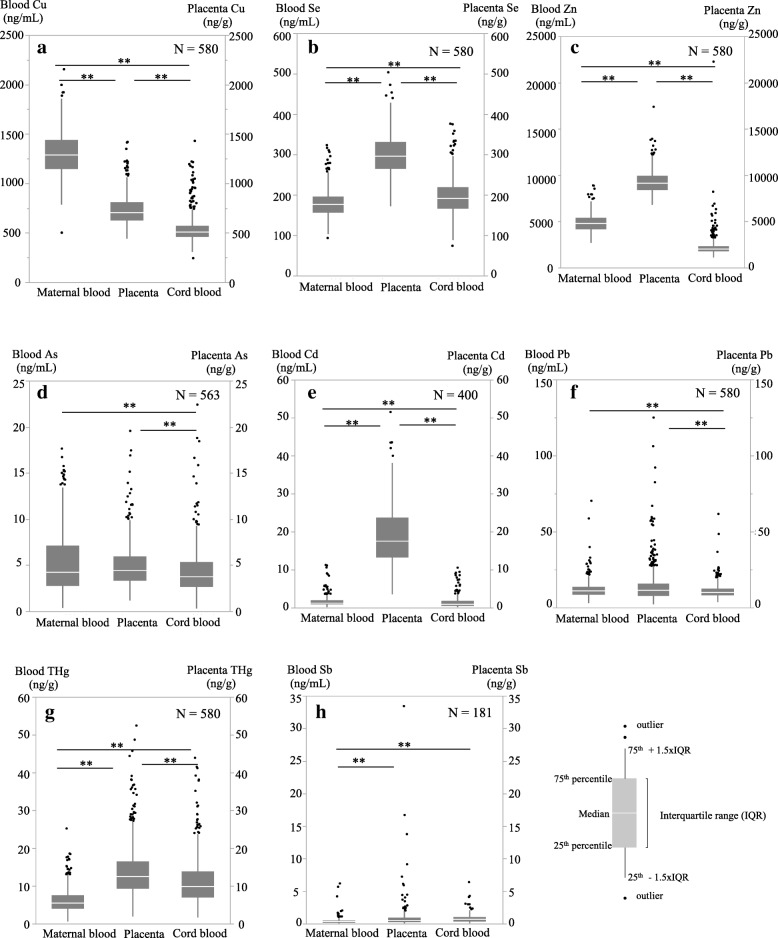
Median concentrations (25th-75th) of As, Cd, Pb, Sb, Sn and THg in the maternal blood were 4.06 (2.68-6.81), 1.18 (0.74-1.79), 10.8 (8.65-13.5), 0.2 (0.06-0.40) and 0.2 (0.1-0.38) ng mL and 5.42 (3.89-7.59) ng g, respectively. Median concentrations (25th-75th) of As, Cd, Pb, Sb, Sn and THg in the cord blood were 3.68 (2.58-5.25), 0.53 (0.10-1.25), 9.89 (8.02-12.5), 0.39 (0.06-0.92) and 0.2 (0.2-0.38) ng mL and 9.96 (7.05-13.8) ng g, respectively.
THg and Sb levels in the cord blood were twofold higher than those in the maternal blood. Cord blood to maternal blood ratios for As, Cd and Sb widely varied between individuals. To understand the effects of prenatal exposure, further research regarding the variations of placental transfer of elements is necessary.
母体暴露于有毒元素对出生结局和儿童发育的影响一直是人们关注的领域。本研究旨在评估母体血液、脐带血和胎盘组织中砷(As)、铋(Bi)、镉(Cd)、汞(总汞(THg)、甲基汞(MHg)、无机汞(IHg))、铅(Pb)、锑(Sb)和锡(Sn)以及必需微量元素铜(Cu)、硒(Se)和锌(Zn)的暴露水平。
采用电感耦合等离子体质谱法(ICP-MS)测定这些元素(汞除外)的浓度。采用冷蒸气原子吸收分光光度法和气相色谱-电子捕获检测法分别测定总汞和甲基汞的浓度。
母体血液中 As、Cd、Pb、Sb、Sn 和 THg 的中位数浓度(25 至 75 百分位数)分别为 4.06(2.68-6.81)、1.18(0.74-1.79)、10.8(8.65-13.5)、0.2(0.06-0.40)、0.2(0.1-0.38)ng/mL 和 5.42(3.89-7.59)ng/g。脐带血中 As、Cd、Pb、Sb、Sn 和 THg 的中位数浓度(25 至 75 百分位数)分别为 3.68(2.58-5.25)、0.53(0.10-1.25)、9.89(8.02-12.5)、0.39(0.06-0.92)、0.2(0.2-0.38)ng/mL 和 9.96(7.05-13.8)ng/g。
脐带血中的总汞和锑水平是母体血液中的两倍。As、Cd 和 Sb 的脐带血与母体血液比值在个体间差异很大。为了了解母体暴露的影响,有必要进一步研究元素在胎盘转运中的变化。