Division of Theoretical Bioinformatics, German Cancer Research Center (DKFZ), Heidelberg, 69120, Germany.
Faculty of Biosciences, Heidelberg University, Heidelberg, 69120, Germany.
BMC Med Genomics. 2019 May 20;12(1):64. doi: 10.1186/s12920-019-0525-4.
Somatic mutations in cancer genomes occur through a variety of molecular mechanisms, which contribute to different mutational patterns. To summarize these, mutational signatures have been defined using a large number of cancer genomes, and related to distinct mutagenic processes. Each cancer genome can be compared to this reference dataset and its exposure to one or the other signature be determined. Given the very different mutational patterns of these signatures, we anticipate that they will have distinct impact on genomic elements, in particular motifs for transcription factor binding sites (TFBS).
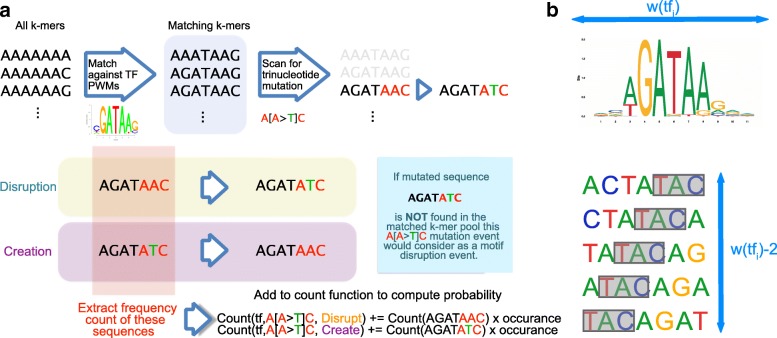
We used the 30 mutational signatures from the COSMIC database, and derived a theoretical framework to infer the impact of these signatures on the alteration of transcription factor (TF) binding motifs from the JASPAR database. Hence, we translated the trinucleotide mutation frequencies of the signatures into alteration frequencies of specific TF binding motifs, leading either to creation or disruption of these motifs.
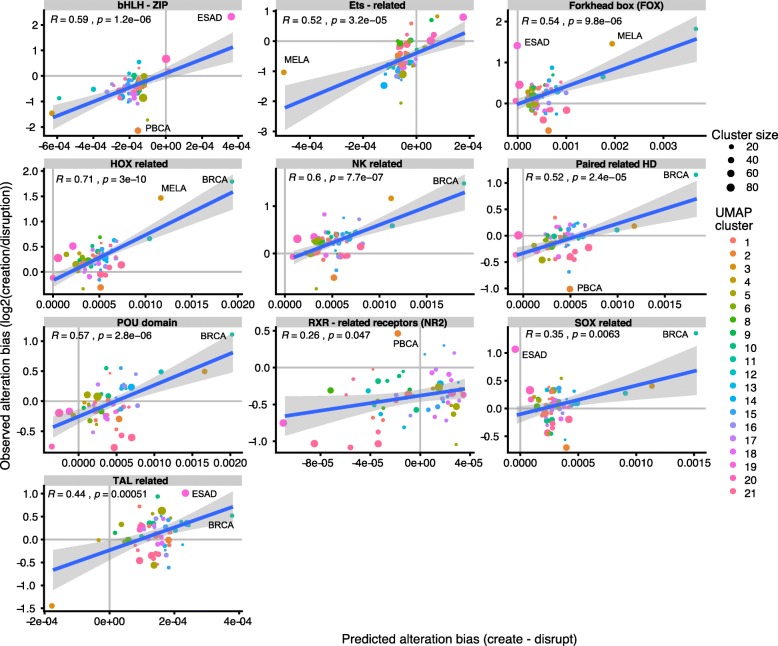
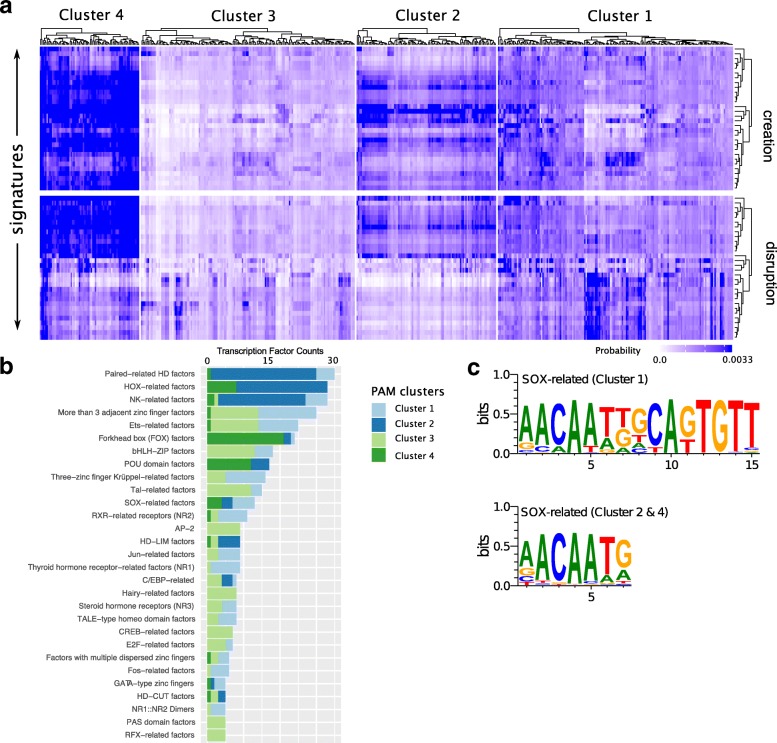
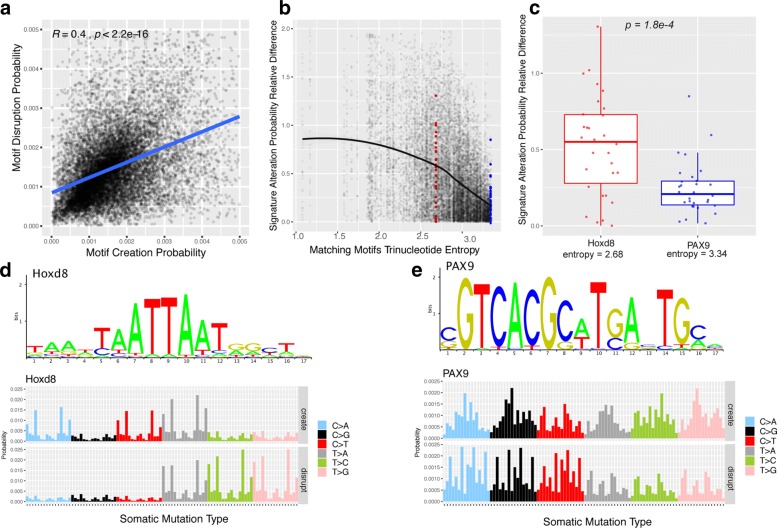
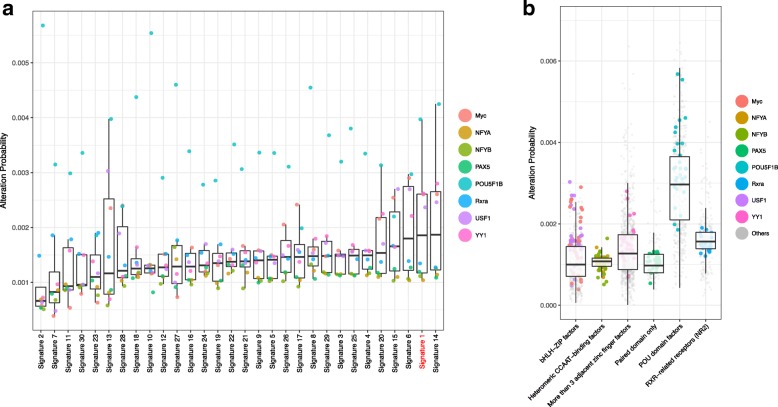
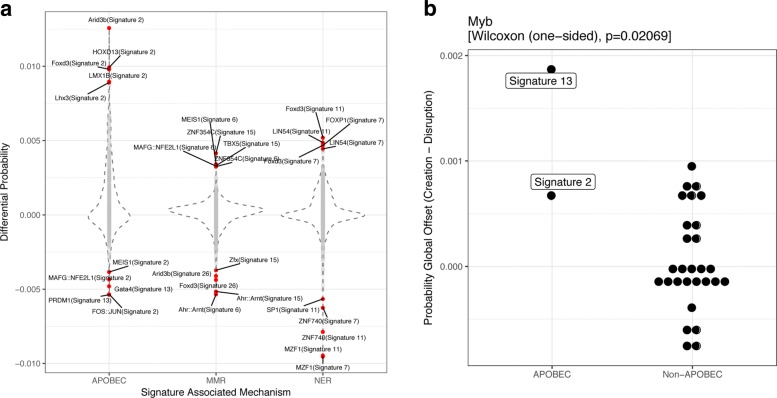
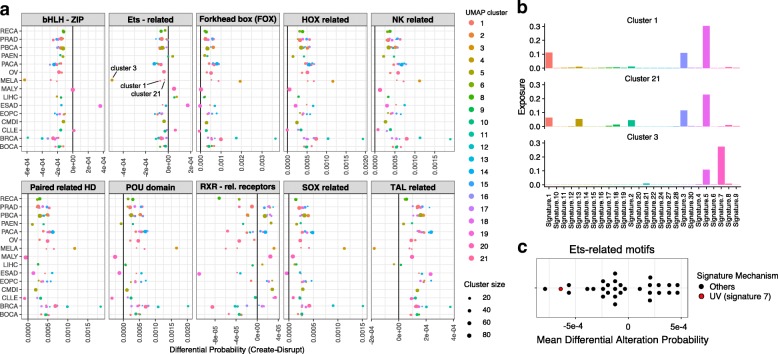
Motif families show different susceptibility to alterations induced by the mutational signatures. For certain motifs, a high correlation is observed between the TFBS motif creation and disruption events related to the information content of the motif. Moreover, we observe striking patterns regarding for example the Ets-motif family, for which a high impact of UV induced signatures is observed. Our model also confirms the susceptibility of specific transcription factor motifs to deamination processes.
Our results show that the mutational signatures have different impact on the binding motifs of transcription factors and that for certain high complexity motifs there is a strong correlation between creation and disruption, related to the information content of the motif. This study represents a background estimation of the alterations due purely to mutational signatures in the absence of additional contributions, e.g. from evolutionary processes.
癌症基因组中的体细胞突变是通过多种分子机制发生的,这些机制导致了不同的突变模式。为了总结这些突变模式,已经使用大量的癌症基因组定义了突变特征,并将其与不同的诱变过程相关联。每个癌症基因组都可以与这个参考数据集进行比较,并确定其对一个或另一个特征的暴露程度。鉴于这些特征的突变模式非常不同,我们预计它们将对基因组元件产生不同的影响,特别是转录因子结合位点(TFBS)的基序。
我们使用了 COSMIC 数据库中的 30 个突变特征,并推导了一个理论框架,从 JASPAR 数据库推断这些特征对转录因子(TF)结合基序改变的影响。因此,我们将特征的三核苷酸突变频率转化为特定 TF 结合基序改变的频率,导致这些基序的产生或破坏。
基序家族对突变特征诱导的改变表现出不同的易感性。对于某些基序,与基序信息含量相关的 TFBS 基序产生和破坏事件之间存在高度相关性。此外,我们观察到了一些引人注目的模式,例如 Ets 基序家族,其中观察到 UV 诱导特征的高影响。我们的模型还证实了特定转录因子基序对脱氨酶过程的易感性。
我们的结果表明,突变特征对转录因子结合基序的影响不同,对于某些高复杂度基序,产生和破坏之间存在很强的相关性,与基序的信息含量有关。这项研究代表了在没有额外贡献(例如进化过程)的情况下,由于突变特征而导致的改变的背景估计。