Dandapat Sudeepta, Siddiqui Fazeel M, Fonarow Gregg C, Bhatt Deepak L, Xu Haolin, Matsouaka Roland, Heidenreich Paul A, Xian Ying, Schwamm Lee H, Smith Eric E
University of Iowa, USA.
Southern Illinois University, USA.
Heliyon. 2019 May 6;5(5):e01659. doi: 10.1016/j.heliyon.2019.e01659. eCollection 2019 May.
The relationship between prior glycemic status and outcomes in intracerebral hemorrhage (ICH) is not established. We hypothesized that higher hemoglobin (Hb) A1c is associated with worse outcomes in ICH.
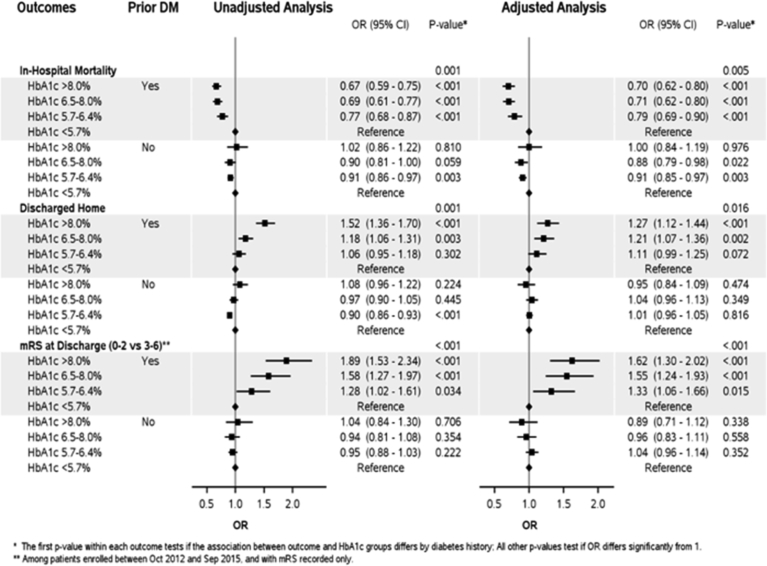
Using the GWTG-Stroke registry, data on patients with ICH between April 1, 2003 and September 30, 2015 were harvested. Patients were divided into four ordinal groups based on HbA1c values of <5.7%, 5.7-6.4%, 6.5-8.0% and >8.0%. Outcomes (mortality, modified Rankin Scale (mRS), home discharge and independent ambulatory status) were analyzed for patients overall and separately for patients with or without history of diabetes using multivariable regression models.
Among 75,455 patients with ICH (with available HbA1c data), patients with lower HbA1c (<5.7%) had higher rates of in-hospital mortality in the entire cohort (15.5%; 3947/25473); as well as those with history of diabetes (19.0%; 542/2852). Among those without history of diabetes, both lower HbA1c (15.1%; 3405/22621) and higher HbA1c (>8.0%), (15.0%; 205/1364) were associated with higher in-hospital mortality. Lower HbA1c was also associated with higher mRS, less chance of going home, and lower likelihood of having independent ambulatory status in patients with prior history of diabetes.
Among patients with no reported history of diabetes, both very low and very high HbA1c were directly associated with higher in-hospital mortality. Only very low HbA1c was associated with higher mortality in known diabetic patients. Further studies are needed to better define the relationship between HbA1c and outcomes, for it may have important implications for care of ICH patients.
脑出血(ICH)患者既往血糖状态与预后之间的关系尚未明确。我们推测较高的糖化血红蛋白(Hb)A1c水平与脑出血患者较差的预后相关。
利用“中风患者治疗改进计划(GWTG)-中风”登记系统,收集了2003年4月1日至2015年9月30日期间脑出血患者的数据。根据HbA1c值将患者分为四个等级组,分别为<5.7%、5.7 - 6.4%、6.5 - 8.0%和>8.0%。使用多变量回归模型对所有患者以及有或无糖尿病史的患者分别分析预后情况(死亡率、改良Rankin量表(mRS)评分、出院回家情况和独立行走状态)。
在75455例脑出血患者(有可用的HbA1c数据)中,HbA1c水平较低(<5.7%)的患者在整个队列中的住院死亡率较高(15.5%;3947/25473);有糖尿病史的患者也是如此(19.0%;542/2852)。在无糖尿病史的患者中,HbA1c水平较低(15.1%;3405/22621)和较高(>8.0%,15.0%;205/1364)均与较高的住院死亡率相关。在有糖尿病史的患者中,较低的HbA1c水平还与较高的mRS评分、较低的回家可能性以及较低的独立行走可能性相关。
在无糖尿病史报告的患者中,极低和极高的HbA1c水平均与较高的住院死亡率直接相关。在已知糖尿病患者中,只有极低的HbA1c水平与较高的死亡率相关。需要进一步研究以更好地明确HbA1c与预后之间的关系,因为这可能对脑出血患者的治疗具有重要意义。