a Department of Pediatrics, Division of Pediatric Hematology/Oncology, University of Utah , Salt Lake City , UT , USA.
b Huntsman Cancer Institute, University of Utah , Salt Lake City , UT , USA.
Hum Vaccin Immunother. 2019;15(7-8):1767-1775. doi: 10.1080/21645515.2019.1619407. Epub 2019 Jun 25.
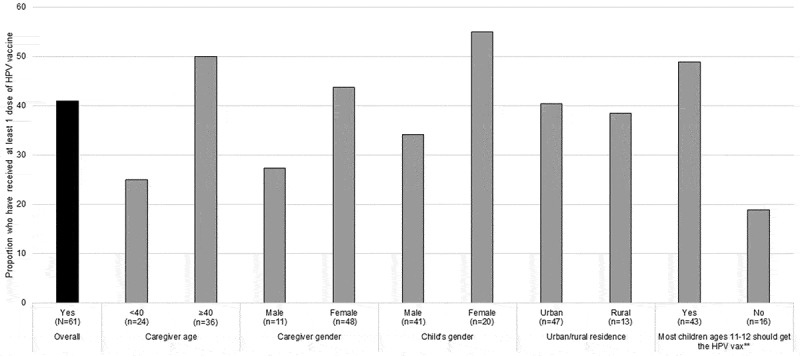
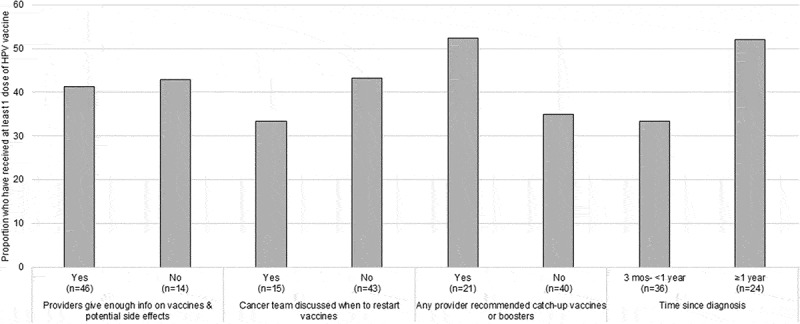
The HPV vaccine is an important vaccine for childhood cancer survivors because of their risks of second cancers, yet few survivors receive it. We examined HPV vaccine knowledge among caregivers of childhood cancer survivors, whether their child had received the vaccine, and their intentions to vaccinate. Eligible participants were caregivers (mostly parents) whose child finished cancer treatment at Primary Children's Hospital in Salt Lake City, Utah 3 to 36 months prior to the start of the study (N = 145). Additional analyses were done among caregivers whose child was age-eligible for the HPV vaccine (ages 11 and up; N = 61). We ran descriptive statistics and fit multivariable generalized linear models to identify factors associated with intention to vaccinate and HPV vaccination uptake. Among caregivers whose child had not yet gotten the HPV vaccine, approximately 30% stated they were not likely to get the vaccine for their child and the most commonly cited reason was not enough information (25.2%). Provider discussion about vaccines and side effects (relative risk (RR) = 1.85, 95% CI 1.16-2.94), along with recommendations regarding vaccines after cancer treatment (RR = 1.35, 95% CI 1.06-1.72), led to greater caregiver intention to get the HPV vaccine for their child with cancer. Approximately 40% of age-eligible survivors had gotten at least one dose of the HPV vaccine. Our findings demonstrate a need for oncology-focused interventions to educate families of childhood cancer survivors about the importance of the HPV vaccine after cancer therapy.
HPV 疫苗是儿童癌症幸存者的重要疫苗,因为他们有罹患第二癌症的风险,但很少有幸存者接种。我们研究了儿童癌症幸存者照顾者的 HPV 疫苗知识,他们的孩子是否接种了疫苗,以及他们接种疫苗的意愿。合格的参与者是在犹他州盐湖城的 Primary Children's Hospital 完成癌症治疗 3 至 36 个月之前开始研究的照顾者(主要是父母)(N=145)。在孩子符合 HPV 疫苗接种年龄(11 岁及以上;N=61)的照顾者中进行了额外的分析。我们进行了描述性统计和多变量广义线性模型拟合,以确定与接种意愿和 HPV 疫苗接种率相关的因素。在那些孩子尚未接种 HPV 疫苗的照顾者中,约 30%表示他们不太可能为孩子接种疫苗,最常提到的原因是没有足够的信息(25.2%)。关于疫苗和副作用的讨论(相对风险(RR)=1.85,95%置信区间 1.16-2.94),以及癌症治疗后关于疫苗的建议(RR=1.35,95%置信区间 1.06-1.72),使更多的照顾者有意愿为他们患有癌症的孩子接种 HPV 疫苗。约 40%符合年龄条件的幸存者至少接种了一剂 HPV 疫苗。我们的研究结果表明,需要开展以肿瘤学为重点的干预措施,向儿童癌症幸存者的家庭宣传癌症治疗后 HPV 疫苗的重要性。