Psychology Department, School of Philosophy, Psychology and Language Sciences, University of Edinburgh, Edinburgh, United Kingdom.
Institute of Psychology, University of Kiel, Kiel, Germany.
PLoS One. 2019 May 23;14(5):e0217051. doi: 10.1371/journal.pone.0217051. eCollection 2019.
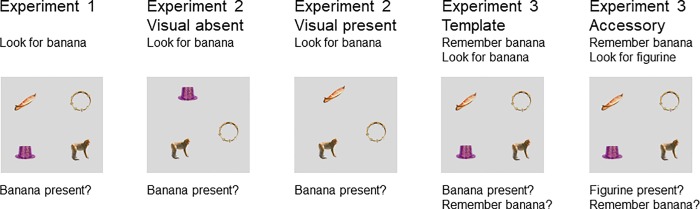
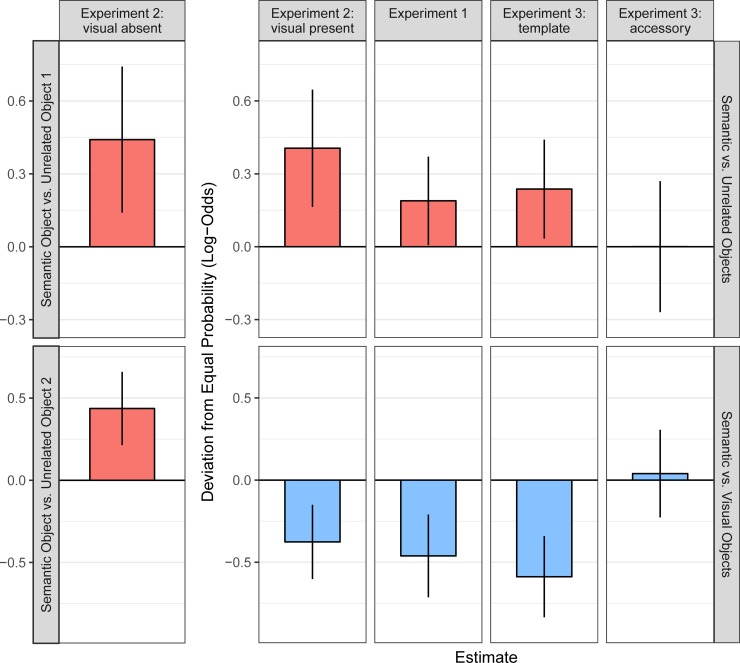
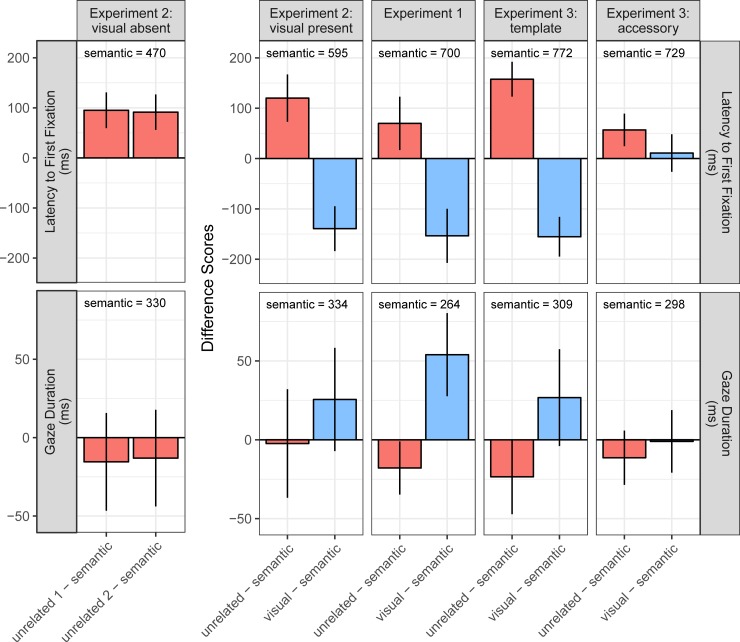
There is ongoing debate on whether object meaning can be processed outside foveal vision, making semantics available for attentional guidance. Much of the debate has centred on whether objects that do not fit within an overall scene draw attention, in complex displays that are often difficult to control. Here, we revisited the question by reanalysing data from three experiments that used displays consisting of standalone objects from a carefully controlled stimulus set. Observers searched for a target object, as per auditory instruction. On the critical trials, the displays contained no target but objects that were semantically related to the target, visually related, or unrelated. Analyses using (generalized) linear mixed-effects models showed that, although visually related objects attracted most attention, semantically related objects were also fixated earlier in time than unrelated objects. Moreover, semantic matches affected the very first saccade in the display. The amplitudes of saccades that first entered semantically related objects were larger than 5° on average, confirming that object semantics is available outside foveal vision. Finally, there was no semantic capture of attention for the same objects when observers did not actively look for the target, confirming that it was not stimulus-driven. We discuss the implications for existing models of visual cognition.
关于目标意义是否可以在中央凹视觉之外被处理,从而使语义可供注意力引导,目前仍存在争议。大部分争论集中在一个问题上,即在复杂的显示环境中,不适合整体场景的目标是否会引起注意,而这种显示环境往往难以控制。在这里,我们通过重新分析三个实验的数据来重新探讨这个问题,这些实验使用的是来自精心控制的刺激集的独立目标对象的显示。观察者根据听觉指令搜索目标对象。在关键试验中,显示中没有目标,但包含与目标语义相关、视觉相关或不相关的对象。使用(广义)线性混合效应模型的分析表明,尽管视觉相关的对象吸引了最多的注意力,但语义相关的对象在时间上也比不相关的对象更早被注视。此外,语义匹配还影响了显示中的第一个眼跳。第一个进入语义相关对象的眼跳的幅度平均超过 5°,这证实了对象语义在中央凹视觉之外是可用的。最后,当观察者没有主动寻找目标时,相同的对象没有受到语义的注意捕获,这证实了这不是由刺激驱动的。我们讨论了这对现有视觉认知模型的影响。