From the Department of Child and Adolescent Psychiatry/Psychology, Erasmus Medical Center-Sophia Children's Hospital, Rotterdam, the Netherlands.
Research Institute of Child Development and Education, University of Amsterdam, Amsterdam, the Netherlands.
Anesth Analg. 2019 Nov;129(5):1344-1353. doi: 10.1213/ANE.0000000000004165.
Medical procedures often evoke pain and anxiety in pediatric patients. Virtual reality (VR) is a relatively new intervention that can be used to provide distraction during, or to prepare patients for, medical procedures. This meta-analysis is the first to collate evidence on the effectiveness of VR on reducing pain and anxiety in pediatric patients undergoing medical procedures.
On April 25, 2018, we searched EMBASE, MEDLINE, CENTRAL, PubMed, Web of Science, and PsycINFO with the keywords "VR," "children," and "adolescents." Studies that applied VR in a somatic setting with participants ≤21 years of age were included. VR was defined as a fully immersive 3-dimensional environment displayed in surround stereoscopic vision on a head-mounted display (HMD). We evaluated pain and anxiety outcomes during medical procedures in VR and standard care conditions.
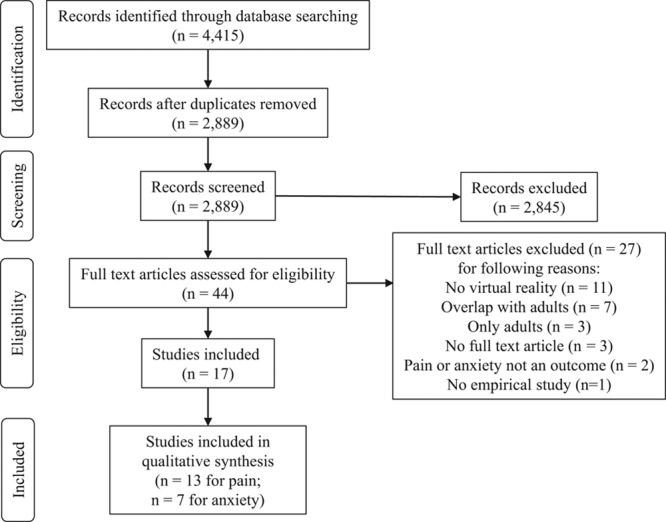
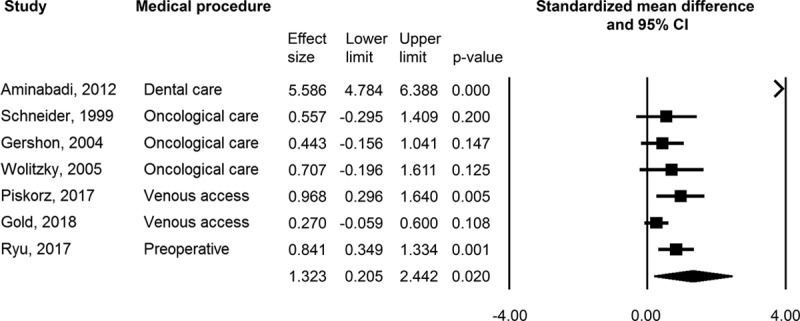
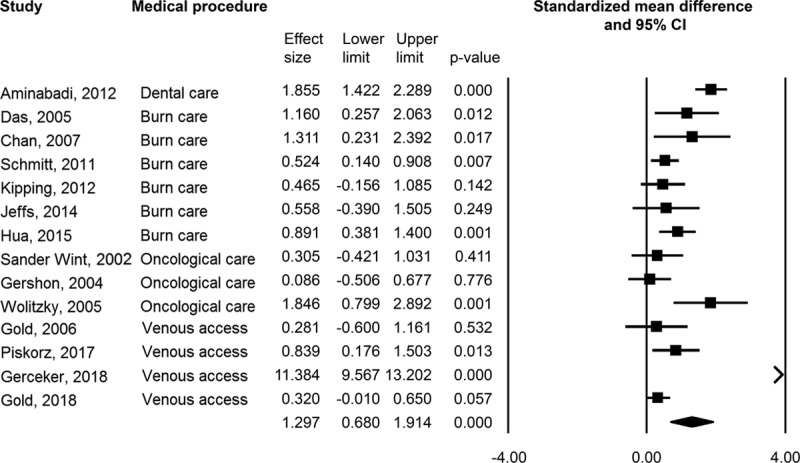
We identified 2889 citations, of which 17 met our inclusion criteria. VR was applied as distraction (n = 16) during venous access, dental, burn, or oncological care or as exposure (n = 1) before elective surgery under general anesthesia. The effect of VR was mostly studied in patients receiving burn care (n = 6). The overall weighted standardized mean difference (SMD) for VR was 1.30 (95% CI, 0.68-1.91) on patient-reported pain (based on 14 studies) and 1.32 (95% CI, 0.21-2.44) on patient-reported anxiety (based on 7 studies). The effect of VR on pediatric pain was also significant when observed by caregivers (SMD = 2.08; 95% CI, 0.55-3.61) or professionals (SMD = 3.02; 95% CI, 0.79-2.25). For anxiety, limited observer data were available.
VR research in pediatrics has mainly focused on distraction. Large effect sizes indicate that VR is an effective distraction intervention to reduce pain and anxiety in pediatric patients undergoing a wide variety of medical procedures. However, further research on the effect of VR exposure as a preparation tool for medical procedures is needed because of the paucity of research into this field.
医疗程序常常会给儿科患者带来疼痛和焦虑。虚拟现实(VR)是一种相对较新的干预手段,可用于在医疗程序期间提供分散注意力,或帮助患者做好医疗程序的准备。这是首次对 VR 减轻儿科患者医疗程序疼痛和焦虑的效果进行汇总评估的荟萃分析。
我们于 2018 年 4 月 25 日检索了 EMBASE、MEDLINE、CENTRAL、PubMed、Web of Science 和 PsycINFO,使用的关键词为“VR”“儿童”和“青少年”。纳入研究对象为年龄≤21 岁、在躯体环境中应用 VR 的患者。VR 被定义为头戴式显示器(HMD)上呈现的完全沉浸式 3 维环境,呈环绕立体视觉。我们评估了 VR 和标准护理条件下医疗程序期间的疼痛和焦虑结果。
我们共检索到 2889 条记录,其中 17 项符合纳入标准。VR 作为分散注意力的手段(n=16)应用于静脉穿刺、牙科、烧伤或肿瘤治疗,或作为暴露疗法(n=1)应用于全身麻醉下择期手术前。VR 主要在接受烧伤治疗的患者(n=6)中进行研究。基于 14 项研究,VR 患者报告疼痛的总体加权标准化均数差(SMD)为 1.30(95%可信区间,0.68-1.91),基于 7 项研究,患者报告焦虑的 SMD 为 1.32(95%可信区间,0.21-2.44)。VR 对儿科疼痛的影响也可由护理人员(SMD=2.08;95%可信区间,0.55-3.61)或专业人员(SMD=3.02;95%可信区间,0.79-2.25)观察到。关于焦虑,可利用的观察数据有限。
儿科 VR 研究主要集中在分散注意力。较大的效应量表明,VR 是一种有效减轻接受各种医疗程序的儿科患者疼痛和焦虑的分散注意力干预手段。但是,由于该领域研究匮乏,需要进一步研究 VR 暴露作为医疗程序准备工具的效果。