Smith Kathryn L, Wang Yang, Colloca Luana
Department of Pain and Translational Symptom Science, School of Nursing, University of Maryland, Baltimore, MD, United States.
Center to Advance Chronic Pain Research, University of Maryland, Baltimore, MD, United States.
Front Virtual Real. 2022 Jan;2. doi: 10.3389/frvir.2021.751735. Epub 2022 Jan 6.
Virtual reality (VR) has the potential to lessen pain and anxiety experienced by pediatric patients undergoing burn wound care procedures. Population-specific variables require novel technological application and thus, a systematic review among studies on its impact is warranted.
The objective of this review was to evaluate the effectiveness of VR on pain in children with burn injuries undergoing wound care procedures.
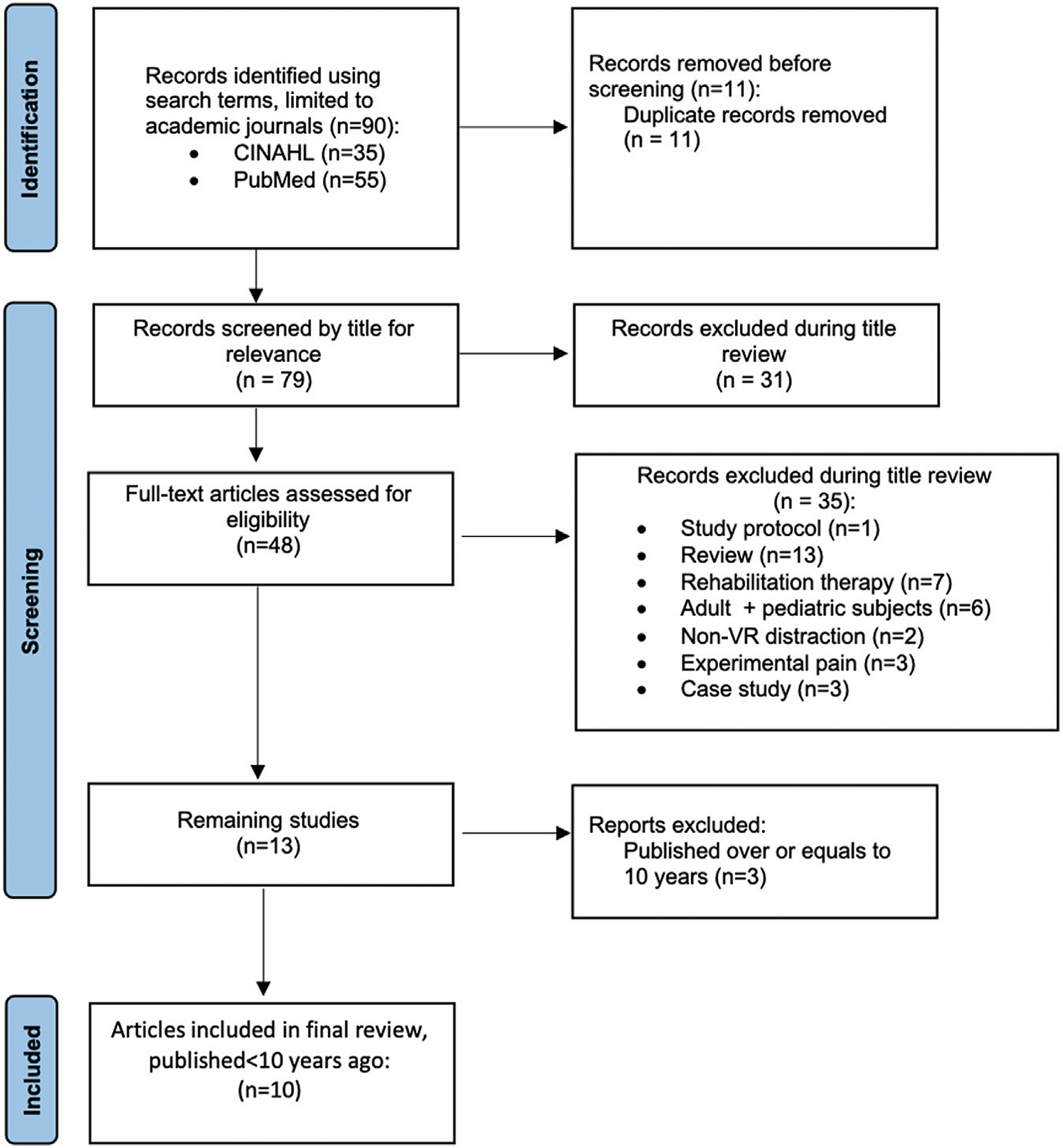
A systematic literature review was performed using PubMed and CINAHL databases from January 2010 to July 2021 with the keywords "pediatric," "burn," "virtual reality," and "pain." We included experimental studies of between- and within-subjects designs in which pediatric patients' exposure to virtual reality technology during burn wound care functioned as the intervention of interest. Two researchers independently performed the literature search, made judgements of inclusion/exclusion based on agreed-upon criteria, abstracted data, and assessed quality of evidence using a standardized appraisal tool. A meta-analysis was conducted to evaluate the effectiveness of the VR on burning procedural pain in pediatric population. Standardized mean difference (SMD) was used as an index of combined effect size, and a random effect model was used for meta-analysis.
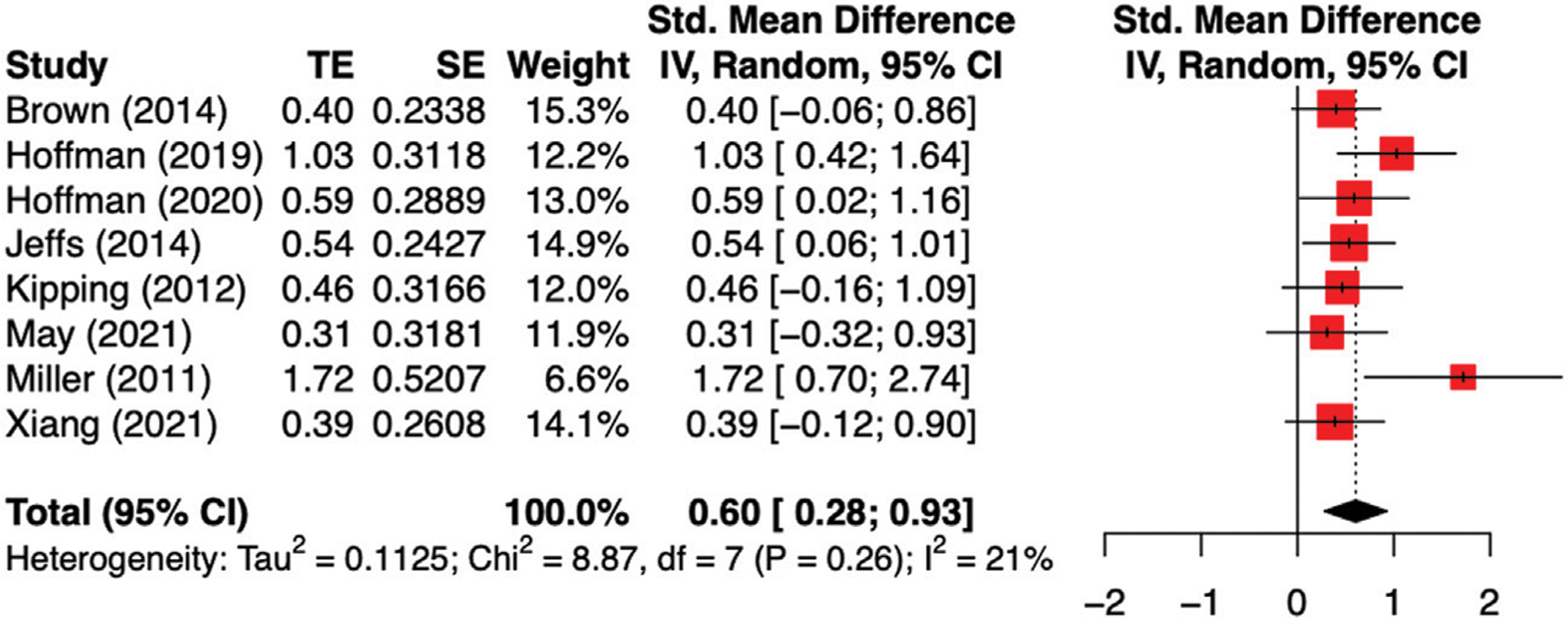
Ten articles published between January 2010 and July 2021 passed the selection criteria: six randomized controlled trials and four randomized repeated-measures studies. Consistent results among the studies provided support for VR as effective in reducing pain and potentially pain related anxiety in children undergoing burn wound care through preprocedural preparation (n = 2) and procedural intervention (n = 8). VR effects on pain intensity ratings were moderate to large (SMD=0.60, 95%CI=0.28-0.93, =0.0037 with no significant heterogeneity of VR intervention effects between studies. Only one study reported direct influence of VR intervention on pre-procedural situational anxiety with a moderate effect size (Cohen's d = 0.575, 95%CI = 0.11-1.04).
Children's exposure to VR during burn care procedures was associated with lower levels of pain and pain related anxiety. Moderate to large effect sizes support the integration of VR into traditional pediatric burn pain protocols irrespective of innovative delivery methods and content required for use in burned pediatric patients.
虚拟现实(VR)有潜力减轻接受烧伤伤口护理程序的儿科患者所经历的疼痛和焦虑。特定人群的变量需要新颖的技术应用,因此,有必要对关于其影响的研究进行系统综述。
本综述的目的是评估VR对接受伤口护理程序的烧伤儿童疼痛的有效性。
使用PubMed和CINAHL数据库进行系统文献综述,时间范围为2010年1月至2021年7月,关键词为“儿科”、“烧伤”、“虚拟现实”和“疼痛”。我们纳入了组间和组内设计的实验研究,其中儿科患者在烧伤伤口护理期间接触虚拟现实技术作为感兴趣的干预措施。两名研究人员独立进行文献检索,根据商定的标准做出纳入/排除判断,提取数据,并使用标准化评估工具评估证据质量。进行荟萃分析以评估VR对儿科人群烧伤程序疼痛的有效性。标准化平均差(SMD)用作综合效应大小的指标,随机效应模型用于荟萃分析。
2010年1月至2021年7月发表的10篇文章通过了选择标准:6项随机对照试验和4项随机重复测量研究。研究结果一致支持VR在通过术前准备(n = 2)和程序干预(n = 8)减轻接受烧伤伤口护理儿童的疼痛和潜在的疼痛相关焦虑方面是有效的。VR对疼痛强度评分的影响为中度至高度(SMD = 0.60,95%CI = 0.28 - 0.93,I² = 0.0037,研究间VR干预效果无显著异质性)。只有一项研究报告了VR干预对术前情境焦虑的直接影响,效应大小为中度(Cohen's d = 0.575,95%CI = 0.11 - 1.04)。
儿童在烧伤护理程序中接触VR与较低水平的疼痛和疼痛相关焦虑有关。中度至高度的效应大小支持将VR纳入传统的儿科烧伤疼痛方案,而无需考虑用于烧伤儿科患者的创新交付方法和内容。