Chycki J, Zajac A, Michalczyk M, Maszczyk A, Langfort J
Department of Sports Training, The Jerzy Kukuczka Academy of Physical Education in Katowice, Katowice, Poland.
Department of Sports Nutrition, The Jerzy Kukuczka Academy of Physical Education in Katowice, Katowice, Poland.
Endocr Connect. 2019 Jul;8(7):814-821. doi: 10.1530/EC-19-0216.
The present study verified the effect of moderate-to-high-intensity aerobic exercise on the endocrine response profile and adipose tissue in young healthy men with different phenotype characteristics.
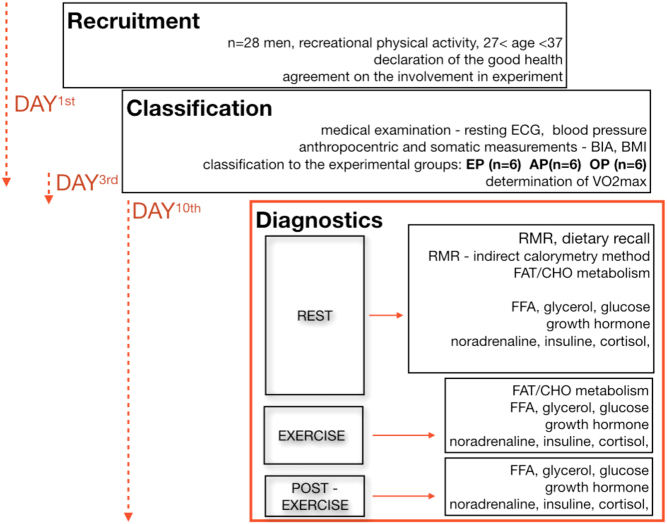
Eighteen men were divided into three experimental groups with defined body components and specific physical fitness: Endurance phenotype - EP (n = 6; low body mass; low fat content; aerobic endurance trained), Athletic phenotype - AP (n = 6; high body mass; low fat content, resistance trained), Obesity phenotype - OP (n = 6; high body mass; high fat content, untrained).
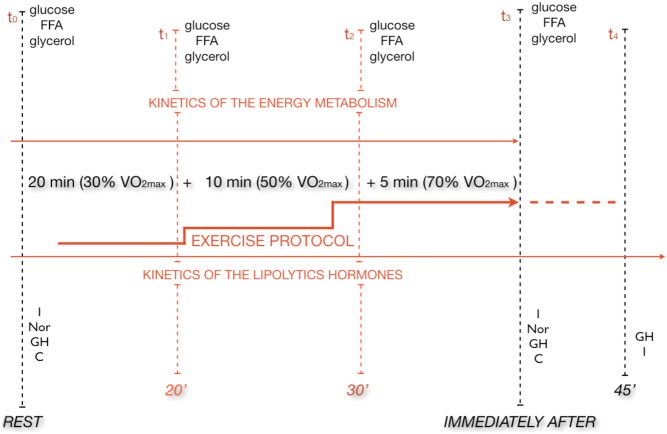
The participants performed an progressive exercise protocol on a treadmill (30% VO2max, 50% VO2max, 70% VO2max), separated by 45 s of passive rest for blood collection.
Plasma glucose oxidation increased in relation to exercise intensity, but to a greater extent in the AP group. The free fatty acids' plasma level decreased with a rise in exercise intensity, but with different kinetics in particular phenotypes. Plasma growth hormone increased after the cessation of exercise and was significantly higher in all groups 45 min into recovery compared to resting values. Plasma insulin decreased during exercise in all groups, but in the OP, the decrease was blunted.
The results indicate that the rate of lipolysis, hormonal and metabolic response to aerobic exercise depends on the individuals' phenotype. Thus, exercise type, duration and intensity have to be strictly individualized in relation to phenotype in order to reach optimal metabolic benefits.
本研究验证了中高强度有氧运动对具有不同表型特征的年轻健康男性内分泌反应谱和脂肪组织的影响。
18名男性被分为三个具有明确身体成分和特定身体素质的实验组:耐力型——EP组(n = 6;低体重;低脂肪含量;有氧耐力训练),运动型——AP组(n = 6;高体重;低脂肪含量,抗阻训练),肥胖型——OP组(n = 6;高体重;高脂肪含量,未训练)。
参与者在跑步机上进行递增运动方案(30%最大摄氧量、50%最大摄氧量、70%最大摄氧量),每次运动之间间隔45秒的被动休息以采集血液。
与运动强度相关,血浆葡萄糖氧化增加,但AP组增加幅度更大。游离脂肪酸的血浆水平随运动强度增加而降低,但在特定表型中具有不同的动力学变化。运动停止后血浆生长激素升高,与静息值相比,恢复45分钟时所有组均显著更高。所有组运动期间血浆胰岛素均降低,但在OP组中降低幅度较小。
结果表明,脂肪分解速率、对有氧运动的激素和代谢反应取决于个体的表型。因此,为了获得最佳代谢益处,运动类型、持续时间和强度必须根据表型严格个体化。