Biological Science Research Center, Southwest University, Chongqing 400716, China.
State Key Laboratory of Silkworm Genome Biology, Southwest University, Chongqing 400716, China.
Int J Mol Sci. 2019 May 20;20(10):2491. doi: 10.3390/ijms20102491.
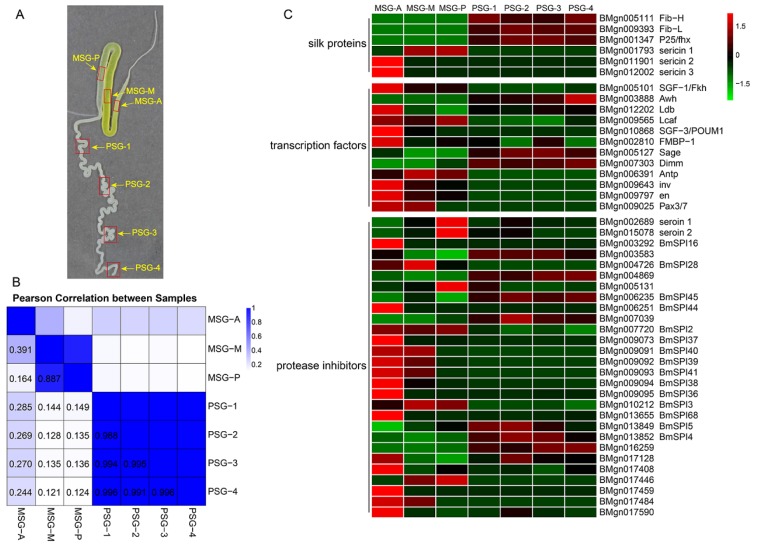
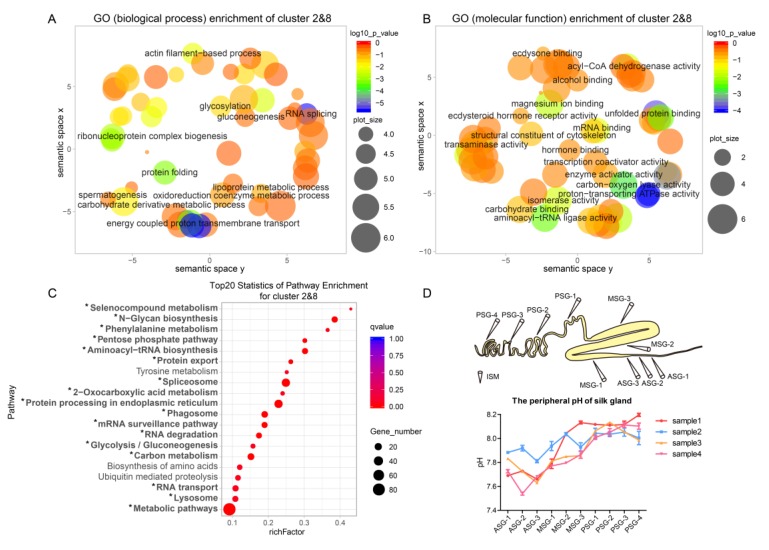
The silk gland synthesizes and secretes a large amount of protein and stores liquid silk protein at an extremely high concentration. Interestingly, silk proteins and serine protease inhibitors are orderly arranged in the silk gland lumen and cocoon shells. Silk fiber formation and the spinning mechanism have not been fully elucidated. Therefore, we conducted a comparative transcriptome analysis of seven segments of the single silk gland to characterize internal changes in the silk gland during the 5th instar of mature larvae. In total, 3121 differentially expressed genes were identified in the seven segments. Genes highly expressed in the middle silk gland (MSG) were mainly involved in unsaturated fatty acid biosynthesis, fatty acid metabolism, apoptosis-fly, and lysosome pathways, whereas genes highly expressed in the posterior silk gland (PSG) were mainly involved in ribosome, proteasome, citrate cycle, and glycolysis/gluconeogenesis pathways. Thus, the MSG and PSG differ greatly in energy source use and function. Further, 773 gradually upregulated genes (from PSG to MSG) were involved in energy metabolism, silk protein synthesis, and secretion, suggesting that these genes play an important role in silk fiber formation. Our findings provide insights into the mechanism of silk protein synthesis and transport and silk fiber formation.
丝腺合成并分泌大量蛋白质,并以极高的浓度储存液体丝蛋白。有趣的是,丝蛋白和丝氨酸蛋白酶抑制剂在丝腺腔和茧壳中有序排列。丝纤维的形成和纺丝机制尚未完全阐明。因此,我们对成熟幼虫第 5 龄期的单个丝腺的 7 个部位进行了比较转录组分析,以描述丝腺在这一时期内部的变化。在这 7 个部位共鉴定出 3121 个差异表达基因。在中丝腺(MSG)中高度表达的基因主要参与不饱和脂肪酸生物合成、脂肪酸代谢、凋亡-飞、和溶酶体途径,而在后部丝腺(PSG)中高度表达的基因主要参与核糖体、蛋白酶体、柠檬酸循环和糖酵解/糖异生途径。因此,MSG 和 PSG 在能源利用和功能上有很大的不同。此外,773 个逐渐上调的基因(从 PSG 到 MSG)参与了能量代谢、丝蛋白合成和分泌,这表明这些基因在丝纤维形成中起着重要作用。我们的研究结果为丝蛋白合成和转运以及丝纤维形成的机制提供了新的见解。