Chen Shuwen, An Ting, Gao Yi, Lyu Jie-Yao, Tang De-Yun, Zhang Xue-Xue, Zhao Fengqi, Yan Qi-Long
Science and Technology on Combustion, Internal Flow and Thermostructure Laboratory, Northwestern Polytechnical University, Xi'an 710072, China.
Science and Technology on Combustion and Explosion Laboratory, Xi'an Modern Chemistry Research Institute, Xi'an 710065, China.
Nanomaterials (Basel). 2019 May 24;9(5):801. doi: 10.3390/nano9050801.
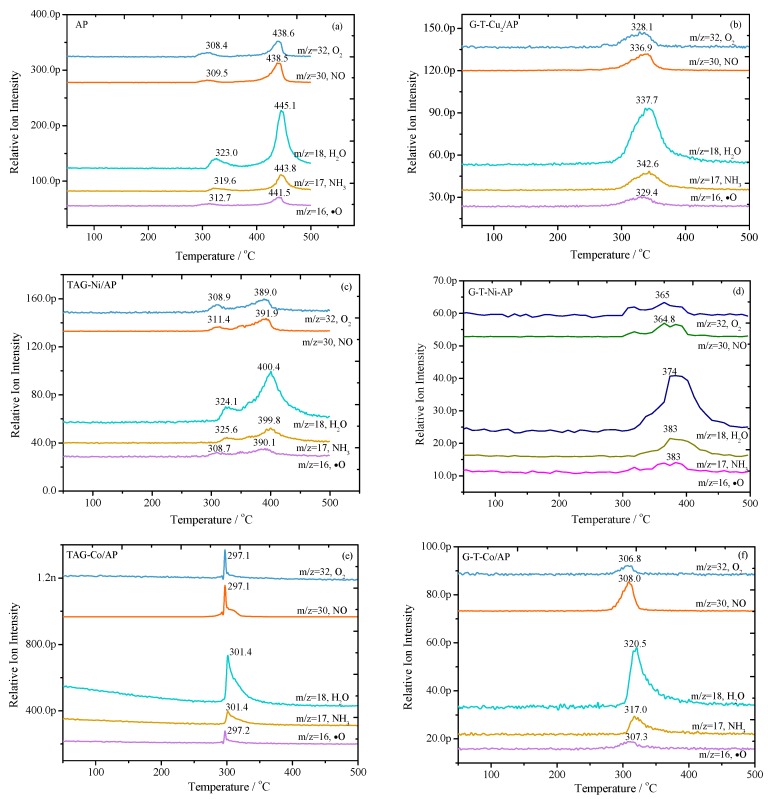
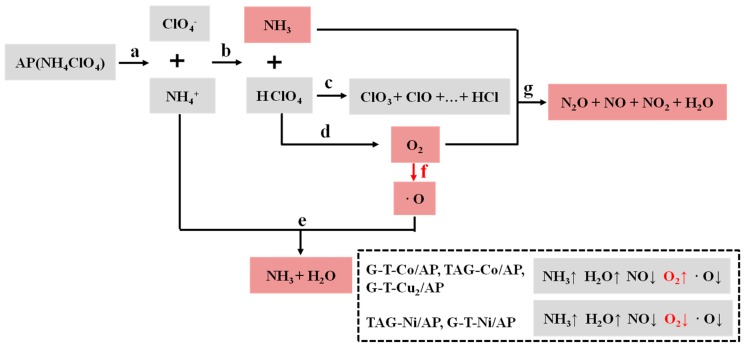
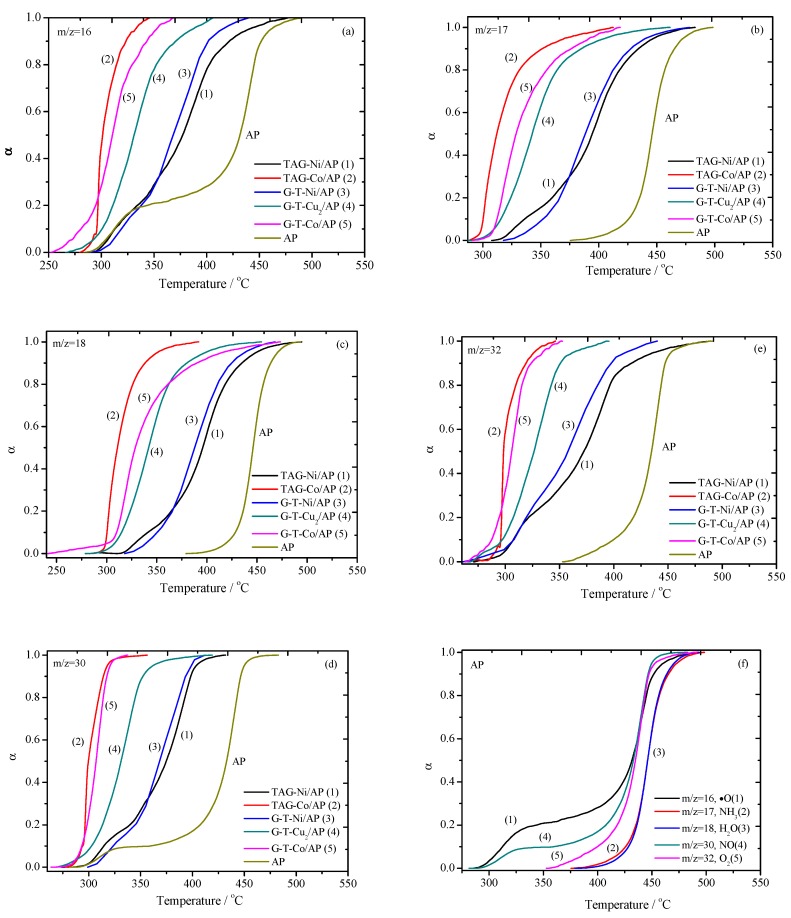
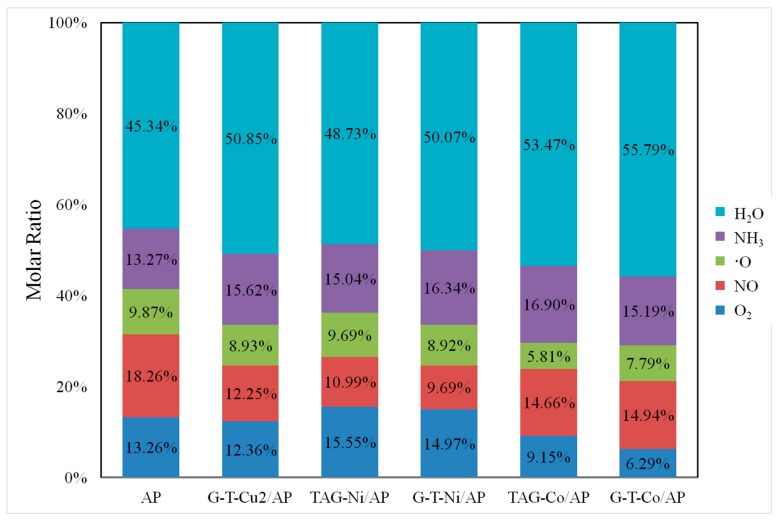
A quantitative evaluation method has been developed to study the effects of nanoadditives on thermal decomposition mechanisms of energetic compounds using the conventional thermogravimetry coupled with mass spectrometry (TG/MS) technique. The decomposition of ammonium perchlorate (AP) under the effect of several energetic catalysts has been investigated as a demonstration. In particular, these catalysts are transition metal (Cu, Co and Ni) complexes of triaminoguanidine (TAG), using graphene oxide (GO) as dopant. They have been well-compared in terms of their catalytic effects on the concentration of the released gaseous products of AP. These detailed quantitative analyses of the gaseous products of AP provide a proof that the proton transfer between O and O determines the catalytic decomposition pathways, which largely depend on the type of reactive centers of the catalysts. This quantitative method could be applied to evaluate the catalytic effects of any other additives on the thermal decomposition of various energetic compounds.
已经开发出一种定量评估方法,以使用传统热重分析法结合质谱(TG/MS)技术研究纳米添加剂对含能化合物热分解机理的影响。作为示例,研究了几种含能催化剂作用下高氯酸铵(AP)的分解。特别地,这些催化剂是三氨基胍(TAG)的过渡金属(Cu、Co和Ni)配合物,并使用氧化石墨烯(GO)作为掺杂剂。就它们对AP释放气态产物浓度的催化作用而言,已经对它们进行了充分比较。对AP气态产物的这些详细定量分析证明,O与O之间的质子转移决定了催化分解途径,这在很大程度上取决于催化剂活性中心的类型。这种定量方法可用于评估任何其他添加剂对各种含能化合物热分解的催化作用。