Fuentes-García Gabriela, Castañeda-Patlán M Cristina, Vercoutter-Edouart Anne-Sophie, Lefebvre Tony, Robles-Flores Martha
Departamento de Bioquímica, Facultad de Medicina, Universidad Nacional Autónoma de México, Mexico City, Mexico.
Unité de Glycobiologie Structurale et Fonctionnelle, CNRS, UMR 8576, University of Lille, Lille, France.
Front Endocrinol (Lausanne). 2019 May 8;10:289. doi: 10.3389/fendo.2019.00289. eCollection 2019.
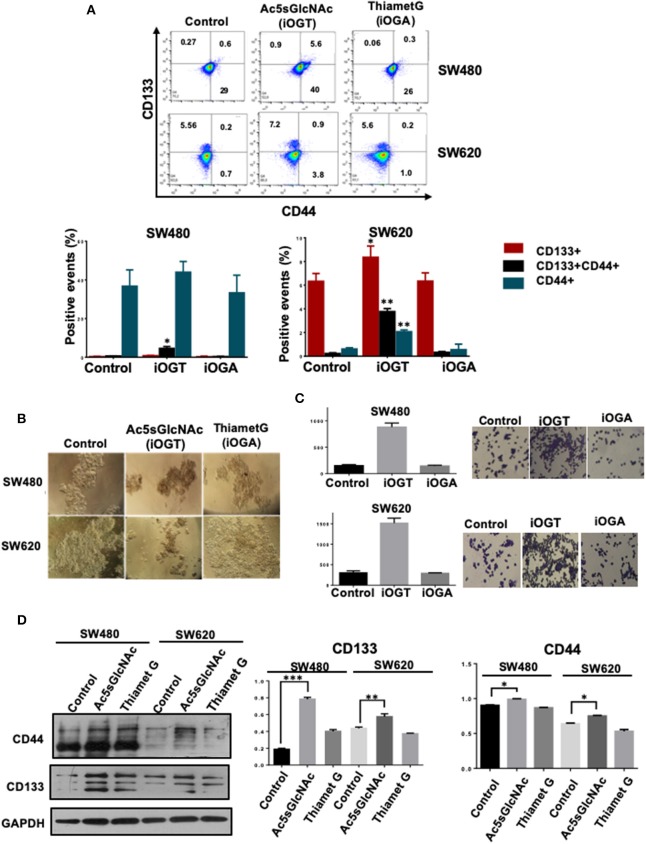
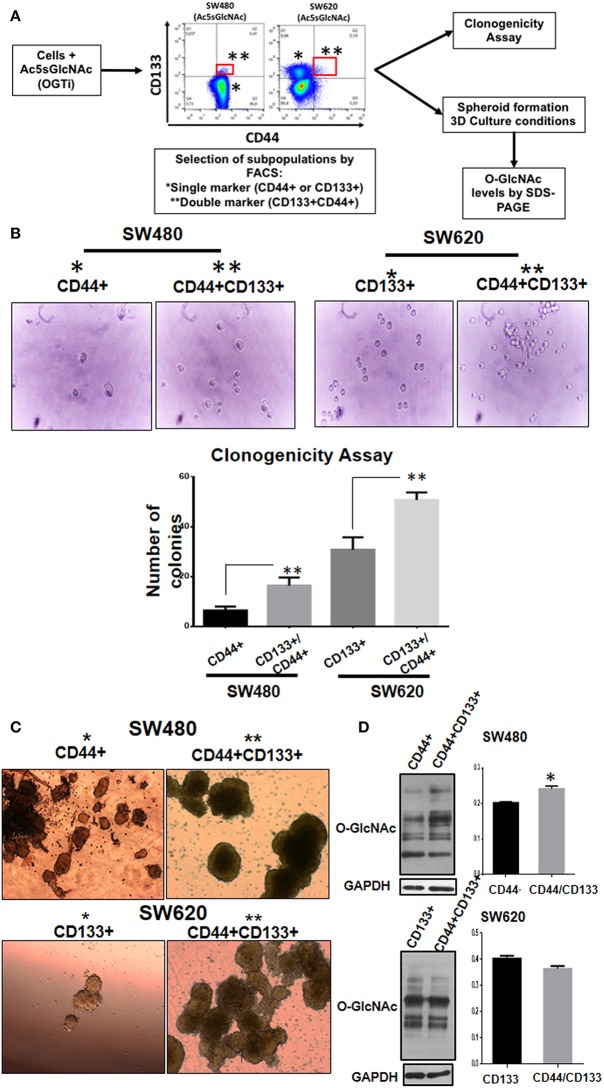
The dynamic -linked-N-acetylglucosamine posttranslational modification of nucleocytoplasmic proteins has emerged as a key regulator of diverse cellular processes including several hallmarks of cancer. However, the role played by this modification in the establishment of CSC phenotype has been poorly studied so far and remains unclear. In this study we confirmed the previous reports showing that colon cancer cells exhibit higher -GlcNAc basal levels than non-malignant cells, and investigated the role played by -GlcNAcylation in the regulation of CSC phenotype. We found that the modification of -GlcNAcylation levels by pharmacological inhibition of the -GlcNAc-transferase enzyme that adds -GlcNAc (OGT), but not of the enzyme that removes it (OGA), increased the expression of all stem cell markers tested in our colon malignant cell lines, and induced the appearance of a double positive (CD44+/CD133+) small stem cell-like subpopulation (which corresponded to 1-10%) that displayed very aggressive malignant phenotype such as increased clonogenicity and spheroid formation abilities in 3D culture. We reasoned that OGT inhibition would mimic in the tumor the presence of severe nutritional stress, and indeed, we demonstrated that nutritional stress reproduced in colon cancer cells the effects obtained with OGT inhibition. Thus, our data strongly suggests that stemness is regulated by HBP/-GlcNAcylation nutrient sensing pathway, and that -GlcNAc nutrient sensor represents an important survival mechanism in cancer cells under nutritional stressful conditions.
核质蛋白的动态连接的N-乙酰葡糖胺翻译后修饰已成为多种细胞过程的关键调节因子,包括癌症的几个标志。然而,这种修饰在癌症干细胞(CSC)表型建立中所起的作用迄今为止研究甚少,仍不清楚。在本研究中,我们证实了先前的报道,即结肠癌细胞比非恶性细胞表现出更高的基础O-连接的N-乙酰葡糖胺(O-GlcNAc)水平,并研究了O-GlcNAc糖基化在CSC表型调节中的作用。我们发现,通过药理学抑制添加O-GlcNAc的O-GlcNAc转移酶(OGT),而不是去除它的酶(OGA)来改变O-GlcNAcylation水平,增加了我们结肠恶性细胞系中所有测试的干细胞标志物的表达,并诱导出现了一个双阳性(CD44+/CD133+)的小干细胞样亚群(占1-10%),该亚群表现出非常侵袭性的恶性表型,如在三维培养中克隆形成能力和球体形成能力增加。我们推测OGT抑制会在肿瘤中模拟严重营养应激的存在,事实上,我们证明了在结肠癌细胞中重现营养应激可获得与OGT抑制相同的效果。因此,我们的数据强烈表明干性由己糖胺生物合成途径/ O-GlcNAcylation营养感应途径调节,并且O-GlcNAc营养传感器代表了营养应激条件下癌细胞中的一种重要生存机制。