Tan Jianglin, Chen Jian, Zhou Junyi, Song Huapei, Deng Huan, Ao Ming, Luo Gaoxing, Wu Jun
1Institute of Burn Research, State Key Laboratory of Trauma, Burns and Combined Injuries, Chongqing Key Laboratory for Disease Proteomics, Southwest Hospital, Third Military (Army) Medical University, Chongqing, 400038 China.
2Department of Burns, First Affiliated Hospital of Sun Yat-Sen University, Guangzhou, 510080 China.
Burns Trauma. 2019 May 20;7:17. doi: 10.1186/s41038-019-0151-6. eCollection 2019.
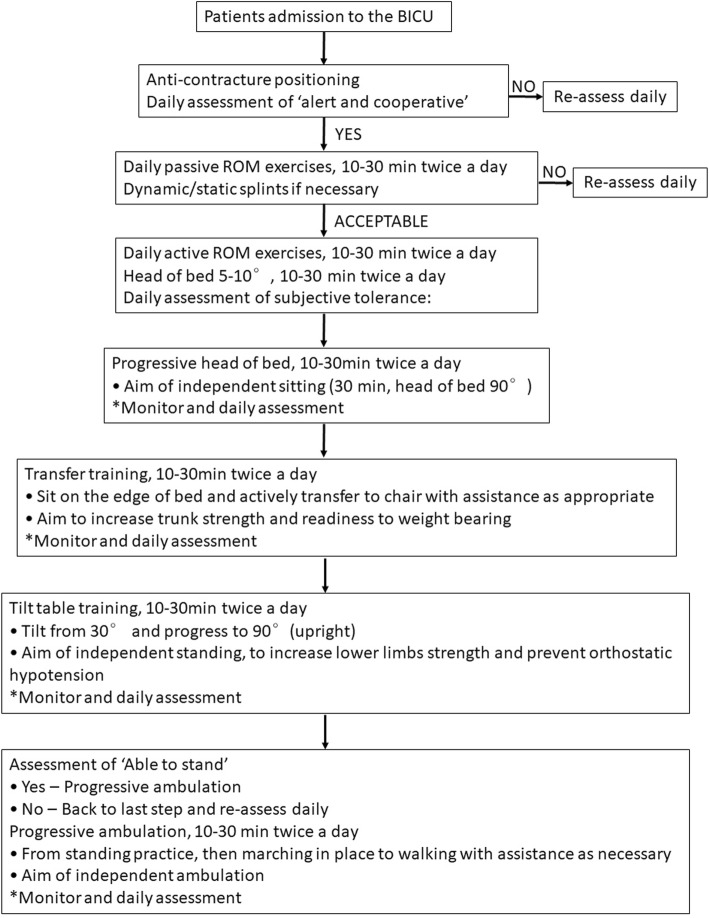
Joint contracture is the major clinical complication in burn patients, especially, the severe burn patients. This study aimed to investigate the number and severity of joint contractures in patients with burns affecting greater than or equal to 50% of the total body surface area (TBSA) undergoing early rehabilitation in a burn intensive care unit (BICU).
We analyzed burn patients with burns affecting greater than or equal to 50% of the TBSA admitted to a BICU who received early rehabilitation within 7 days post-injury from January 2011 to December 2015. Demographic and medical information was collected. The range of motion (ROM) of different joints was measured 1 month post-admission. Spearman's correlation coefficient and logistic regression analysis was used to determine predictors of the presence and severity of contractures.
The average affected TBSA of the included burn patients was 67.4%, and the average length of stay in the BICU was 46.2 ± 28.8 days. One hundred and one of 108 burn patients (93.5%) developed at least one joint contracture. The ROM in 67.9% of the affected joints was mildly limited. The majority of contractures in severe burn patients were mild (37.7%) or moderate (33.2%). The wrist was the most commonly affected joint (18.2%), followed by the shoulder, ankle, hip, knee, and elbow. A predictor of the presence of contractures was the length of hospital stay ( = 0.049). The severe contracture was related to the area of full-thickness burns, the strict bed rest time, and the duration of rehabilitation in BICU. The length of rehabilitation stay (days) in patients with moderate contracture is 54.5% longer than that in severe contracture ( = 0.024).
During the long stay in BICU, the length of rehabilitation stay in a BICU could decrease the severity of contractures from severe to moderate in the patients with equal to 50% of the TBSA. Hence, this research reveals the important role of early rehabilitation interventions in severe burn patients.
关节挛缩是烧伤患者尤其是重度烧伤患者的主要临床并发症。本研究旨在调查在烧伤重症监护病房(BICU)接受早期康复治疗的烧伤面积大于或等于50%总体表面积(TBSA)的患者关节挛缩的数量和严重程度。
我们分析了2011年1月至2015年12月期间入住BICU且在受伤后7天内接受早期康复治疗、烧伤面积大于或等于50%TBSA的烧伤患者。收集了人口统计学和医学信息。入院1个月后测量不同关节的活动范围(ROM)。采用Spearman相关系数和逻辑回归分析来确定挛缩存在和严重程度的预测因素。
纳入的烧伤患者平均烧伤TBSA为67.4%,在BICU的平均住院时间为46.2±28.8天。108例烧伤患者中有101例(93.5%)出现至少一处关节挛缩。67.9%的受累关节ROM轻度受限。重度烧伤患者的挛缩大多为轻度(37.7%)或中度(33.2%)。腕关节是最常受累的关节(18.2%),其次是肩关节、踝关节、髋关节、膝关节和肘关节。住院时间是挛缩存在的一个预测因素(=0.049)。严重挛缩与全层烧伤面积、严格卧床时间和在BICU的康复时间有关。中度挛缩患者的康复住院时间(天)比严重挛缩患者长54.5%(=0.024)。
在BICU的长时间住院期间,对于烧伤面积等于50%TBSA的患者,在BICU的康复住院时间可降低挛缩的严重程度,从重度降至中度。因此,本研究揭示了早期康复干预在重度烧伤患者中的重要作用。