Academic and Clinical Affairs, Texas Liver Institute, 607 Camden Street, San Antonio, TX 78215, United States.
World J Gastroenterol. 2019 May 14;25(18):2229-2239. doi: 10.3748/wjg.v25.i18.2229.
The hepatitis C virus (HCV) NS5A inhibitor ABT-267 (ombitasvir, OBV), the HCV NS4/4A protease inhibitor ABT-450 (paritaprevir, PTV), the CYP3A inhibitor ritonavir (r) and the non-nucleoside NS5B polymerase inhibitor ABT-333 (dasabuvir, DSV) (OBV/PTV/r + DSV) with or without ribavirin (RBV) is a direct-acting antiviral regimen approved in the United States and other major countries for the treatment of HCV in genotype 1 (GT1) infected patients. Patients with HCV who are considered "hard-to-cure" have generally been excluded from registration trials due to rigorous study inclusion criteria, presence of comorbidities and previous treatment failures.
To investigate the efficacy of this regimen in HCV G1-infected patients historically excluded from clinical trials.
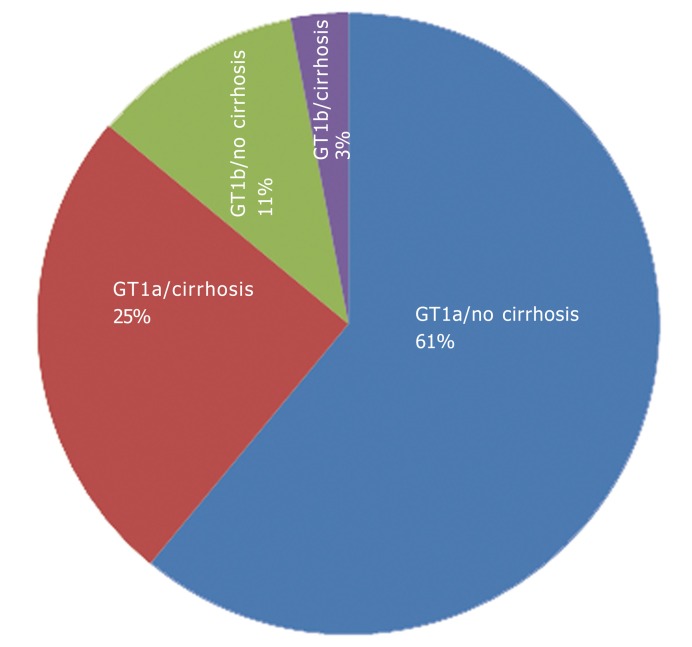
Patients were ≥ 18 years old and chronically infected with HCV GT1 (GT1a, GT1b or GT1a/1b). Patients were treatment-naïve or previously failed a regimen including pegylated interferon/RBV +/- telaprevir, boceprevir, or simeprevir. One hundred patients were treated with the study drug regimen, which was administered for 12 or 24 wk +/- RBV according to GT1 subtype and presence/absence of cirrhosis. Patients were evaluated every 4 wk from treatment day 1 and at 4 and 12 wk after end-of-treatment.
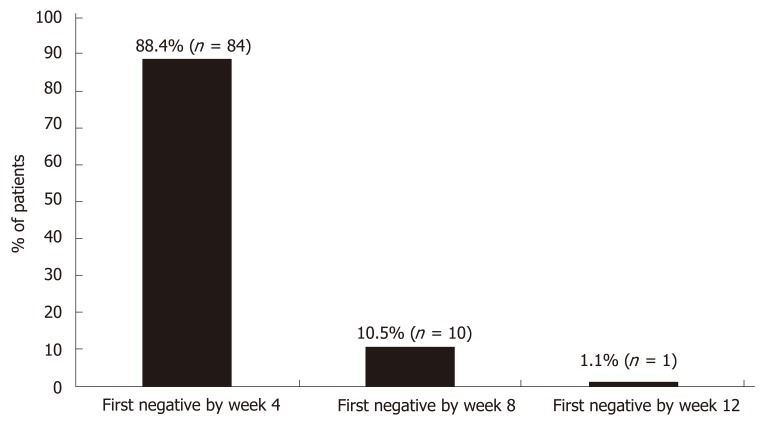
Many of the patients studied had comorbidities (44.2% hypertensive, 33.7% obese, 20.2% cirrhotic) and 16% previously failed HCV treatment. Ninety-six patients completed study follow-up and 99% achieved 12-wk sustained virologic response. The majority (88.4%) of patients had undetectable HCV RNA by week 4. The most common adverse events were fatigue (12%), headache (10%), insomnia (9%) and diarrhea (8%); none led to treatment discontinuation. Physical and mental patient reported outcomes scores significantly improved after treatment. Almost all (98%) patients were treatment compliant.
In an all-comers HCV GT1 population, 12 or 24-wk of OBV/PTV/r + DSV +/- RBV is highly effective and tolerable and results in better mental and physical health following treatment.
丙型肝炎病毒(HCV)NS5A 抑制剂 ABT-267(ombitasvir,OBV)、HCV NS4/4A 蛋白酶抑制剂 ABT-450(paritaprevir,PTV)、CYP3A 抑制剂利托那韦(ritonavir,r)和非核苷 NS5B 聚合酶抑制剂 ABT-333(dasabuvir,DSV)(OBV/PTV/r+DSV)联合或不联合利巴韦林(RBV)在美国和其他主要国家被批准用于治疗基因型 1(GT1)感染的 HCV 患者。由于严格的研究纳入标准、合并症和先前治疗失败,一般将被认为是“难治性”的 HCV 患者排除在注册试验之外。
研究该方案在既往排除在临床试验之外的 HCV G1 感染患者中的疗效。
患者年龄≥18 岁,慢性感染 HCV GT1(GT1a、GT1b 或 GT1a/1b)。患者为初治或先前接受过含聚乙二醇干扰素/RBV 的方案治疗失败,包括 telaprevir、boceprevir 或simeprevir。100 例患者接受了研究药物治疗方案,根据 GT1 亚型和是否存在肝硬化,该方案治疗 12 或 24 周+/-RBV。从治疗第 1 天开始,每 4 周评估一次患者,在治疗结束后 4 周和 12 周进行评估。
研究中许多患者有合并症(44.2%高血压、33.7%肥胖、20.2%肝硬化),16%以前曾接受过 HCV 治疗失败。96 例患者完成了研究随访,99%的患者在 12 周时实现了持续病毒学应答。大多数(88.4%)患者在第 4 周时 HCV RNA 检测不到。最常见的不良事件是疲劳(12%)、头痛(10%)、失眠(9%)和腹泻(8%);无因不良事件导致停药。治疗后,患者的身体和精神报告结局评分显著改善。几乎所有(98%)患者都有良好的治疗依从性。
在所有基因型 1 HCV 患者中,12 或 24 周的 OBV/PTV/r+DSV +/-RBV 治疗方案具有高度疗效和耐受性,且在治疗后可改善身心健康。