Li Pengfei, Wang Xin, Lai Yutian, Zhou Kun, Tang Yuxin, Che Guowei
Department of Thoracic Surgery, West China Hospital.
West China School of Public Health, Sichuan University, Chengdu, P.R. China.
Medicine (Baltimore). 2019 May;98(22):e15280. doi: 10.1097/MD.0000000000015280.
Prognostic nutritional index (PNI) is an easily obtained index inflecting both one's nutritional and inflammatory status. Its clinical role in esophageal squamous cell carcinoma (ESCC) remains still in debate. The aim of this meta-analysis was to assess the prognostic value and the clinical-pathological features of pre-treatment PNI in ESCC patients.
A comprehensive search of online databases (PubMed, Embase, Web of Science) was performed. Studies explored the relationship between pre-treatment PNI and long-term survival of ESCC patients were regarded eligible for this meta-analysis. Outcomes were extracted and synthesized. Hazard ratio (HR) and relative ratio (RR) with 95% confidence interval (CI) were used to evaluate the prognostic value of PNI on long-term survival and association with clinical-pathological features, respectively. The heterogeneity levels and publication bias between studies were also estimated.
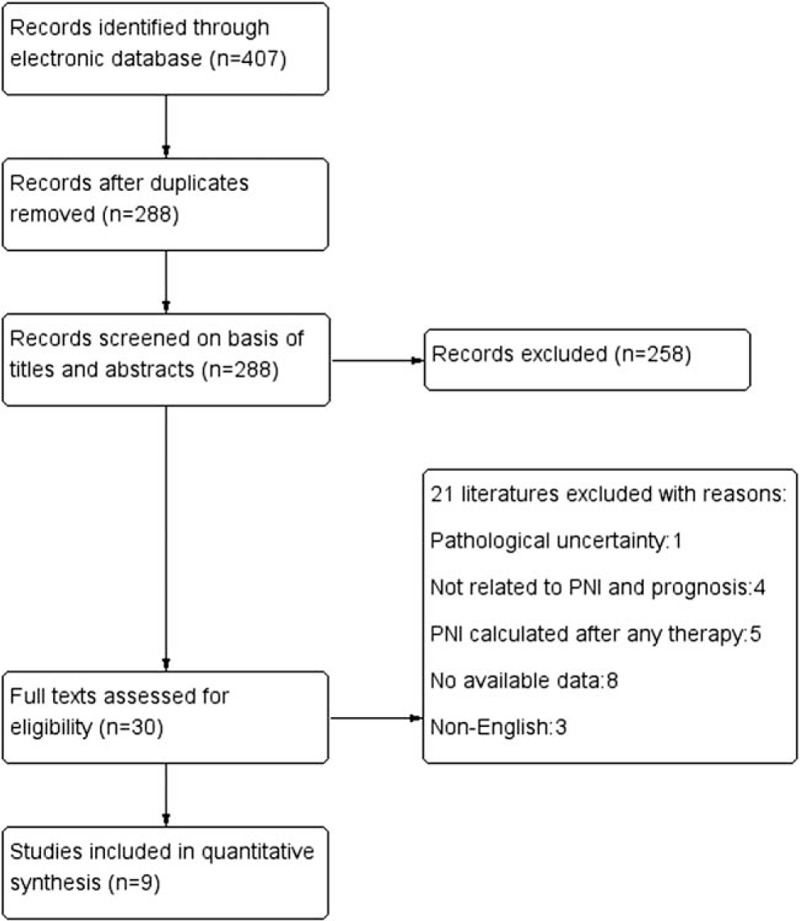
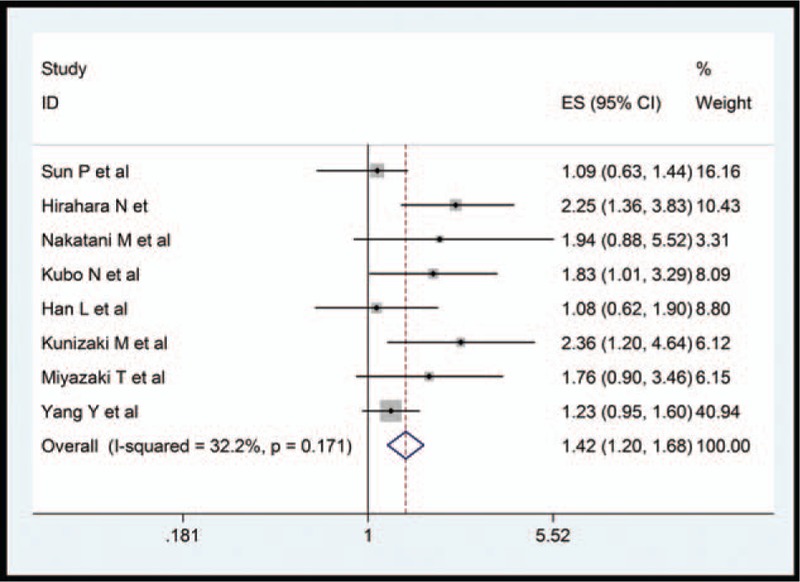
Nine observational studies involving 2276 patients were considered eligible for this meta-analysis. The pooled results showed that low PNI score was significantly correlated with poorer overall survival (OS) of esophageal cancer (pooled HR = 1.418 95%CI: 1.200-1.676, P = .000), poorer recurrence free survival (HR = 1.880 95%CI: 1.207-2.929, P = .005) but not cancer specific survival (CSS) (HR = 1.948 95%CI: 0.544-6.977, P = .306). The PNI value was not related with patient age, sex, depth of tumor invasion, nodular metastasis, and differential grade but the TNM stage (III/IV vs 0/I/II, RR = 1.276, 95% CI 1.146-1.420).
Low pre-treatment PNI was significantly related with OS and recurrence free survival but not CSS for ESCC. PNI was a reliable prognostic factor of ESCC, and higher stage ESCC have higher incidence of low PNI.
预后营养指数(PNI)是一个易于获取的指标,能反映人的营养和炎症状态。其在食管鳞状细胞癌(ESCC)中的临床作用仍存在争议。本荟萃分析的目的是评估ESCC患者治疗前PNI的预后价值和临床病理特征。
对在线数据库(PubMed、Embase、Web of Science)进行全面检索。探索治疗前PNI与ESCC患者长期生存关系的研究被认为符合本荟萃分析的条件。提取并综合结果。风险比(HR)和相对比(RR)及其95%置信区间(CI)分别用于评估PNI对长期生存的预后价值以及与临床病理特征的关联。还估计了研究之间的异质性水平和发表偏倚。
9项涉及2276例患者的观察性研究被认为符合本荟萃分析的条件。汇总结果显示,低PNI评分与食管癌较差的总生存期(OS)显著相关(汇总HR = 1.418,95%CI:1.200 - 1.676,P = 0.000),较差的无复发生存期(HR = 1.880,95%CI:1.207 - 2.929,P = 0.005),但与癌症特异性生存期(CSS)无关(HR = 1.948,95%CI:0.544 - 6.977,P = 0.306)。PNI值与患者年龄、性别、肿瘤浸润深度、结节转移和分化程度无关,但与TNM分期有关(III/IV期与0/I/II期相比,RR = 1.276,95%CI 1.146 - 1.420)。
治疗前低PNI与ESCC的OS和无复发生存期显著相关,但与CSS无关。PNI是ESCC的一个可靠预后因素,且较高分期的ESCC患者低PNI的发生率更高。