Tianjin Key Laboratory of Biomaterial Research, Institute of Biomedical Engineering, Chinese Academy of Medical Sciences and Peking Union Medical College, Tianjin 300192, China.
State Key Laboratory of Medicinal Chemical Biology, the Key Laboratory of Bioactive Materials, Ministry of education, College of Life Sciences, Nankai University, Tianjin 300071, China.
Theranostics. 2019 Apr 12;9(8):2299-2314. doi: 10.7150/thno.30577. eCollection 2019.
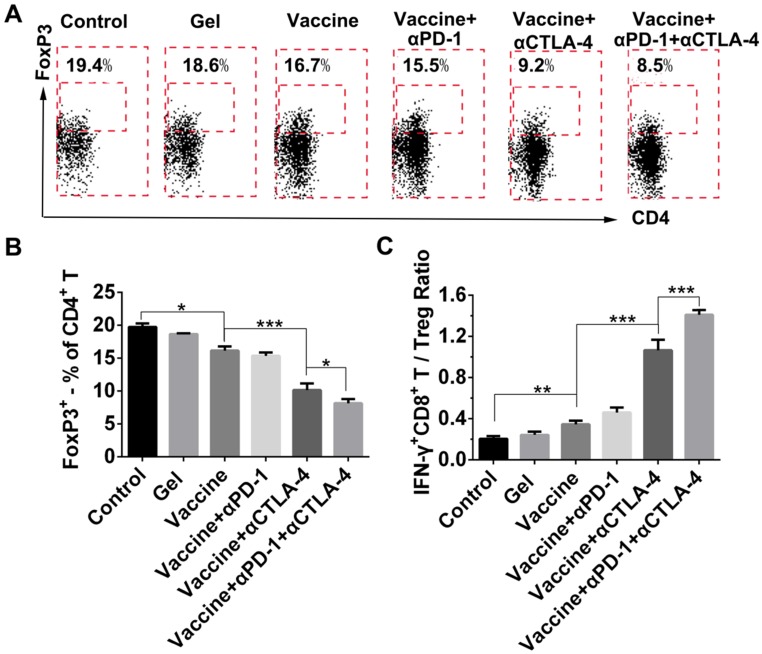
Immunotherapy, an attractive option for cancer treatment, necessitates the direct stimulation of immune cells and the simultaneous effective inhibition of immunosuppressive tumor microenvironments. : In the present study, we developed an injectable PEG--poly(L-alanine) hydrogel for co-delivery of a tumor vaccine and dual immune checkpoint inhibitors to increase tumor immunotherapy efficacy. Tumor cell lysates, granulocyte-macrophage colony stimulating factor (GM-CSF), and immune checkpoint inhibitors (anti-CTLA-4/PD-1 antibody) were readily encapsulated in the porous hydrogel during the spontaneous self-assembly of polypeptide in aqueous solution. : Sustained release of tumor antigens and GM-CSF persistently recruited and activated dendritic cells (DCs) and induced a strong T-cell response , which was further enhanced by the immune checkpoint therapy. The hydrogel vaccine also upregulated the production of IgG and the secretion of cytokines including IFN-γ, IL-4, and TNF-α. Importantly, the hydrogel-based combination therapy had superior immunotherapy effects against melanoma and 4T-1 tumor in comparison with the vaccine alone or in addition with a single immune checkpoint blockade. In studying the underlying mechanism, we found that the hydrogel-based combinatorial immunotherapy not only significantly increased the activated effector CD8 T cells within the spleens and tumors of vaccinated mice, but also reduced the ratio of Tregs. : Our findings indicate that the polypeptide hydrogel can be used as an effective sustained delivery platform for vaccines and immune checkpoint inhibitors, providing an advanced combinatorial immunotherapy approach for cancer treatment.
免疫疗法是癌症治疗的一种有吸引力的选择,需要直接刺激免疫细胞,同时有效抑制免疫抑制性肿瘤微环境。在本研究中,我们开发了一种可注射的 PEG-聚(L-丙氨酸)水凝胶,用于共递送肿瘤疫苗和双重免疫检查点抑制剂,以提高肿瘤免疫治疗的效果。肿瘤细胞裂解物、粒细胞-巨噬细胞集落刺激因子(GM-CSF)和免疫检查点抑制剂(抗 CTLA-4/PD-1 抗体)在多肽水溶液中自发自组装过程中很容易被包封在多孔水凝胶中。肿瘤抗原和 GM-CSF 的持续释放持续招募和激活树突状细胞(DC),并诱导强烈的 T 细胞反应,免疫检查点治疗进一步增强了这种反应。水凝胶疫苗还上调了 IgG 的产生和细胞因子的分泌,包括 IFN-γ、IL-4 和 TNF-α。重要的是,与单独使用疫苗或联合使用单一免疫检查点阻断相比,水凝胶基联合治疗对黑色素瘤和 4T-1 肿瘤具有更好的免疫治疗效果。在研究其潜在机制时,我们发现水凝胶基组合免疫疗法不仅显著增加了接种疫苗小鼠脾脏和肿瘤内激活的效应 CD8 T 细胞的数量,而且还降低了 Tregs 的比例。我们的研究结果表明,多肽水凝胶可用作疫苗和免疫检查点抑制剂的有效持续释放载体,为癌症治疗提供了一种先进的组合免疫治疗方法。