
欧洲和北美的脓毒性休克发病率和死亡率:系统评价和荟萃分析。
Frequency and mortality of septic shock in Europe and North America: a systematic review and meta-analysis.
机构信息
Department of Intensive Care, Erasme Hospital, Université libre de Bruxelles, Route de Lennik 808, 1070, Brussels, Belgium.
PHMR Ltd., Berkeley Works, Berkley Grove, London, NW1 8XY, UK.
出版信息
Crit Care. 2019 May 31;23(1):196. doi: 10.1186/s13054-019-2478-6.
BACKGROUND
Septic shock is the most severe form of sepsis, in which profound underlying abnormalities in circulatory and cellular/metabolic parameters lead to substantially increased mortality. A clear understanding and up-to-date assessment of the burden and epidemiology of septic shock are needed to help guide resource allocation and thus ultimately improve patient care. The aim of this systematic review and meta-analysis was therefore to provide a recent evaluation of the frequency of septic shock in intensive care units (ICUs) and associated ICU and hospital mortality.
METHODS
We searched MEDLINE, Embase, and the Cochrane Library from 1 January 2005 to 20 February 2018 for observational studies that reported on the frequency and mortality of septic shock. Four reviewers independently selected studies and extracted data. Disagreements were resolved via consensus. Random effects meta-analyses were performed to estimate pooled frequency of septic shock diagnosed at admission and during the ICU stay and to estimate septic shock mortality in the ICU, hospital, and at 28 or 30 days.
RESULTS
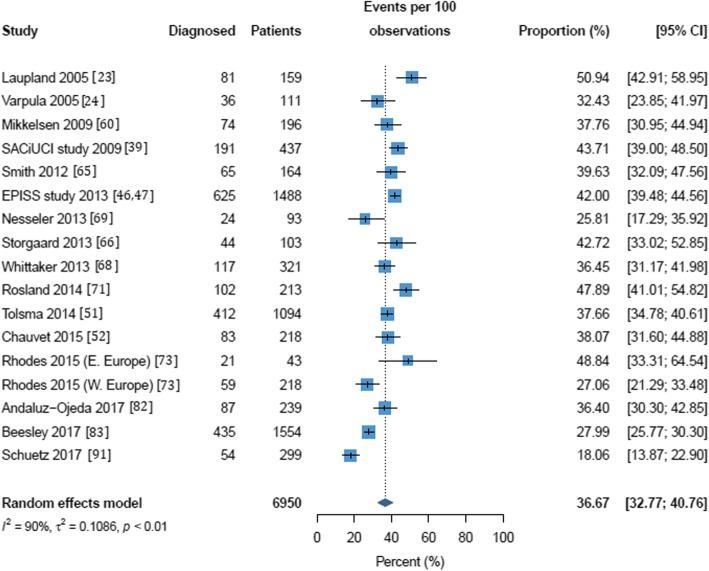
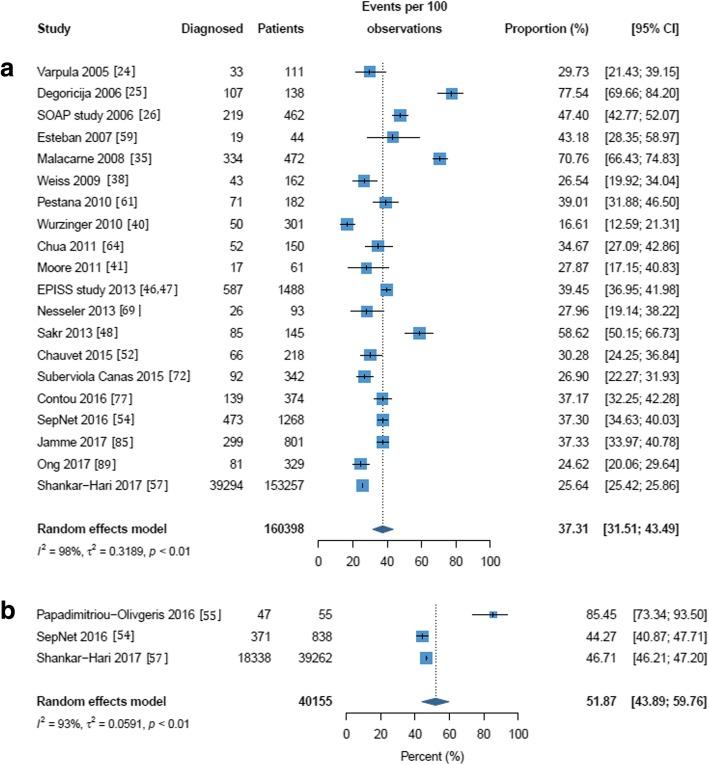
The literature search identified 6291 records of which 71 articles met the inclusion criteria. The frequency of septic shock was estimated at 10.4% (95% CI 5.9 to 16.1%) in studies reporting values for patients diagnosed at ICU admission and at 8.3% (95% CI 6.1 to 10.7%) in studies reporting values for patients diagnosed at any time during the ICU stay. ICU mortality was 37.3% (95% CI 31.5 to 43.5%), hospital mortality 39.0% (95% CI 34.4 to 43.9%), and 28-/30-day mortality 36.7% (95% CI 32.8 to 40.8%). Significant between-study heterogeneity was observed.
CONCLUSIONS
Our literature review reaffirms the continued common occurrence of septic shock and estimates a high mortality of around 38%. The high level of heterogeneity observed in this review may be driven by variability in defining and applying the diagnostic criteria, as well as differences in treatment and care across settings and countries.
背景
感染性休克是败血症最严重的形式,其特征为循环和细胞/代谢参数的严重异常,导致死亡率显著增加。为了帮助指导资源配置,从而最终改善患者的护理,我们需要清楚地了解和掌握感染性休克的负担和流行病学现状。因此,本系统评价和荟萃分析的目的是对重症监护病房(ICU)中感染性休克的发生频率以及相关 ICU 和医院死亡率进行最新评估。
方法
我们从 2005 年 1 月 1 日至 2018 年 2 月 20 日,在 MEDLINE、Embase 和 Cochrane 图书馆中检索了关于感染性休克发生率和死亡率的观察性研究。四位审查员独立选择研究并提取数据。通过协商解决分歧。采用随机效应荟萃分析来估计入院时和 ICU 期间诊断的感染性休克的合并频率,并估计 ICU、医院和 28 或 30 天的感染性休克死亡率。
结果
文献检索共确定了 6291 条记录,其中 71 篇文章符合纳入标准。报告 ICU 入院时诊断患者的研究中,感染性休克的发生率估计为 10.4%(95%CI 5.9%至 16.1%),报告 ICU 期间任何时间诊断患者的研究中,感染性休克的发生率估计为 8.3%(95%CI 6.1%至 10.7%)。ICU 死亡率为 37.3%(95%CI 31.5%至 43.5%),医院死亡率为 39.0%(95%CI 34.4%至 43.9%),28/30 天死亡率为 36.7%(95%CI 32.8%至 40.8%)。观察到研究间存在显著的异质性。
结论
我们的文献复习再次证实了感染性休克的持续普遍发生,并估计其死亡率约为 38%。本综述中观察到的高异质性可能是由于诊断标准的定义和应用存在差异,以及不同国家和地区的治疗和护理存在差异所致。



 Zotero 插件