Cai Anxiang, Zhang Tianyi, Gao Kaiwen, Chen Xinglin, Li Shu, Lin Qisheng, Mou Shan, Ni Zhaohui, Jin Haijiao
Department of Nephrology, Ren Ji Hospital, Shanghai Jiao Tong University School of Medicine, Shanghai, China.
Molecular Cell Laboratory for Kidney Disease, Ren Ji Hospital, Shanghai Jiao Tong University School of Medicine, Shanghai, China.
Front Med (Lausanne). 2025 May 30;12:1582894. doi: 10.3389/fmed.2025.1582894. eCollection 2025.
Dysregulation of serum potassium is a common electrolyte disturbance in critically ill patients, and both hypokalemia and hyperkalemia have been linked to adverse outcomes in sepsis. However, the relationship between serum potassium levels and mortality in ICU patients with diabetes and sepsis remains poorly understood.
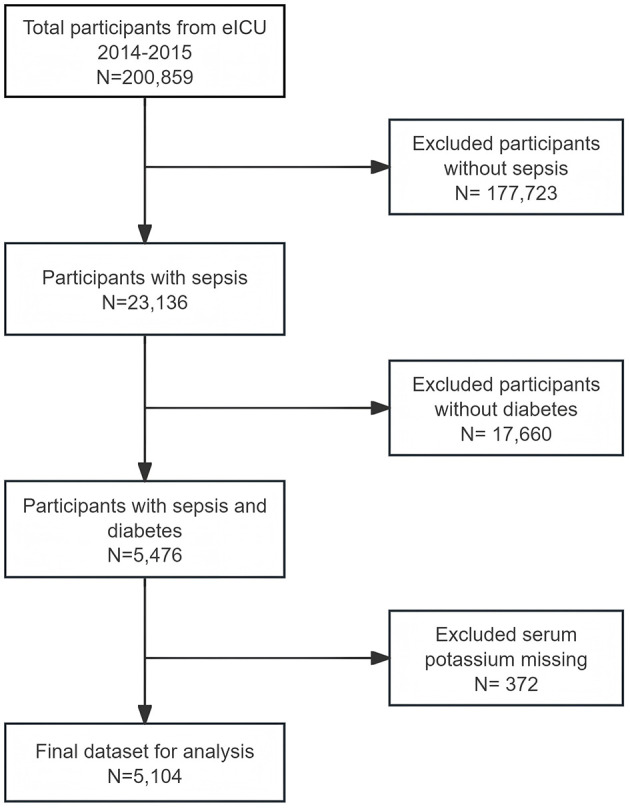
A retrospective cohort study was conducted using data from the eICU Collaborative Research Database (2014-2015). The study included 5,104 adult ICU patients with diabetes and sepsis from 208 hospitals in the U.S. Serum potassium levels measured within 24 h of ICU admission were categorized into hypokalemia (<3.5 mmol/L), normokalemia (3.5-5.0 mmol/L), and hyperkalemia (>5.0 mmol/L). Multivariable logistic regression models were used to assess the association between serum potassium levels and 28-day ICU mortality.
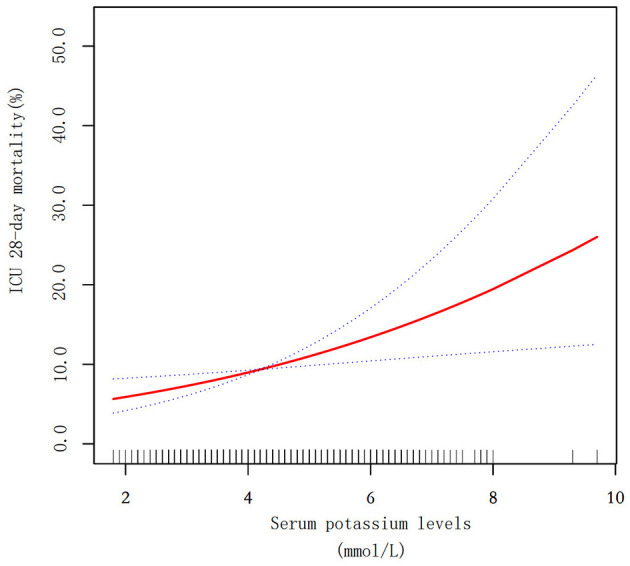
Of the 5,104 patients (mean age, 66.8 years; 49.1% male), 1,046 (20.5%) had hypokalemia, 3,377 (66.2%) had normokalemia, and 681 (13.3%) had hyperkalemia. After adjusting for demographic factors, comorbidities, and treatment measures, each 1 mmol/L increase in serum potassium was associated with a 25% higher risk of 28-day mortality (adjusted OR, 1.25; 95% CI, 1.07-1.47). Compared to hypokalemia, hyperkalemia was associated with significantly higher mortality risk (adjusted OR, 1.86; 95% CI, 1.17-2.96). A linear relationship was observed between serum potassium levels and mortality ( = 0.006), differing from the previously reported U-shaped relationship in general ICU populations.
Elevated serum potassium levels were independently associated with increased 28-day mortality in ICU patients with diabetes and sepsis. These findings suggest that potassium management strategies should be specifically tailored for this high-risk patient population.
血清钾失调是危重症患者常见的电解质紊乱,低钾血症和高钾血症均与脓毒症的不良预后相关。然而,糖尿病合并脓毒症的重症监护病房(ICU)患者血清钾水平与死亡率之间的关系仍知之甚少。
利用eICU协作研究数据库(2014 - 2015年)的数据进行回顾性队列研究。该研究纳入了美国208家医院的5104例成年糖尿病合并脓毒症的ICU患者。将ICU入院后24小时内测得的血清钾水平分为低钾血症(<3.5 mmol/L)、正常血钾(3.5 - 5.0 mmol/L)和高钾血症(>5.0 mmol/L)。采用多变量逻辑回归模型评估血清钾水平与28天ICU死亡率之间的关联。
在5104例患者中(平均年龄66.8岁;49.1%为男性),1046例(20.5%)为低钾血症,3377例(66.2%)为正常血钾,681例(13.3%)为高钾血症。在调整了人口统计学因素、合并症和治疗措施后,血清钾每升高1 mmol/L,28天死亡率风险增加25%(调整后的比值比,1.25;95%置信区间,1.07 - 1.47)。与低钾血症相比,高钾血症与显著更高的死亡风险相关(调整后的比值比,1.86;95%置信区间,1.17 - 2.96)。观察到血清钾水平与死亡率之间存在线性关系( = 0.006),这与之前报道的一般ICU人群中的U型关系不同。
血清钾水平升高与糖尿病合并脓毒症的ICU患者2天死亡率增加独立相关。这些发现表明,钾管理策略应针对这一高危患者群体进行专门定制。