Fatima Razia, Yaqoob Aashifa, Qadeer Ejaz, Hinderaker Sven Gudmund, Heldal Einar, Zachariah Rony, Harries Anthony D, Kumar Ajay M V
a Research Department , National TB Control Program , Islamabad , Pakistan.
b Department of Hospital Management Information System , Pakistan Institute of Medical Sciences , Islamabad , Pakistan.
Glob Health Action. 2019;12(1):1555215. doi: 10.1080/16549716.2018.1555215.
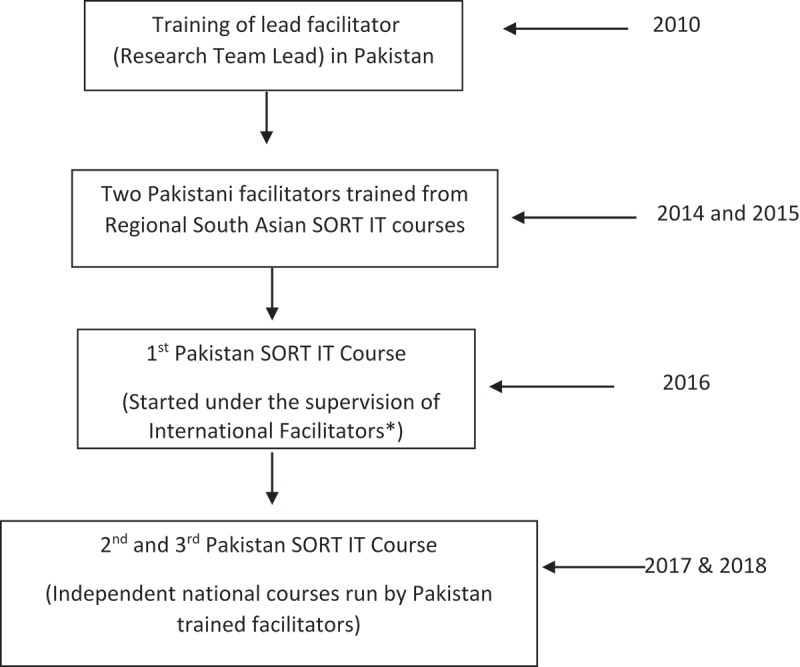
: For many years, operational research capacity has been a challenge and has remained a low priority for the health sector in Pakistan. Building research capacity for developing a critical mass of researchers in Pakistan was done through Structured Operational Research and Training Initiative (SORT IT) courses in Paris and Asia between 2010 and 2016. : The aim of this paper is to describe the journey of SORT-IT in Pakistan from its inception to progressive expansion and discuss the challenges and ways forward. : The journey began with the training of the Pakistan NTP research team lead in 2010 in an international SORT IT course at Paris. This was followed by training of two team members in Asia SORT IT courses in 2014 and 2015. These three then worked together to conceive and implement the first national Pakistan SORT IT course supported by WHO/TDR and the Global Fund in 2016. This was facilitated by international facilitators and local trained SORT-IT participants from Paris and Asia. This was followed by two further national SORT IT courses in 2017 and 2018. : Between 2010 and 2017, a total of 34 participants from Pakistan had been enrolled in national and international SORT IT courses. Of the 23 participants from completed courses, 18(78%) successfully completed the course. In total 18 papers were submitted and up until June 2018, 15(83%) have been published and 21 institutions in Pakistan involved with operational research as a result of the SORT IT initiative. : The SORT IT course has been an effective way to build operational research capacity at national level and this has resulted in a large number of published papers providing local evidence for decision making on TB and other disease control programmes. The experience from Pakistan should stimulate other countries to adopt the SORT-IT model.
多年来,运筹学能力一直是一项挑战,在巴基斯坦卫生部门的工作中仍未得到高度重视。2010年至2016年期间,通过在巴黎和亚洲举办的结构化运筹学与培训倡议(SORT IT)课程,为在巴基斯坦培养足够数量的研究人员建立了研究能力。
本文旨在描述SORT-IT在巴基斯坦从创立到逐步扩展的历程,并探讨所面临的挑战及未来发展方向。
这一历程始于2010年巴基斯坦国家结核病规划研究团队负责人在巴黎参加的一次国际SORT IT课程培训。随后在2014年和2015年,两名团队成员参加了亚洲SORT IT课程培训。这三人随后共同构思并实施了2016年由世卫组织/热带病研究与培训特别规划(TDR)和全球基金支持的首个巴基斯坦国家SORT IT课程。此次课程由国际协调员以及来自巴黎和亚洲的经过培训的当地SORT-IT学员协助开展。之后在2017年和2018年又举办了另外两次国家SORT IT课程。
2010年至2017年期间,共有34名来自巴基斯坦的学员参加了国家和国际SORT IT课程。在已完成课程的23名学员中,18名(78%)成功结业。总共提交了18篇论文,截至2018年6月,15篇(83%)已发表,并且由于SORT IT倡议,巴基斯坦有21个机构参与了运筹学研究。
SORT IT课程是在国家层面建立运筹学能力的有效方式,这带来了大量已发表的论文,为结核病及其他疾病控制项目的决策提供了本地依据。巴基斯坦的经验应促使其他国家采用SORT-IT模式。